PDFTests Originals

There is / There are – Fiche 1

A1 Débutant FicheAnglais

Cette fiche de niveau A1 permet de s'entraîner à utiliser there is et there are pour décrire une pièce, un logement ou une ville. Les élèves choisissent la bonne forme selon que le nom est au singulier ou au pluriel, forment des phrases négatives et interrogatives avec a et any, et donnent des réponses courtes. Elle convient aux débutants, en classe comme à la maison.
items
36
Durée
30 min
PDF
5 pages
Corrigé
Inclus
  • 100 % gratuit
  • Sans inscription
  • PDF A4 prêt à imprimer
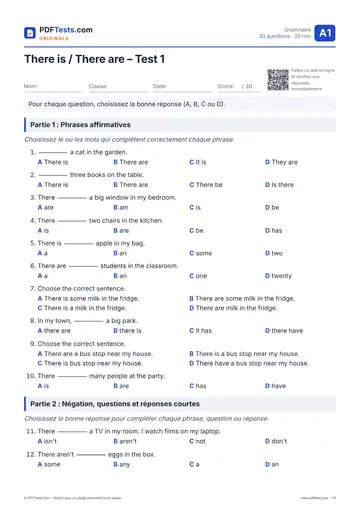
Aperçu de la page 1 : There is / There are – Fiche 1 Ouvrir le PDF

Faire la fiche en ligne

Tapez vos réponses puis cliquez sur « Vérifier mes réponses ». Les autres réponses correctes sont acceptées.

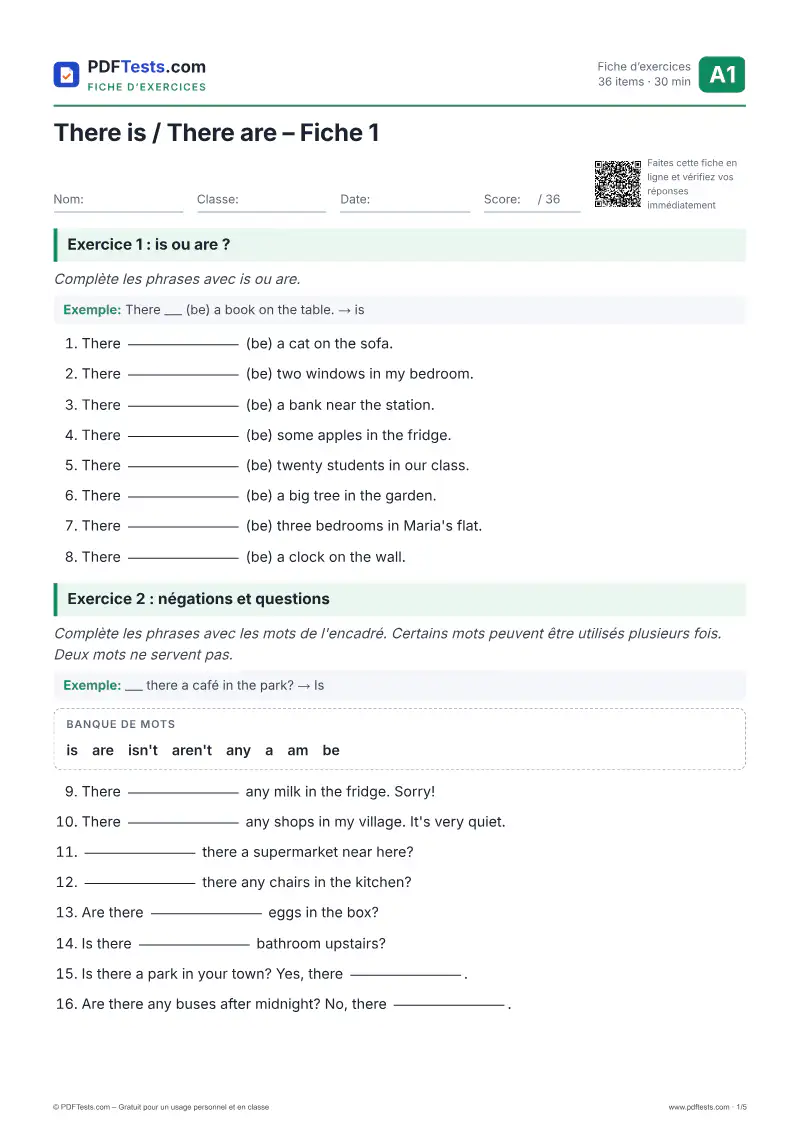
Exercice 1 : is ou are ?

Complète les phrases avec is ou are.

Exemple: There ___ (be) a book on the table. → is

  1. There (be) a cat on the sofa.

  2. There (be) two windows in my bedroom.

  3. There (be) a bank near the station.

  4. There (be) some apples in the fridge.

  5. There (be) twenty students in our class.

  6. There (be) a big tree in the garden.

  7. There (be) three bedrooms in Maria's flat.

  8. There (be) a clock on the wall.

Exercice 2 : négations et questions

Complète les phrases avec les mots de l'encadré. Certains mots peuvent être utilisés plusieurs fois. Deux mots ne servent pas.

Exemple: ___ there a café in the park? → Is

Banque de mots isareisn'taren'tanyaambe

  1. There any milk in the fridge. Sorry!

  2. There any shops in my village. It's very quiet.

  3. there a supermarket near here?

  4. there any chairs in the kitchen?

  5. Are there eggs in the box?

  6. Is there bathroom upstairs?

  7. Is there a park in your town? Yes, there .

  8. Are there any buses after midnight? No, there .

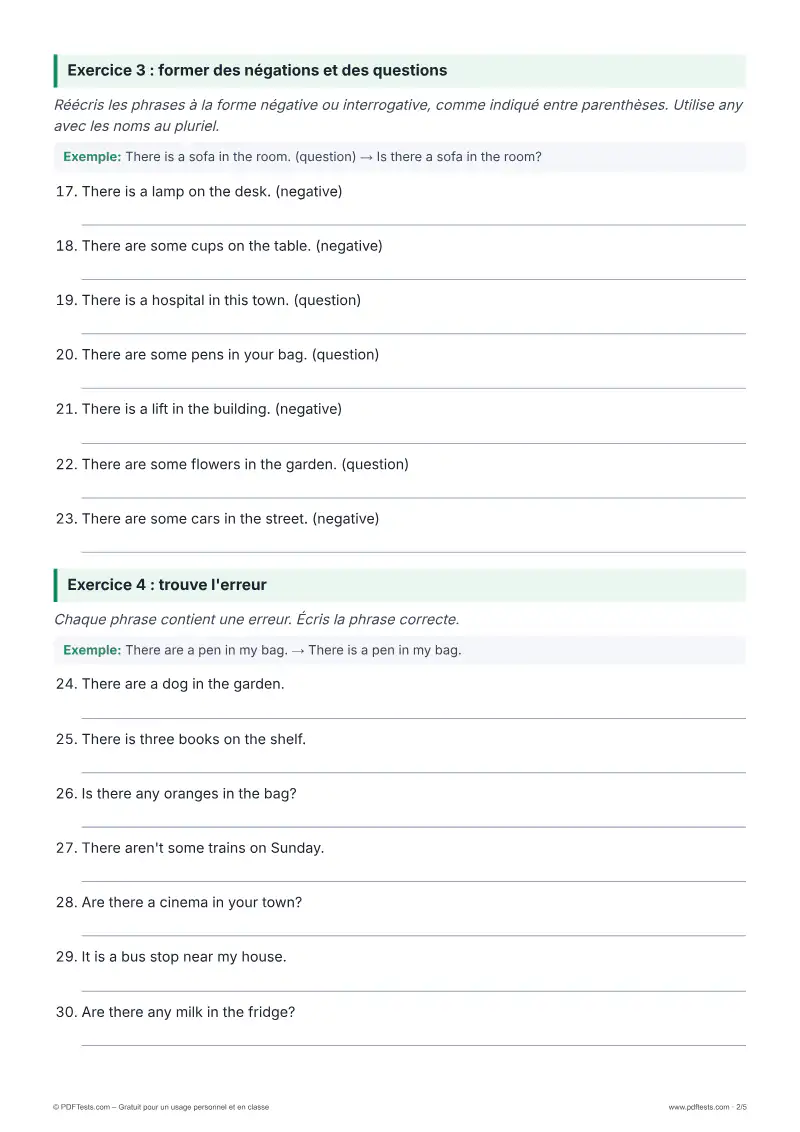
Exercice 3 : former des négations et des questions

Réécris les phrases à la forme négative ou interrogative, comme indiqué entre parenthèses. Utilise any avec les noms au pluriel.

Exemple: There is a sofa in the room. (question) → Is there a sofa in the room?

  1. There is a lamp on the desk. (negative)

  2. There are some cups on the table. (negative)

  3. There is a hospital in this town. (question)

  4. There are some pens in your bag. (question)

  5. There is a lift in the building. (negative)

  6. There are some flowers in the garden. (question)

  7. There are some cars in the street. (negative)

Exercice 4 : trouve l'erreur

Chaque phrase contient une erreur. Écris la phrase correcte.

Exemple: There are a pen in my bag. → There is a pen in my bag.

  1. There are a dog in the garden.

  2. There is three books on the shelf.

  3. Is there any oranges in the bag?

  4. There aren't some trains on Sunday.

  5. Are there a cinema in your town?

  6. It is a bus stop near my house.

  7. Are there any milk in the fridge?

Exercice 5 : remets les mots dans l'ordre

Remets les mots dans le bon ordre pour former des phrases ou des questions.

Exemple: is / there / a / chair / here → There is a chair here.

  1. a / there / is / near / park / my house

  2. any / there / are / in / your street / shops / ?

  3. TV / there / a / isn't / my bedroom / in

  4. there / two / are / in / cats / the kitchen

  5. there / a / is / bus stop / here / near / ?

  6. aren't / there / any / on / the table / glasses

Cette page vous a-t-elle été utile ?

Signaler une erreur

Une mauvaise réponse, une faute de frappe ou une explication peu claire ? Dites-le-nous, nous corrigerons.

Aperçu

À propos de ce test

Fiche d'anglais A1 gratuite en PDF sur there is / there are : affirmation, négation, questions avec a, some et any. Exercices corrigés.

Thèmes abordés

there is / there arenoms singuliers et plurielsla négation : isn't / aren'tquestions et réponses courtesa / some / any

Notes pour l’enseignant

Commencez par décrire votre salle de classe à voix haute (There is a board, There are twenty chairs), puis laissez les élèves faire les exercices dans l'ordre. Erreurs fréquentes : employer is avec un nom pluriel, utiliser some au lieu de any dans les phrases négatives et interrogatives, dire It is au lieu de There is (calque de « c'est » / « il y a »), et la réponse courte Yes, there's (il faut dire Yes, there is). En prolongement, les élèves peuvent dessiner leur chambre et poser des questions Is there…? / Are there…? à un camarade pour trouver les différences.

Tous les tests Anglais A1 →