PDFTests Originals

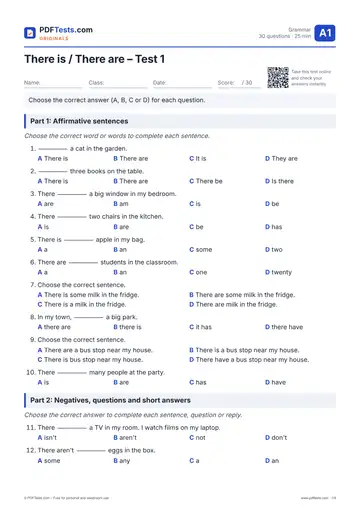
There is / There are – Worksheet 1

A1 Beginner WorksheetEnglish

This A1 worksheet practises there is and there are for describing rooms, homes and towns. Learners use the correct form with singular and plural nouns, make negatives and questions with a and any, and give short answers. It suits beginners in class or at home.
items
36
Time
30 min
PDF
5 pages
Answer key
Included
  • 100% free
  • No sign-up or email
  • Print-ready A4 PDF
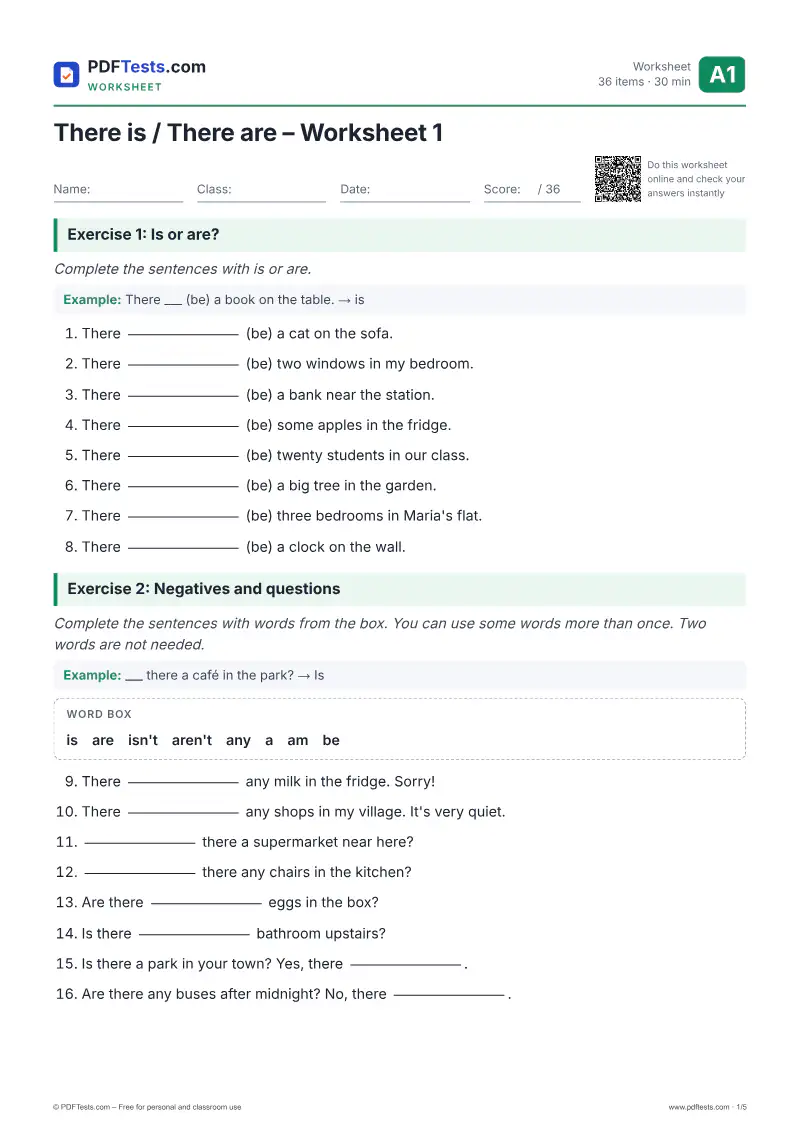
Preview of page 1 of There is / There are – Worksheet 1 Open PDF
New to this topic? Read the guide first: There is / There are: Rules, Examples and Common Mistakes

Do the worksheet online

Type your answers, then press “Check my answers”. Alternative correct answers are accepted.

Exercise 1: Is or are?

Complete the sentences with is or are.

Example: There ___ (be) a book on the table. → is

  1. There (be) a cat on the sofa.

  2. There (be) two windows in my bedroom.

  3. There (be) a bank near the station.

  4. There (be) some apples in the fridge.

  5. There (be) twenty students in our class.

  6. There (be) a big tree in the garden.

  7. There (be) three bedrooms in Maria's flat.

  8. There (be) a clock on the wall.

Exercise 2: Negatives and questions

Complete the sentences with words from the box. You can use some words more than once. Two words are not needed.

Example: ___ there a café in the park? → Is

Word box isareisn'taren'tanyaambe

  1. There any milk in the fridge. Sorry!

  2. There any shops in my village. It's very quiet.

  3. there a supermarket near here?

  4. there any chairs in the kitchen?

  5. Are there eggs in the box?

  6. Is there bathroom upstairs?

  7. Is there a park in your town? Yes, there .

  8. Are there any buses after midnight? No, there .

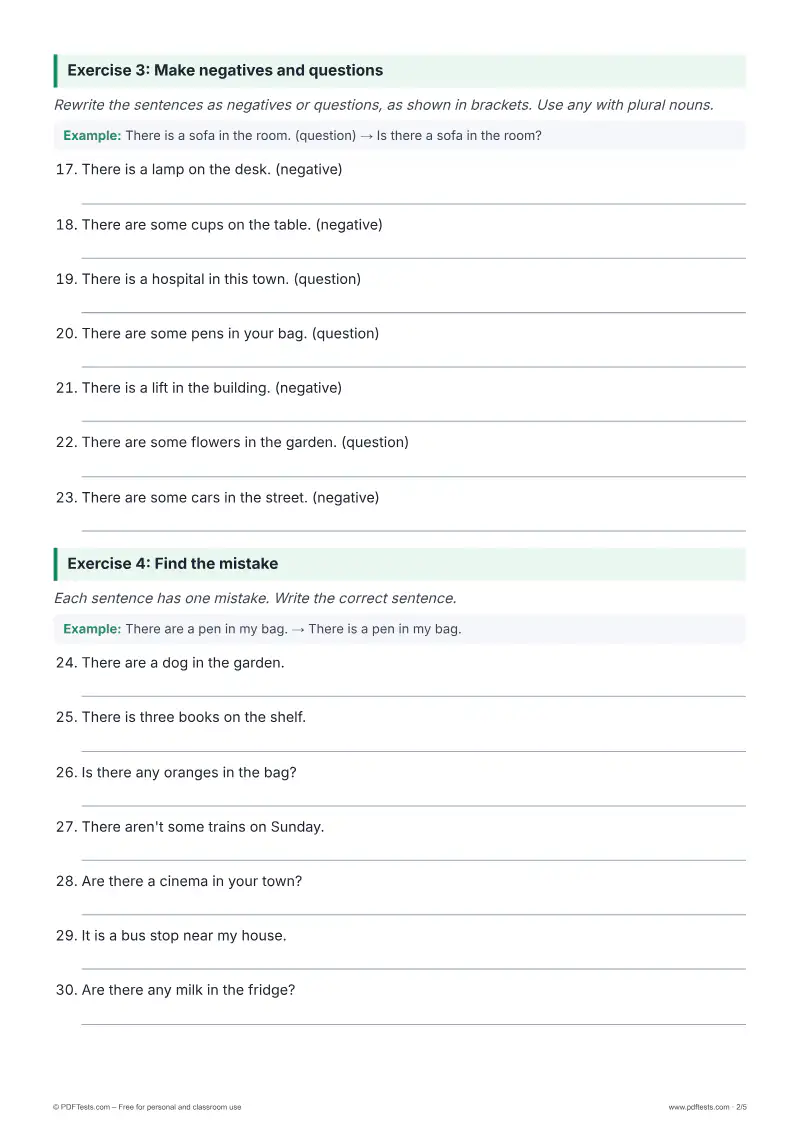
Exercise 3: Make negatives and questions

Rewrite the sentences as negatives or questions, as shown in brackets. Use any with plural nouns.

Example: There is a sofa in the room. (question) → Is there a sofa in the room?

  1. There is a lamp on the desk. (negative)

  2. There are some cups on the table. (negative)

  3. There is a hospital in this town. (question)

  4. There are some pens in your bag. (question)

  5. There is a lift in the building. (negative)

  6. There are some flowers in the garden. (question)

  7. There are some cars in the street. (negative)

Exercise 4: Find the mistake

Each sentence has one mistake. Write the correct sentence.

Example: There are a pen in my bag. → There is a pen in my bag.

  1. There are a dog in the garden.

  2. There is three books on the shelf.

  3. Is there any oranges in the bag?

  4. There aren't some trains on Sunday.

  5. Are there a cinema in your town?

  6. It is a bus stop near my house.

  7. Are there any milk in the fridge?

Exercise 5: Put the words in order

Put the words in the correct order to make sentences or questions.

Example: is / there / a / chair / here → There is a chair here.

  1. a / there / is / near / park / my house

  2. any / there / are / in / your street / shops / ?

  3. TV / there / a / isn't / my bedroom / in

  4. there / two / are / in / cats / the kitchen

  5. there / a / is / bus stop / here / near / ?

  6. aren't / there / any / on / the table / glasses

Was this page helpful?

Report a mistake

Spotted a wrong answer, a typo or an unclear explanation? Tell us and we will fix it.

Preview

About this test

Free printable A1 worksheet on There is / There are: affirmative, negative and question forms with a, some and any. Answers included.

Topics covered

there is / there aresingular and plural nounsnegatives: isn't / aren'tquestions and short answersa / some / any

Notes for teachers

Start by describing your classroom aloud (There is a board, There are twenty chairs), then let students work through the exercises in order. Common mistakes are using is with plural nouns, using some instead of any in negatives and questions, saying It is instead of There is, and the short answer Yes, there's (it should be Yes, there is). As a follow-up, students can draw their bedroom and ask a partner Is there…? / Are there…? questions to find the differences.

All English A1 tests →