PDFTests Originals

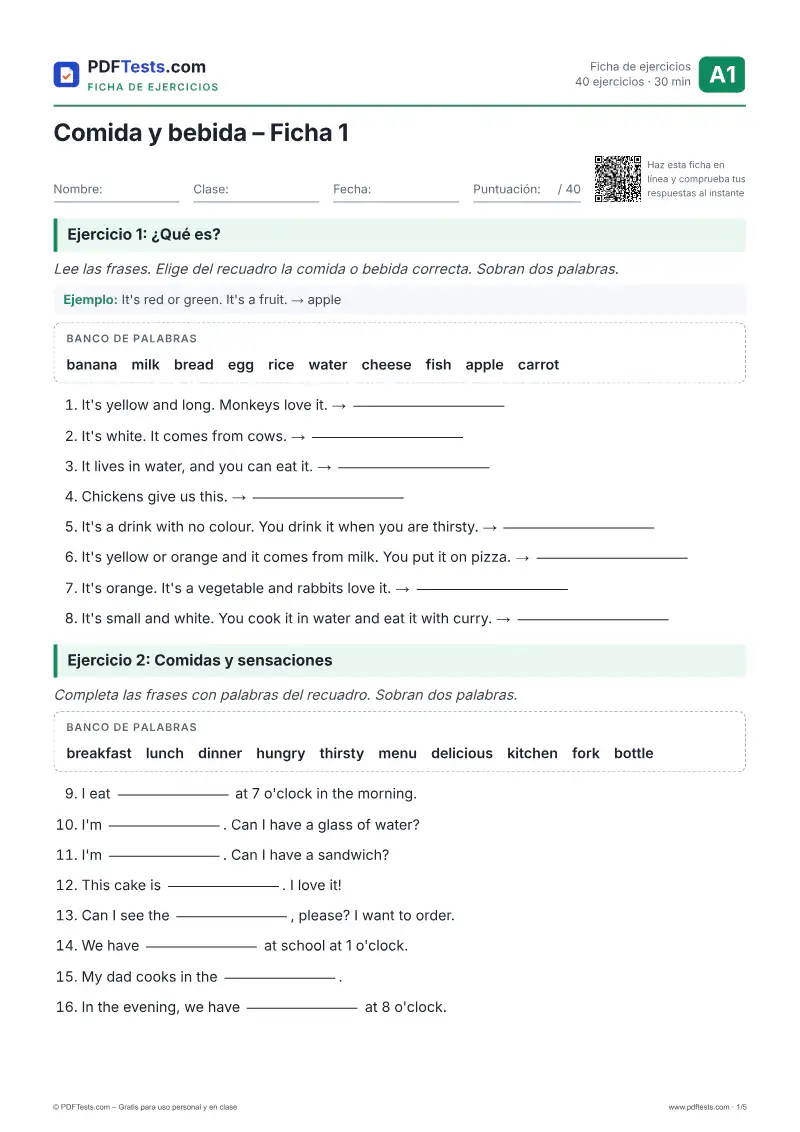
Comida y bebida – Ficha 1

A1 Principiante FichaInglés

Esta ficha de nivel A1 trabaja en contexto el vocabulario cotidiano de comida y bebida: alimentos comunes, las comidas del día, adjetivos como hungry y thirsty, el plural y colocaciones sencillas como a cup of tea o a glass of juice. Es ideal para alumnos principiantes, tanto en clase como en casa.
ejercicios
40
Tiempo
30 min
PDF
5 páginas
Soluciones
Incluidas
  • 100 % gratis
  • Sin registro
  • PDF A4 listo para imprimir
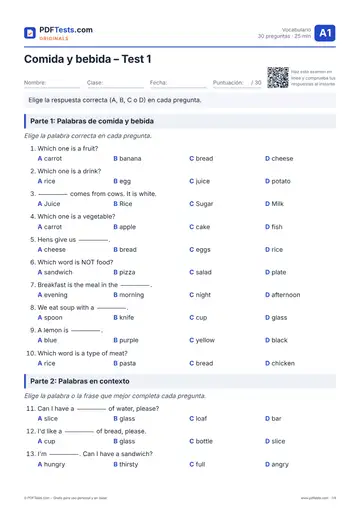
Vista previa de la página 1: Comida y bebida – Ficha 1 Abrir PDF

Haz la ficha en línea

Escribe tus respuestas y pulsa «Comprobar respuestas». Se aceptan otras respuestas correctas.

Ejercicio 1: ¿Qué es?

Lee las frases. Elige del recuadro la comida o bebida correcta. Sobran dos palabras.

Ejemplo: It's red or green. It's a fruit. → apple

Banco de palabras bananamilkbreadeggricewatercheesefishapplecarrot

  1. It's yellow and long. Monkeys love it.

  2. It's white. It comes from cows.

  3. It lives in water, and you can eat it.

  4. Chickens give us this.

  5. It's a drink with no colour. You drink it when you are thirsty.

  6. It's yellow or orange and it comes from milk. You put it on pizza.

  7. It's orange. It's a vegetable and rabbits love it.

  8. It's small and white. You cook it in water and eat it with curry.

Ejercicio 2: Comidas y sensaciones

Completa las frases con palabras del recuadro. Sobran dos palabras.

Banco de palabras breakfastlunchdinnerhungrythirstymenudeliciouskitchenforkbottle

  1. I eat at 7 o'clock in the morning.

  2. I'm . Can I have a glass of water?

  3. I'm . Can I have a sandwich?

  4. This cake is . I love it!

  5. Can I see the , please? I want to order.

  6. We have at school at 1 o'clock.

  7. My dad cooks in the .

  8. In the evening, we have at 8 o'clock.

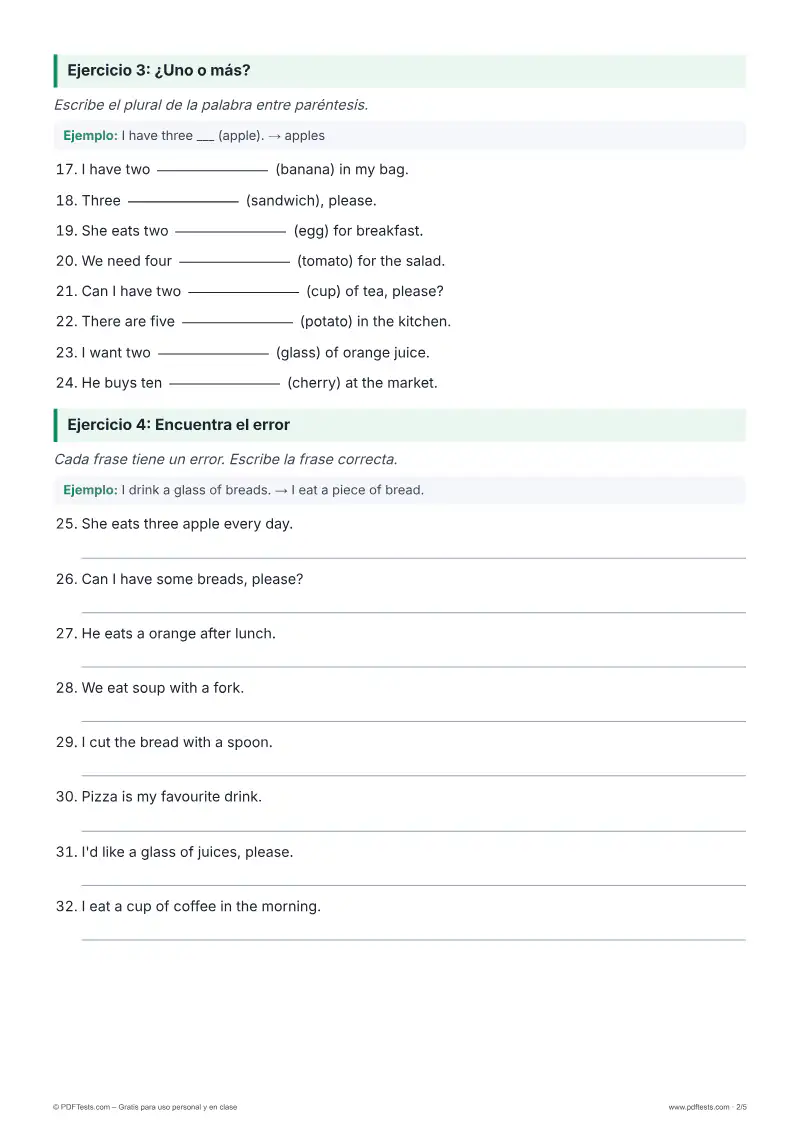
Ejercicio 3: ¿Uno o más?

Escribe el plural de la palabra entre paréntesis.

Ejemplo: I have three ___ (apple). → apples

  1. I have two (banana) in my bag.

  2. Three (sandwich), please.

  3. She eats two (egg) for breakfast.

  4. We need four (tomato) for the salad.

  5. Can I have two (cup) of tea, please?

  6. There are five (potato) in the kitchen.

  7. I want two (glass) of orange juice.

  8. He buys ten (cherry) at the market.

Ejercicio 4: Encuentra el error

Cada frase tiene un error. Escribe la frase correcta.

Ejemplo: I drink a glass of breads. → I eat a piece of bread.

  1. She eats three apple every day.

  2. Can I have some breads, please?

  3. He eats a orange after lunch.

  4. We eat soup with a fork.

  5. I cut the bread with a spoon.

  6. Pizza is my favourite drink.

  7. I'd like a glass of juices, please.

  8. I eat a cup of coffee in the morning.

Ejercicio 5: Forma frases

Ordena las palabras para formar frases.

Ejemplo: like / I / cheese → I like cheese.

  1. like / I / bananas / don't

  2. you / Do / like / fish

  3. Can / I / have / a / cup / of / tea / please

  4. eat / for / breakfast / I / eggs

  5. favourite / is / My / pizza / food

  6. drinks / She / milk / every / day

  7. would / like / What / you

  8. hungry / very / I'm

¿Te ha resultado útil esta página?

Informar de un error

¿Has visto una respuesta incorrecta, una errata o una explicación poco clara? Avísanos y lo corregiremos.

Vista previa

Sobre este examen

Ficha de inglés A1 en PDF sobre comida y bebida: comidas del día, plurales, a cup of tea y frases para la cafetería. Imprimible con soluciones.

Temas

Vocabulario de comida y bebidaLas comidas del díaEl plural de los sustantivosSustantivos contables e incontablesColocaciones: a cup of, a glass ofPedir comida

Notas para el profesor

Empiece con el ejercicio 1 como actividad de calentamiento rápida, por ejemplo como juego de adivinanzas por parejas. Entre los errores más frecuentes están añadir -s a los sustantivos incontables (breads, juices), usar «a» delante de vocal (a orange) y la ortografía de plurales como tomatoes y cherries. Como actividad de ampliación, pida a los alumnos que escriban sus propias adivinanzas (It's red. It's a fruit.) o que representen una escena en la que piden comida en una cafetería.

Todos los exámenes de Inglés A1 →