PDFTests Originals

Comprensión lectora – Test 1

B2 Intermedio alto Comprensión lectoraInglés

Este test de comprensión lectora de nivel B2 incluye tres textos originales de distintos géneros: un artículo de revista, un correo electrónico de empresa y un relato breve. Sus 20 preguntas de opción múltiple evalúan la comprensión de las ideas principales, los detalles concretos, el significado implícito y el vocabulario en contexto. Es ideal para alumnos de nivel intermedio alto, candidatos a exámenes oficiales y profesores que necesitan una prueba de lectura lista para usar.

Preguntas
20
Tiempo
40 min
PDF
6 páginas
Soluciones
Incluidas
  • 100 % gratis
  • Sin registro
  • PDF A4 listo para imprimir
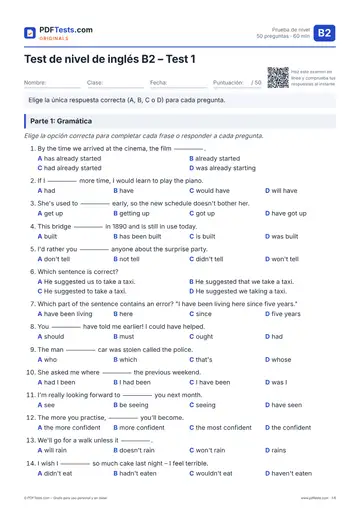
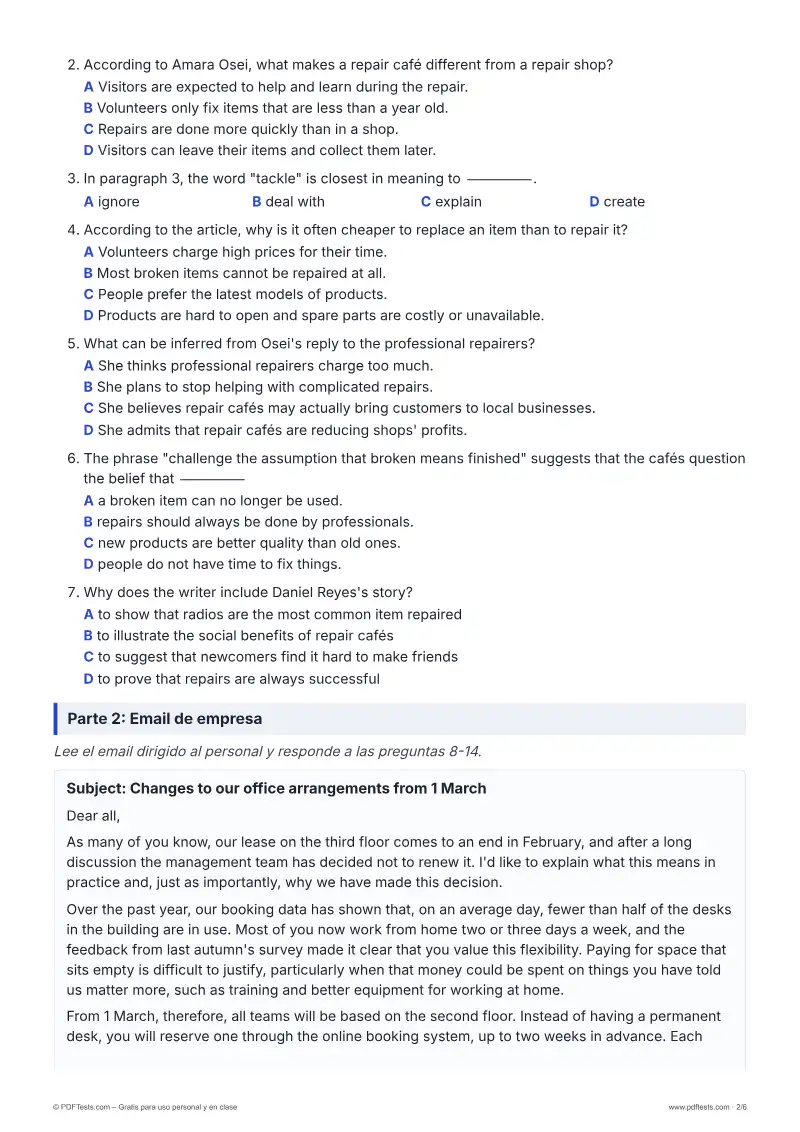
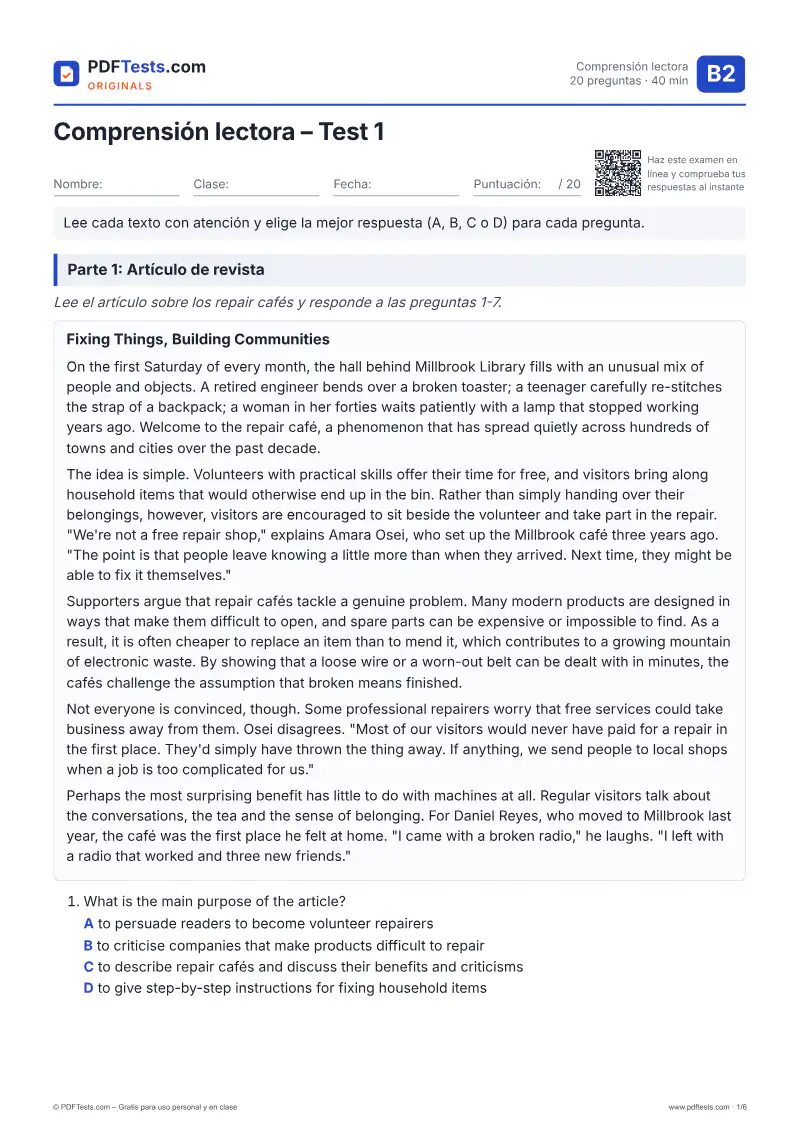
Vista previa de la página 1: Comprensión lectora – Test 1 Abrir PDF

Haz el examen en línea

Lee cada texto con atención y elige la mejor respuesta (A, B, C o D) para cada pregunta. Elige tus respuestas y pulsa «Comprobar respuestas».

Parte 1: Artículo de revista

Lee el artículo sobre los repair cafés y responde a las preguntas 1-7.

Fixing Things, Building Communities

On the first Saturday of every month, the hall behind Millbrook Library fills with an unusual mix of people and objects. A retired engineer bends over a broken toaster; a teenager carefully re-stitches the strap of a backpack; a woman in her forties waits patiently with a lamp that stopped working years ago. Welcome to the repair café, a phenomenon that has spread quietly across hundreds of towns and cities over the past decade.

The idea is simple. Volunteers with practical skills offer their time for free, and visitors bring along household items that would otherwise end up in the bin. Rather than simply handing over their belongings, however, visitors are encouraged to sit beside the volunteer and take part in the repair. "We're not a free repair shop," explains Amara Osei, who set up the Millbrook café three years ago. "The point is that people leave knowing a little more than when they arrived. Next time, they might be able to fix it themselves."

Supporters argue that repair cafés tackle a genuine problem. Many modern products are designed in ways that make them difficult to open, and spare parts can be expensive or impossible to find. As a result, it is often cheaper to replace an item than to mend it, which contributes to a growing mountain of electronic waste. By showing that a loose wire or a worn-out belt can be dealt with in minutes, the cafés challenge the assumption that broken means finished.

Not everyone is convinced, though. Some professional repairers worry that free services could take business away from them. Osei disagrees. "Most of our visitors would never have paid for a repair in the first place. They'd simply have thrown the thing away. If anything, we send people to local shops when a job is too complicated for us."

Perhaps the most surprising benefit has little to do with machines at all. Regular visitors talk about the conversations, the tea and the sense of belonging. For Daniel Reyes, who moved to Millbrook last year, the café was the first place he felt at home. "I came with a broken radio," he laughs. "I left with a radio that worked and three new friends."

  1. What is the main purpose of the article?

  2. According to Amara Osei, what makes a repair café different from a repair shop?

  3. In paragraph 3, the word "tackle" is closest in meaning to _____.

  4. According to the article, why is it often cheaper to replace an item than to repair it?

  5. What can be inferred from Osei's reply to the professional repairers?

  6. The phrase "challenge the assumption that broken means finished" suggests that the cafés question the belief that _____

  7. Why does the writer include Daniel Reyes's story?

Parte 2: Email de empresa

Lee el email dirigido al personal y responde a las preguntas 8-14.

Subject: Changes to our office arrangements from 1 March

Dear all,

As many of you know, our lease on the third floor comes to an end in February, and after a long discussion the management team has decided not to renew it. I'd like to explain what this means in practice and, just as importantly, why we have made this decision.

Over the past year, our booking data has shown that, on an average day, fewer than half of the desks in the building are in use. Most of you now work from home two or three days a week, and the feedback from last autumn's survey made it clear that you value this flexibility. Paying for space that sits empty is difficult to justify, particularly when that money could be spent on things you have told us matter more, such as training and better equipment for working at home.

From 1 March, therefore, all teams will be based on the second floor. Instead of having a permanent desk, you will reserve one through the online booking system, up to two weeks in advance. Each team will also have a "home zone", a group of desks near each other, so that colleagues who want to work together on the same days can do so easily.

I appreciate that this will be a significant change for some of you, especially those who have had the same desk for many years. Lockers will be provided for personal belongings, and anyone who needs a particular set-up for health reasons should contact Priya Nair in HR by 14 February so that we can make sure a suitable desk is permanently available.

We will be holding two drop-in sessions next week, on Tuesday at 12:30 and Thursday at 16:00, where you can see the new layout and ask questions. If you can't make either, feel free to reply to this email directly.

Thank you for your patience while we make this transition. I'm confident that, once we've settled in, the new arrangement will work well for everyone.

Best wishes,

Tomasz Lindqvist

Operations Director

  1. What is the main purpose of the email?

  2. Why has the management team decided not to renew the lease?

  3. What is the purpose of a team's "home zone"?

  4. Who should contact Priya Nair by 14 February?

  5. The phrase "difficult to justify" in paragraph 2 means _____.

  6. What can be inferred about how the writer expects some staff to react?

  7. Which statement is true according to the email?

Parte 3: Relato breve

Lee el relato y responde a las preguntas 15-20.

The Last Train

Leila had missed the last train before, but never in a town where she didn't know a single person. She stood on the empty platform, watching the red lights disappear into the darkness, and felt her stomach drop. Her phone battery had died an hour earlier, somewhere between the conference dinner and the long walk to the station that she had been so sure would take ten minutes.

The ticket office was closed. A single vending machine hummed in the corner, its light flickering. She checked her purse: a few coins, a bank card and a crumpled receipt. Not exactly the ingredients for a rescue.

"You look like someone who's just watched their plans leave without them."

She turned. An elderly man in a long grey coat was sweeping the far end of the platform. She hadn't noticed him at all.

"Is it that obvious?" she asked.

"I've been doing this job for thirty-one years," he said, leaning on his broom. "I can spot a missed train from a hundred metres."

He explained that the next service wasn't until 5:40, but there was a small hotel across the square that stayed open late. Then, without being asked, he pulled an old-fashioned mobile phone from his pocket and offered it to her. "In case there's someone waiting up for you."

Leila hesitated. Back home, she would never have accepted a stranger's phone, let alone followed his directions through an unfamiliar town at midnight. But there was something in his calm, unhurried manner that made her worries seem slightly ridiculous. She called her sister, who answered on the first ring, half asleep and wholly relieved.

The hotel was exactly where he had said. The receptionist, a young woman with tired eyes, smiled when Leila mentioned the station. "Ah, you met Walter," she said. "He sends us at least one lost traveller a week. We keep a room free for them, just in case."

Lying in bed later, Leila realised she had never even told him her name. She suspected he wouldn't have asked.

  1. Why does Leila feel anxious at the beginning of the story?

  2. What does "Not exactly the ingredients for a rescue" suggest?

  3. How was the man able to tell that Leila had missed her train?

  4. Why did Leila decide to accept the man's offer?

  5. What does the receptionist's comment reveal about Walter?

  6. What does the final sentence imply about Walter?

Vista previa

Sobre este examen

Este test de comprensión lectora de nivel B2 incluye tres textos originales de distintos géneros: un artículo de revista, un correo electrónico de empresa y un relato breve. Sus 20 preguntas de opción múltiple evalúan la comprensión de las ideas principales, los detalles concretos, el significado implícito y el vocabulario en contexto. Es ideal para alumnos de nivel intermedio alto, candidatos a exámenes oficiales y profesores que necesitan una prueba de lectura lista para usar.

Temas

Comprensión global (reading for gist)Comprensión detallada (reading for detail)InferenciaVocabulario en contextoIntención del autorGéneros textuales: artículo, email y relato

Cómo usar este examen

  1. Descarga el PDF e imprímelo, o haz el examen en línea más abajo.
  2. Responde todas las preguntas sin diccionario y sin prisas.
  3. Comprueba tus respuestas y apunta los temas que debes repasar.

Notas para el profesor

Calcula unos 40 minutos, o utiliza una parte por clase como actividad más breve. Las preguntas se centran en las dificultades típicas del nivel B2: confundir un detalle mencionado con la idea principal, elegir opciones verosímiles que el texto no afirma e interpretar literalmente expresiones figuradas. Como actividad de seguimiento, pide a los alumnos que subrayen en cada texto las palabras que justifican sus respuestas o que escriban una breve respuesta al email de la Parte 2.