PDFTests Originals

Test de nivel de inglés C1 – Test 2

C1 Avanzado Prueba de nivelInglés

Esta prueba de nivel C1 recoge la gramática y el vocabulario avanzados que se esperan de un usuario competente y seguro del inglés. Trabaja los verbos modales, la inversión, las oraciones de participio, las colocaciones, los phrasal verbs y la formación de palabras, y termina con un texto de comprensión lectora. Está pensada para profesores y estudiantes que quieran comprobar si un alumno domina con solidez el nivel C1.

Preguntas
50
Tiempo
60 min
PDF
7 páginas
Soluciones
Incluidas
  • 100 % gratis
  • Sin registro
  • PDF A4 listo para imprimir
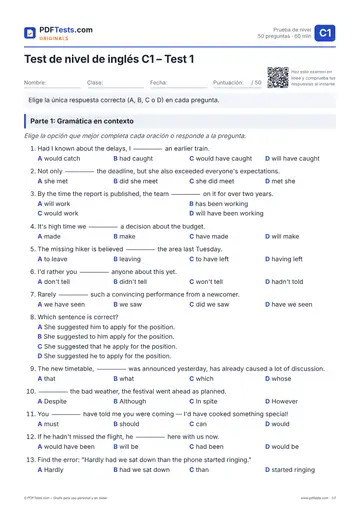
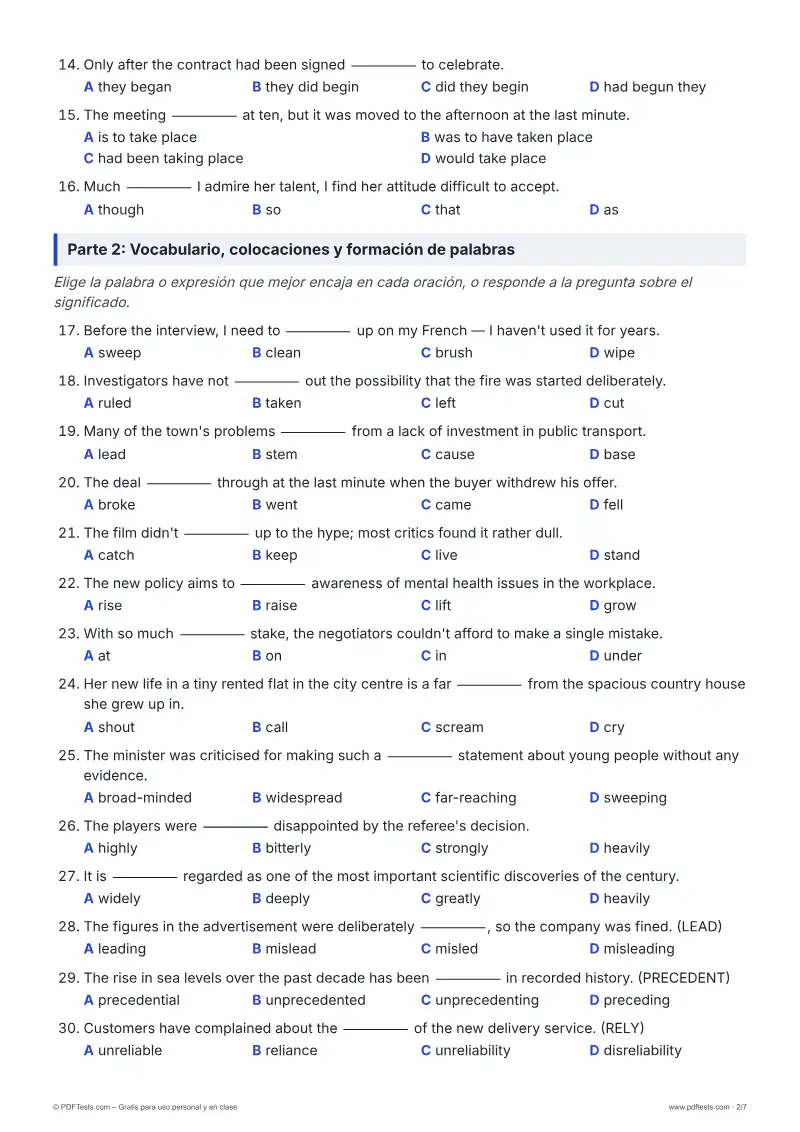
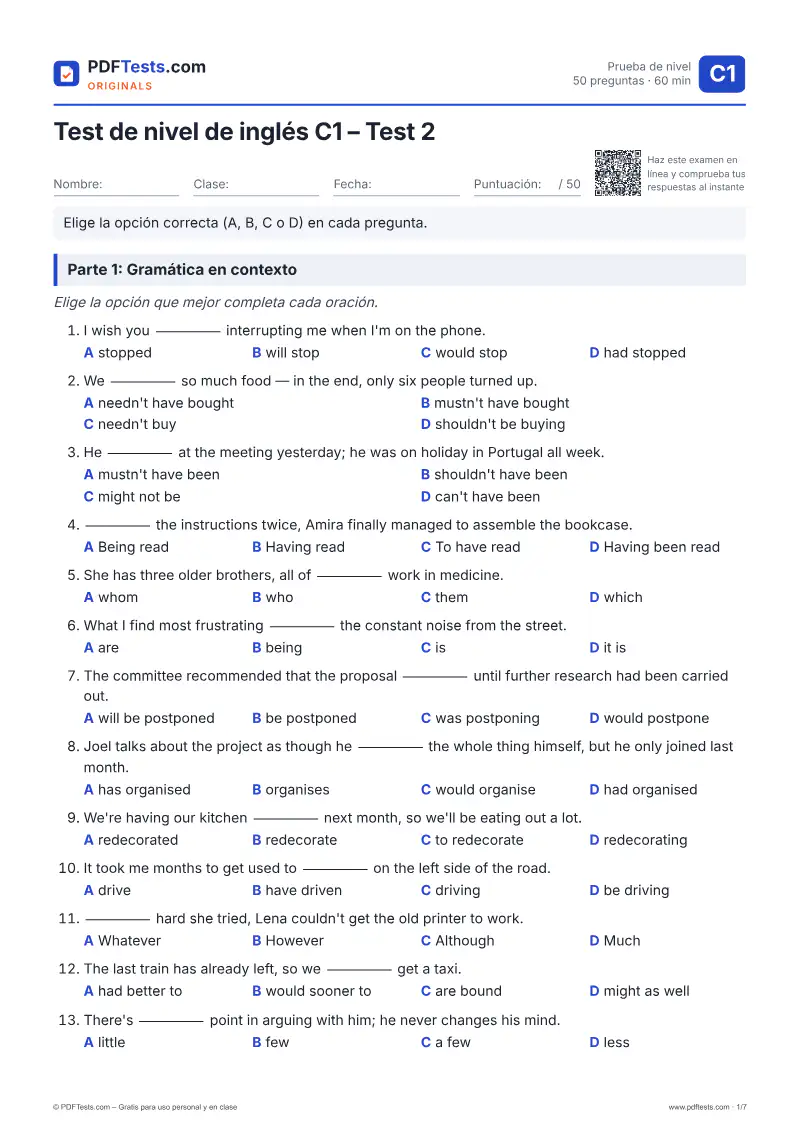
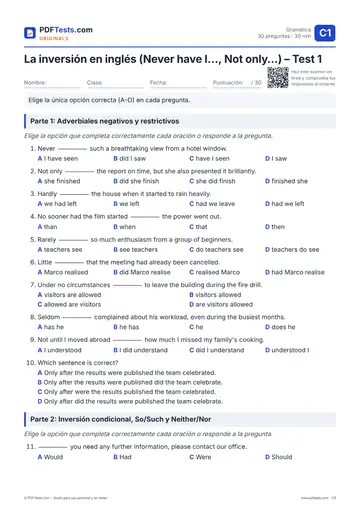
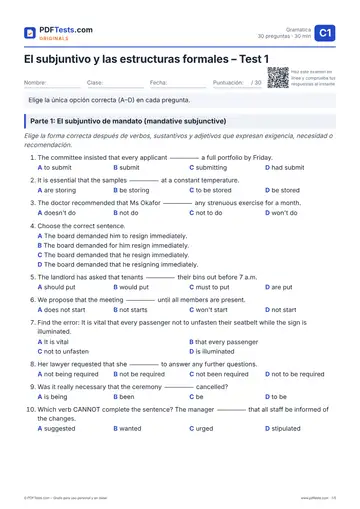
Vista previa de la página 1: Test de nivel de inglés C1 – Test 2 Abrir PDF

Haz el examen en línea

Elige la opción correcta (A, B, C o D) en cada pregunta. Elige tus respuestas y pulsa «Comprobar respuestas».

Parte 1: Gramática en contexto

Elige la opción que mejor completa cada oración.

  1. I wish you _____ interrupting me when I'm on the phone.

  2. We _____ so much food — in the end, only six people turned up.

  3. He _____ at the meeting yesterday; he was on holiday in Portugal all week.

  4. _____ the instructions twice, Amira finally managed to assemble the bookcase.

  5. She has three older brothers, all of _____ work in medicine.

  6. What I find most frustrating _____ the constant noise from the street.

  7. The committee recommended that the proposal _____ until further research had been carried out.

  8. Joel talks about the project as though he _____ the whole thing himself, but he only joined last month.

  9. We're having our kitchen _____ next month, so we'll be eating out a lot.

  10. It took me months to get used to _____ on the left side of the road.

  11. _____ hard she tried, Lena couldn't get the old printer to work.

  12. The last train has already left, so we _____ get a taxi.

  13. There's _____ point in arguing with him; he never changes his mind.

  14. Only after the contract had been signed _____ to celebrate.

  15. The meeting _____ at ten, but it was moved to the afternoon at the last minute.

  16. Much _____ I admire her talent, I find her attitude difficult to accept.

Parte 2: Vocabulario, colocaciones y formación de palabras

Elige la palabra o expresión que mejor encaja en cada oración, o responde a la pregunta sobre el significado.

  1. Before the interview, I need to _____ up on my French — I haven't used it for years.

  2. Investigators have not _____ out the possibility that the fire was started deliberately.

  3. Many of the town's problems _____ from a lack of investment in public transport.

  4. The deal _____ through at the last minute when the buyer withdrew his offer.

  5. The film didn't _____ up to the hype; most critics found it rather dull.

  6. The new policy aims to _____ awareness of mental health issues in the workplace.

  7. With so much _____ stake, the negotiators couldn't afford to make a single mistake.

  8. Her new life in a tiny rented flat in the city centre is a far _____ from the spacious country house she grew up in.

  9. The minister was criticised for making such a _____ statement about young people without any evidence.

  10. The players were _____ disappointed by the referee's decision.

  11. It is _____ regarded as one of the most important scientific discoveries of the century.

  12. The figures in the advertisement were deliberately _____, so the company was fined. (LEAD)

  13. The rise in sea levels over the past decade has been _____ in recorded history. (PRECEDENT)

  14. Customers have complained about the _____ of the new delivery service. (RELY)

  15. To most people at the time, the idea of travelling to the moon seemed _____. (CONCEIVE)

  16. When Priya lost her job, she took it in her stride and started applying elsewhere the next day. What does 'took it in her stride' mean?

  17. The proposal received a lukewarm response from the board. What does 'lukewarm' mean here?

  18. From his tone of voice, I _____ that he wasn't happy with the result.

Parte 3: Estructuras avanzadas y corrección

Elige la opción correcta, la oración correcta o la parte de la oración que contiene un error.

  1. Find the error: "We are looking forward to hear from you at your earliest convenience."

  2. Find the error: "Although the team had trained hard, but they lost the final in the last minute."

  3. Which sentence is correct?

  4. Which sentence is correct?

  5. Nowhere _____ the effects of climate change more visible than in the Arctic.

  6. The company introduced a scheme _____ employees can buy shares at a reduced price.

  7. It is the government, not the local council, _____ responsible for the delays.

  8. _____ to the public in 1998, the bridge quickly became the city's most famous landmark.

  9. _____ as she might, Mei couldn't remember where she had left her keys.

  10. _____ what to say, she simply smiled and nodded.

Parte 4: Comprensión lectora

Lee el texto y elige la mejor respuesta para cada pregunta.

The Quiet Return of Repair

For much of the last half-century, broken household objects have been treated as rubbish. A toaster stops working, a zip breaks, a lamp begins to flicker — and the instinctive response has been to throw the item away and buy a replacement. Yet in towns and cities across many countries, a small but growing movement is challenging this habit. Volunteers organise community repair events in libraries and local centres, where residents bring in damaged items and learn to fix them alongside skilled helpers.

The appeal is partly economic. Replacing a device can cost several times more than mending it, and for households under financial pressure, a free repair can make a real difference. Organisers insist, however, that money is only part of the story. Many participants say they come for the conversation as much as for the screwdrivers. At a time when neighbours often barely know each other's names, an afternoon spent coaxing an old radio back to life can create unexpected connections.

There is also an environmental argument. Manufacturing new goods consumes raw materials and energy, and discarded electronics are among the fastest-growing sources of waste. Every repaired item, campaigners point out, is one fewer object in a landfill. Critics, however, warn against overstating the impact. A few hundred mended kettles, they argue, will hardly dent global waste figures while products continue to be designed in ways that make repair difficult or impossible.

It is here that the movement may prove most significant. By drawing attention to sealed casings, glued-in batteries and unavailable spare parts, repair volunteers have helped shift the debate from individual behaviour to product design. Several governments are now considering rules that would require manufacturers to supply spare parts for a set number of years. Whether such measures will be properly enforced remains to be seen. Still, the sight of a teenager proudly carrying home a lamp she has rewired herself suggests that something more lasting than an appliance is being restored: a sense that the objects around us are worth understanding, and worth keeping.

  1. What does the writer say about the usual response to broken household items?

  2. According to the second paragraph, why do many participants attend repair events?

  3. The phrase 'coaxing an old radio back to life' suggests that the repair requires:

  4. What point do critics make in the third paragraph?

  5. According to the writer, what may be the movement's most significant achievement?

  6. Which best describes the writer's overall attitude to the repair movement?

¿Te ha resultado útil esta página?

Informar de un error

¿Has visto una respuesta incorrecta, una errata o una explicación poco clara? Avísanos y lo corregiremos.

Vista previa

Sobre este examen

Esta prueba de nivel C1 recoge la gramática y el vocabulario avanzados que se esperan de un usuario competente y seguro del inglés. Trabaja los verbos modales, la inversión, las oraciones de participio, las colocaciones, los phrasal verbs y la formación de palabras, y termina con un texto de comprensión lectora. Está pensada para profesores y estudiantes que quieran comprobar si un alumno domina con solidez el nivel C1.

Temas

Verbos modales avanzadosInversión y oraciones escindidas (cleft sentences)Oraciones de participio (participle clauses)Phrasal verbs y expresiones idiomáticasColocaciones (collocations)Formación de palabrasCorrección de erroresComprensión lectora

Cómo usar este examen

  1. Descarga el PDF e imprímelo, o haz el examen en línea más abajo.
  2. Responde todas las preguntas sin diccionario y sin prisas.
  3. Comprueba tus respuestas y apunta los temas que debes repasar.

Notas para el profesor

Utilice este test como prueba de nivel o como evaluación de final de curso: una puntuación de 40/50 o más indica que el alumno domina el nivel C1, mientras que una puntuación inferior a 30 revela lagunas que podrían situarlo en un B2+. El test se centra en errores típicos de estudiantes avanzados, como confundir los modales en pasado, usar mal los patrones verbales (suggest, accuse, look forward to), emplear conjunciones redundantes o recurrir a colocaciones poco naturales. Como actividad de seguimiento, pida a los alumnos que reescriban correctamente las opciones incorrectas de las partes 1 y 3 y que expliquen con sus propias palabras el significado de las expresiones idiomáticas.