PDFTests Originals

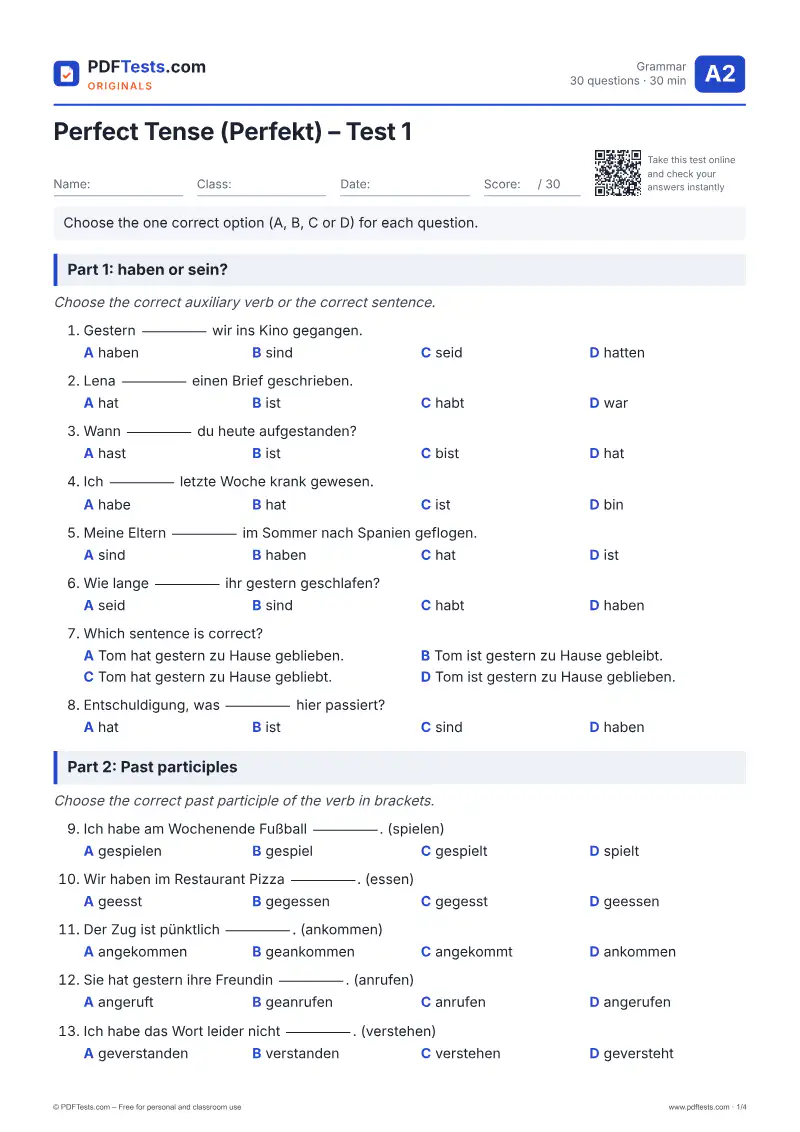
Perfect Tense (Perfekt) – Test 1

A2 Elementary GrammarGerman

This A2 German grammar test practises the Perfekt, the past tense used most often in spoken German. It covers choosing haben or sein, forming regular, irregular, separable and inseparable past participles, word order, negatives and questions, and ends with a short email in context. It suits learners finishing A2 and teachers who need a quick, printable check.
Questions
30
Time
30 min
PDF
4 pages
Answer key
Included
  • 100% free
  • No sign-up or email
  • Print-ready A4 PDF
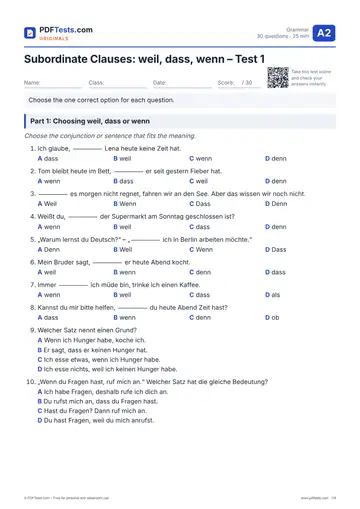
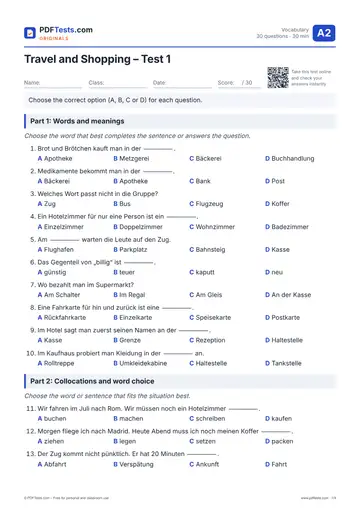
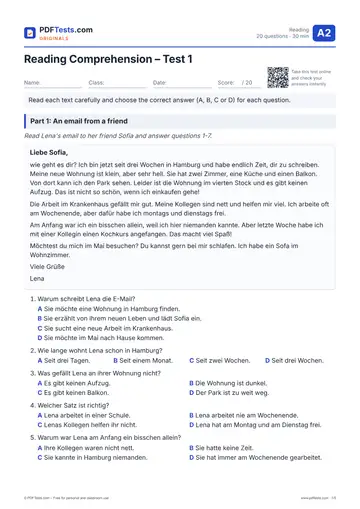
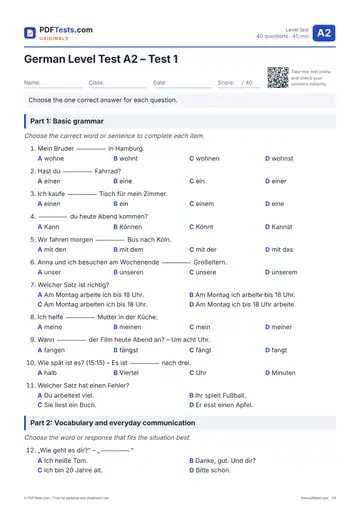
Preview of page 1 of Perfect Tense (Perfekt) – Test 1 Open PDF

Take the test online

Choose the one correct option (A, B, C or D) for each question. Choose your answers, then press “Check my answers”.

Part 1: haben or sein?

Choose the correct auxiliary verb or the correct sentence.

  1. Gestern _____ wir ins Kino gegangen.

  2. Lena _____ einen Brief geschrieben.

  3. Wann _____ du heute aufgestanden?

  4. Ich _____ letzte Woche krank gewesen.

  5. Meine Eltern _____ im Sommer nach Spanien geflogen.

  6. Wie lange _____ ihr gestern geschlafen?

  7. Which sentence is correct?

  8. Entschuldigung, was _____ hier passiert?

Part 2: Past participles

Choose the correct past participle of the verb in brackets.

  1. Ich habe am Wochenende Fußball _____. (spielen)

  2. Wir haben im Restaurant Pizza _____. (essen)

  3. Der Zug ist pünktlich _____. (ankommen)

  4. Sie hat gestern ihre Freundin _____. (anrufen)

  5. Ich habe das Wort leider nicht _____. (verstehen)

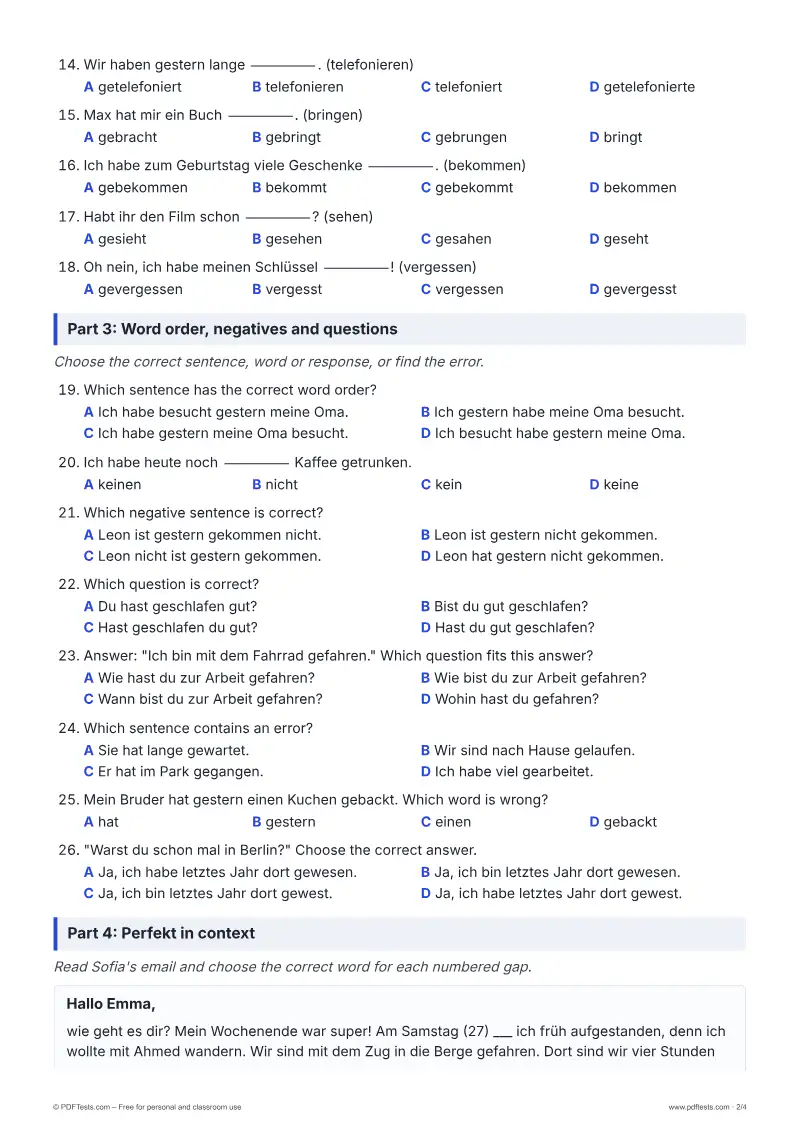
  6. Wir haben gestern lange _____. (telefonieren)

  7. Max hat mir ein Buch _____. (bringen)

  8. Ich habe zum Geburtstag viele Geschenke _____. (bekommen)

  9. Habt ihr den Film schon _____? (sehen)

  10. Oh nein, ich habe meinen Schlüssel _____! (vergessen)

Part 3: Word order, negatives and questions

Choose the correct sentence, word or response, or find the error.

  1. Which sentence has the correct word order?

  2. Ich habe heute noch _____ Kaffee getrunken.

  3. Which negative sentence is correct?

  4. Which question is correct?

  5. Answer: "Ich bin mit dem Fahrrad gefahren." Which question fits this answer?

  6. Which sentence contains an error?

  7. Mein Bruder hat gestern einen Kuchen gebackt. Which word is wrong?

  8. "Warst du schon mal in Berlin?" Choose the correct answer.

Part 4: Perfekt in context

Read Sofia's email and choose the correct word for each numbered gap.

Hallo Emma,

wie geht es dir? Mein Wochenende war super! Am Samstag (27) ___ ich früh aufgestanden, denn ich wollte mit Ahmed wandern. Wir sind mit dem Zug in die Berge gefahren. Dort sind wir vier Stunden (28) ___. Am Abend haben wir in einem kleinen Restaurant gegessen.

Am Sonntag habe ich lange geschlafen. Danach habe ich meine Wohnung (29) ___, und am Nachmittag habe ich mit meiner Mutter Kaffee (30) ___. Und du? Was hast du am Wochenende gemacht?

Liebe Grüße

Sofia

  1. Gap (27): Am Samstag _____ ich früh aufgestanden.

  2. Gap (28): Dort sind wir vier Stunden _____.

  3. Gap (29): Danach habe ich meine Wohnung _____.

  4. Gap (30): Am Nachmittag habe ich mit meiner Mutter Kaffee _____.

Preview

About this test

This A2 German grammar test practises the Perfekt, the past tense used most often in spoken German. It covers choosing haben or sein, forming regular, irregular, separable and inseparable past participles, word order, negatives and questions, and ends with a short email in context. It suits learners finishing A2 and teachers who need a quick, printable check.

Topics covered

Perfekt with habenPerfekt with seinRegular and irregular participlesSeparable and inseparable verbsVerbs ending in -ierenWord order and negationQuestions in the Perfekt

How to use this test

  1. Download the PDF and print it, or take the test online below.
  2. Answer every question without a dictionary or time pressure.
  3. Check your answers and note the topics you need to review.

Notes for teachers

The test targets the most common A2 errors: using haben with verbs of movement or change, adding ge- to inseparable and -ieren verbs, putting ge- in the wrong place in separable verbs, and using weak endings (-t) with strong verbs. It also checks that the participle goes at the end of the clause. For follow-up, ask learners to write a short email about their weekend, then swap and correct each other's auxiliaries and participles.