PDFTests Originals

Participles as Adjectives – Test 1

B2 Upper-intermediate GrammarGerman

This B2 grammar test checks how well you use Partizip I and Partizip II as adjectives in German. It covers forms and endings, active and passive meaning, extended participial attributes, zu + Partizip I, negation and nominalised participles. It suits upper-intermediate learners, exam candidates and teachers who want a focused practice or review sheet.

Questions
30
Time
30 min
PDF
5 pages
Answer key
Included
  • 100% free
  • No sign-up or email
  • Print-ready A4 PDF
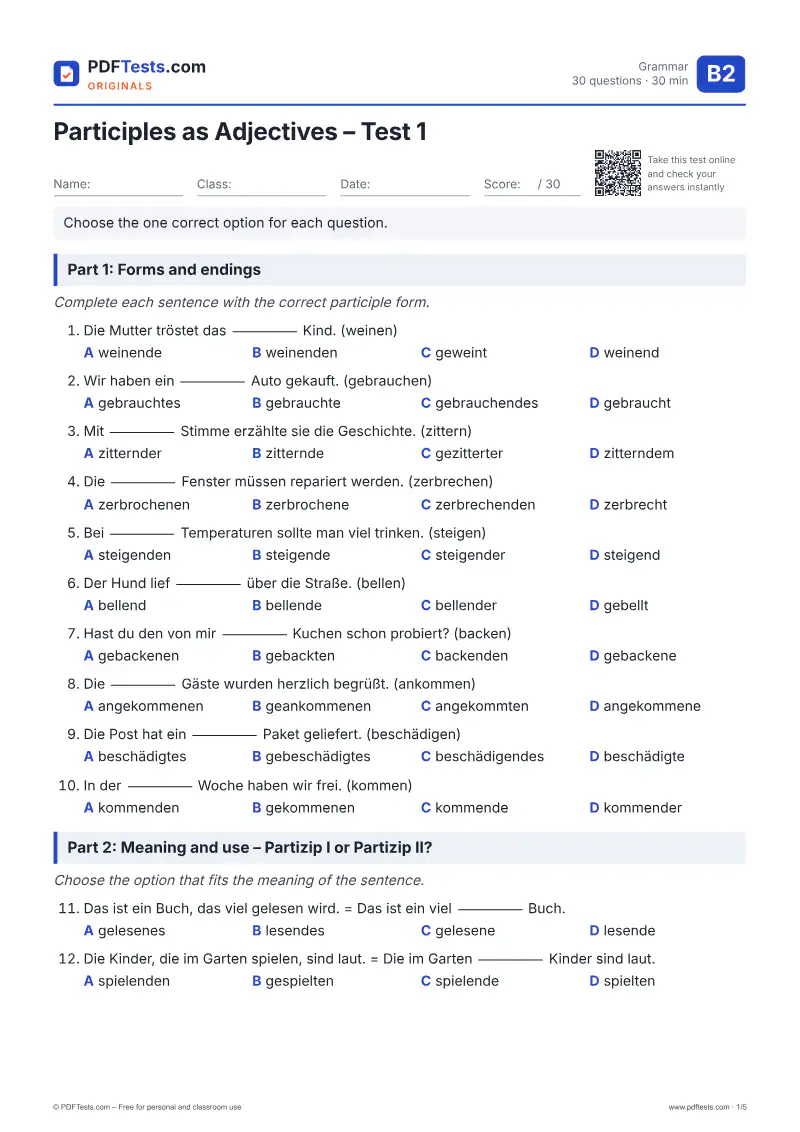
Preview of page 1 of Participles as Adjectives – Test 1 Open PDF

Take the test online

Choose the one correct option for each question. Choose your answers, then press “Check my answers”.

Part 1: Forms and endings

Complete each sentence with the correct participle form.

  1. Die Mutter tröstet das _____ Kind. (weinen)

  2. Wir haben ein _____ Auto gekauft. (gebrauchen)

  3. Mit _____ Stimme erzählte sie die Geschichte. (zittern)

  4. Die _____ Fenster müssen repariert werden. (zerbrechen)

  5. Bei _____ Temperaturen sollte man viel trinken. (steigen)

  6. Der Hund lief _____ über die Straße. (bellen)

  7. Hast du den von mir _____ Kuchen schon probiert? (backen)

  8. Die _____ Gäste wurden herzlich begrüßt. (ankommen)

  9. Die Post hat ein _____ Paket geliefert. (beschädigen)

  10. In der _____ Woche haben wir frei. (kommen)

Part 2: Meaning and use – Partizip I or Partizip II?

Choose the option that fits the meaning of the sentence.

  1. Das ist ein Buch, das viel gelesen wird. = Das ist ein viel _____ Buch.

  2. Die Kinder, die im Garten spielen, sind laut. = Die im Garten _____ Kinder sind laut.

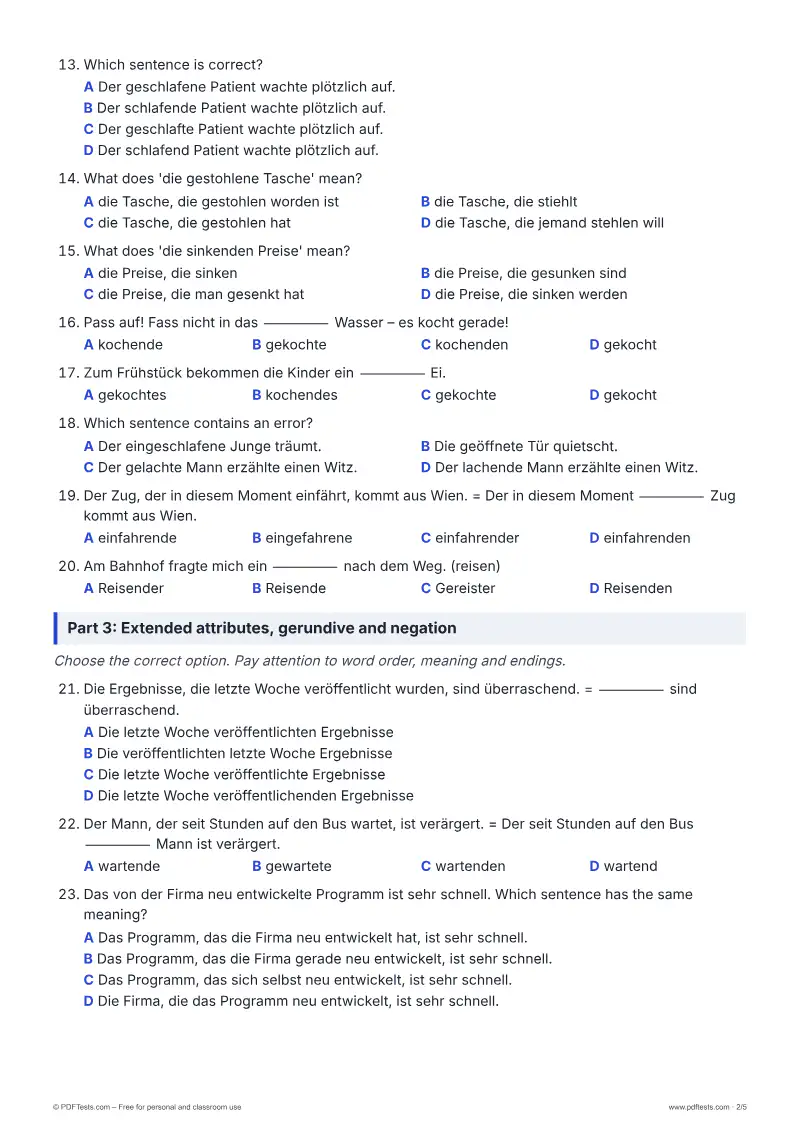
  3. Which sentence is correct?

  4. What does 'die gestohlene Tasche' mean?

  5. What does 'die sinkenden Preise' mean?

  6. Pass auf! Fass nicht in das _____ Wasser – es kocht gerade!

  7. Zum Frühstück bekommen die Kinder ein _____ Ei.

  8. Which sentence contains an error?

  9. Der Zug, der in diesem Moment einfährt, kommt aus Wien. = Der in diesem Moment _____ Zug kommt aus Wien.

  10. Am Bahnhof fragte mich ein _____ nach dem Weg. (reisen)

Part 3: Extended attributes, gerundive and negation

Choose the correct option. Pay attention to word order, meaning and endings.

  1. Die Ergebnisse, die letzte Woche veröffentlicht wurden, sind überraschend. = _____ sind überraschend.

  2. Der Mann, der seit Stunden auf den Bus wartet, ist verärgert. = Der seit Stunden auf den Bus _____ Mann ist verärgert.

  3. Das von der Firma neu entwickelte Programm ist sehr schnell. Which sentence has the same meaning?

  4. Die Aufgaben, die man bis Freitag erledigen muss, liegen auf dem Tisch. = Die bis Freitag _____ Aufgaben liegen auf dem Tisch.

  5. What does 'ein nicht zu unterschätzendes Problem' mean?

  6. Die Rechnungen, die noch nicht bezahlt sind, liegen im Ordner. = Die noch nicht _____ Rechnungen liegen im Ordner.

  7. Auf dem Tisch lag eine Rechnung, die noch niemand geöffnet hatte. = Auf dem Tisch lag eine _____ Rechnung.

  8. Which sentence is correct?

  9. Nach dem Unfall wurden die _____ ins Krankenhaus gebracht. (verletzen)

  10. – Welchen Koffer soll ich nehmen? – Den schon _____. (packen)

Preview

About this test

This B2 grammar test checks how well you use Partizip I and Partizip II as adjectives in German. It covers forms and endings, active and passive meaning, extended participial attributes, zu + Partizip I, negation and nominalised participles. It suits upper-intermediate learners, exam candidates and teachers who want a focused practice or review sheet.

Topics covered

Partizip I as adjectivePartizip II as adjectiveAdjective endingsActive vs. passive meaningExtended participial attributeszu + Partizip I (gerundive)Negation with participlesNominalised participles

How to use this test

  1. Download the PDF and print it, or take the test online below.
  2. Answer every question without a dictionary or time pressure.
  3. Check your answers and note the topics you need to review.

Notes for teachers

Use Part 1 to check forms and endings, Part 2 to check meaning (ongoing/active vs. completed/passive), and Part 3 to check extended attributes, the gerundive and negation. The test targets typical B2 errors: missing or wrong endings, ge- added to inseparable or separable verbs in the wrong place, attributive Partizip II of intransitive haben-verbs (*der gelachte Mann*), and confusing Partizip I and II. As a follow-up, ask students to rewrite newspaper headlines or relative clauses as extended participial attributes and back again.