PDFTests Originals

Idioms and Fixed Expressions (C2) – Test 1

C2 Proficiency VocabularyEnglish

This C2 vocabulary test checks how well you understand and use advanced English idioms and fixed expressions. It covers completing idioms, understanding them in context, spotting misused or misquoted expressions, and recognising idioms in a reading text. It is designed for proficient learners, exam candidates and teachers who want a quick, printable check of idiomatic accuracy.
Questions
30
Time
30 min
PDF
5 pages
Answer key
Included
  • 100% free
  • No sign-up or email
  • Print-ready A4 PDF
Preview of page 1 of Idioms and Fixed Expressions (C2) – Test 1 Open PDF

Take the test online

Choose the one correct answer (A, B, C or D) for each question. Choose your answers, then press “Check my answers”.

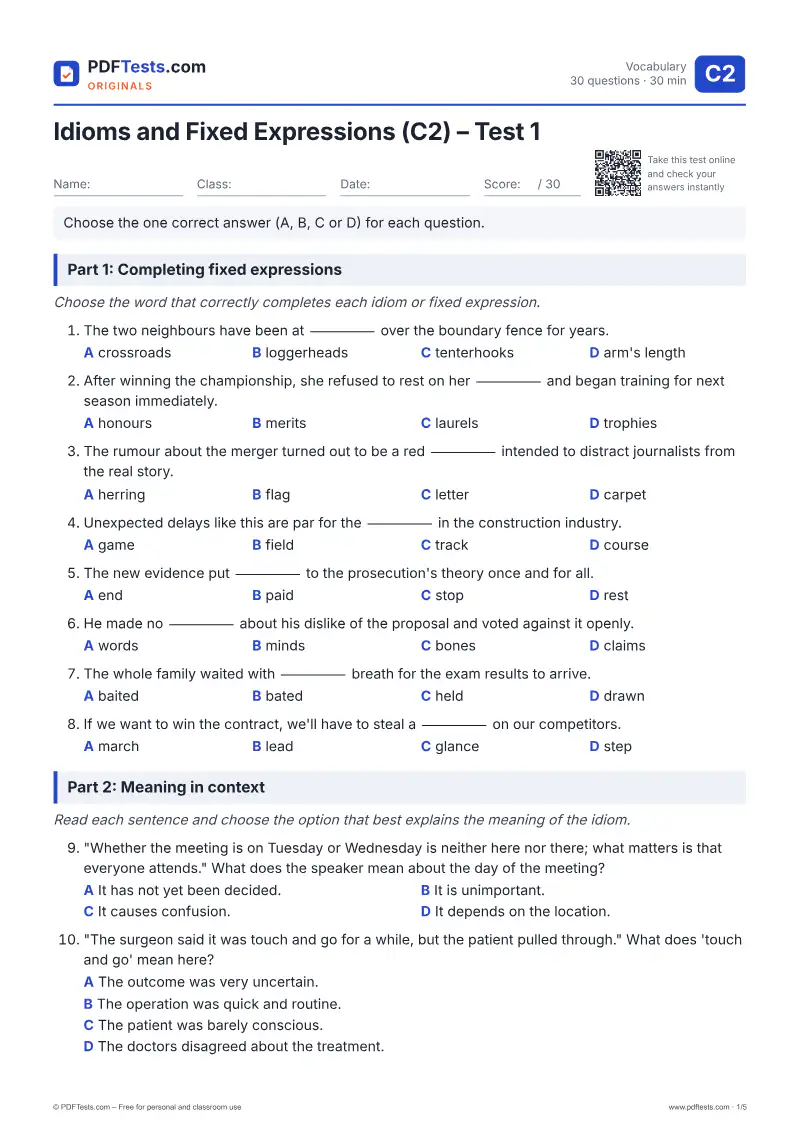
Part 1: Completing fixed expressions

Choose the word that correctly completes each idiom or fixed expression.

  1. The two neighbours have been at _____ over the boundary fence for years.

  2. After winning the championship, she refused to rest on her _____ and began training for next season immediately.

  3. The rumour about the merger turned out to be a red _____ intended to distract journalists from the real story.

  4. Unexpected delays like this are par for the _____ in the construction industry.

  5. The new evidence put _____ to the prosecution's theory once and for all.

  6. He made no _____ about his dislike of the proposal and voted against it openly.

  7. The whole family waited with _____ breath for the exam results to arrive.

  8. If we want to win the contract, we'll have to steal a _____ on our competitors.

Part 2: Meaning in context

Read each sentence and choose the option that best explains the meaning of the idiom.

  1. "Whether the meeting is on Tuesday or Wednesday is neither here nor there; what matters is that everyone attends." What does the speaker mean about the day of the meeting?

  2. "The surgeon said it was touch and go for a while, but the patient pulled through." What does 'touch and go' mean here?

  3. "Daniel was at a loose end on Saturday, so he offered to help us paint the kitchen." What was Daniel's situation?

  4. "The chair of the committee gave the journalist's question short shrift." What did the chair do?

  5. "By setting a trap for her colleague, Mia was hoist with her own petard when her manager discovered the plan." What happened to Mia?

  6. "After their argument, Hana kept her former business partner at arm's length." This means Hana _____ him.

  7. "Don't split hairs — the difference between 'nearly' and 'almost' isn't important here." The speaker is asking the listener not to _____.

  8. "Sofia's proposal flies in the face of everything we learned from the last project." This means the proposal _____ the lessons of the last project.

Part 3: Accuracy and usage

Choose the correct sentence, the best response, the right word, or the part of the sentence that contains an error.

  1. Which sentence is correct?

  2. Which part of the sentence contains an error? "She has / a chip in her shoulder / about not having / gone to university."

  3. In which sentence is 'sail close to the wind' used correctly?

  4. The team won a _____ victory: the cost of winning was so high that it was hardly worth it.

  5. A: "I've been putting off telling the client about the delay for weeks." B: "_____"

  6. Which part of the sentence contains an error? "The plan went down / like a lead balloon / with the staff, who thought it was / a damp squid."

  7. In which sentence is 'cut the mustard' used correctly?

Part 4: Idioms in a reading text

Read the text. Choose the word that best fills each numbered gap, then answer the questions about meaning.

When Amara Osei took over the struggling design studio, few people gave her much chance of success. The business had been (1) ___ water for years, and its most talented designers were already thinking about jumping (2) ___.

Amara didn't mince her words. At her first staff meeting, she explained that the studio had its work (3) ___ out and that cutting corners would no longer be tolerated. Some long-serving employees felt she was throwing the baby out with the (4) ___, scrapping systems that had worked perfectly well for decades.

Within a year, however, the tide had (5) ___. Two major clients signed long-term contracts, and the studio's reputation as a safe pair of hands began to spread. Rather than letting success go to her head, Amara invested the profits in training, arguing that complacency was the surest way to end up back at square one.

Today the studio is thriving, and even those who once doubted her are the first to admit that she has more than earned her stripes.

  1. Gap (1): The business had been _____ water for years.

  2. Gap (2): Its most talented designers were already thinking about jumping _____.

  3. Gap (3): The studio had its work _____ out.

  4. Gap (4): She was throwing the baby out with the _____.

  5. Gap (5): Within a year, however, the tide had _____.

  6. In paragraph 2, 'Amara didn't mince her words' suggests that she _____.

  7. In the final paragraph, 'she has more than earned her stripes' means that Amara has _____.

Preview

About this test

This C2 vocabulary test checks how well you understand and use advanced English idioms and fixed expressions. It covers completing idioms, understanding them in context, spotting misused or misquoted expressions, and recognising idioms in a reading text. It is designed for proficient learners, exam candidates and teachers who want a quick, printable check of idiomatic accuracy.

Topics covered

IdiomsFixed expressionsMeaning in contextCollocationsCommon idiom errorsReading comprehension

How to use this test

  1. Download the PDF and print it, or take the test online below.
  2. Answer every question without a dictionary or time pressure.
  3. Check your answers and note the topics you need to review.

Notes for teachers

Use this test as a diagnostic or revision tool for proficient learners preparing for advanced exams. Many distractors target typical C2 errors: misremembered key words (damp squid, baited breath), wrong prepositions (a chip in your shoulder) and idioms used with the wrong meaning (sailing close to the wind, cutting the mustard). As a follow-up, ask students to write a short story or email that uses at least six of the idioms correctly, or to find them in authentic articles.