PDFTests Originals

Collocations and Nuance (C2) – Test 1

C2 Proficiency VocabularyEnglish

This C2 vocabulary test checks your control of advanced English collocations, subtle differences in meaning and word choice in context. It covers verb–noun and adverb–adjective collocations, confusable word families and a gapped reading text. It suits advanced learners preparing for proficiency-level exams and teachers who need a ready-made assessment.

Questions
30
Time
35 min
PDF
4 pages
Answer key
Included
  • 100% free
  • No sign-up or email
  • Print-ready A4 PDF
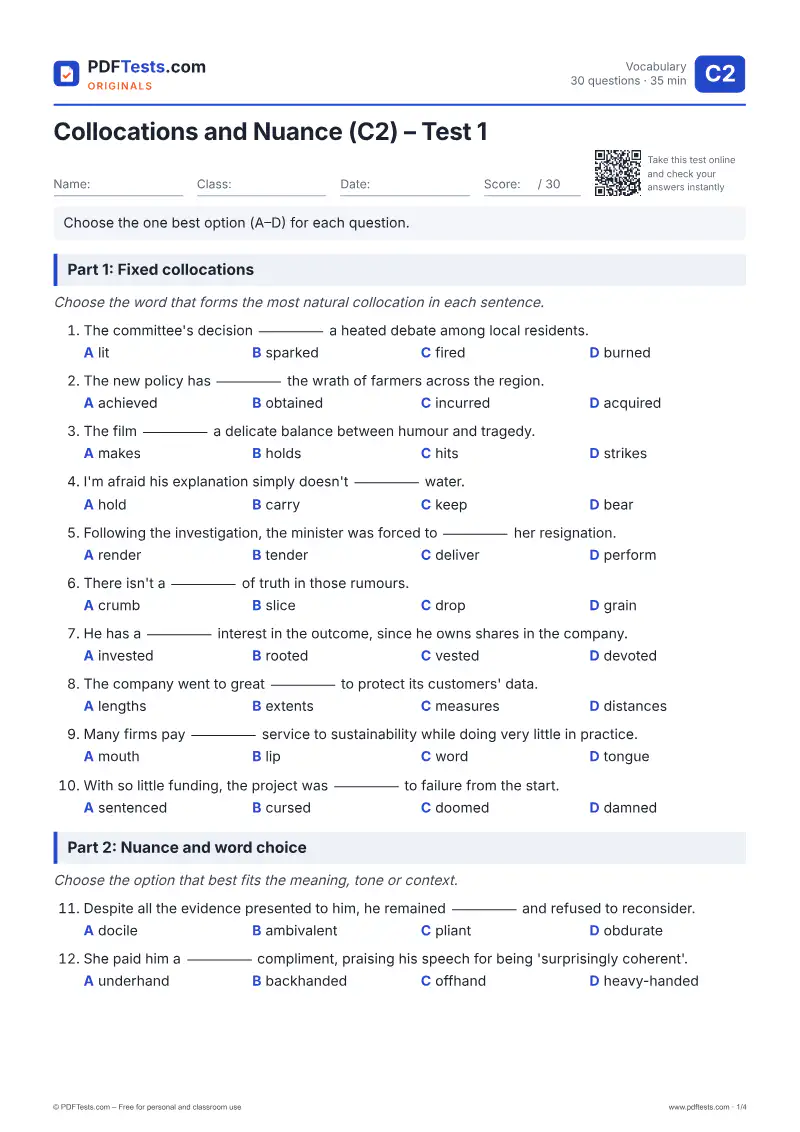
Preview of page 1 of Collocations and Nuance (C2) – Test 1 Open PDF

Take the test online

Choose the one best option (A–D) for each question. Choose your answers, then press “Check my answers”.

Part 1: Fixed collocations

Choose the word that forms the most natural collocation in each sentence.

  1. The committee's decision _____ a heated debate among local residents.

  2. The new policy has _____ the wrath of farmers across the region.

  3. The film _____ a delicate balance between humour and tragedy.

  4. I'm afraid his explanation simply doesn't _____ water.

  5. Following the investigation, the minister was forced to _____ her resignation.

  6. There isn't a _____ of truth in those rumours.

  7. He has a _____ interest in the outcome, since he owns shares in the company.

  8. The company went to great _____ to protect its customers' data.

  9. Many firms pay _____ service to sustainability while doing very little in practice.

  10. With so little funding, the project was _____ to failure from the start.

Part 2: Nuance and word choice

Choose the option that best fits the meaning, tone or context.

  1. Despite all the evidence presented to him, he remained _____ and refused to reconsider.

  2. She paid him a _____ compliment, praising his speech for being 'surprisingly coherent'.

  3. In which sentence is 'deleterious' used correctly?

  4. My grandmother was _____ rather than mean; she simply couldn't bear waste.

  5. 'The minister's reply was deliberately equivocal.' What does 'equivocal' mean here?

  6. Which sentence contains a collocation error?

  7. In the end, the difference between the two proposals was _____; neither offered a real solution.

  8. The sudden silence in the room was slightly _____; nobody seemed to know what to say.

  9. A: 'I hear you've been offered the post in Lisbon.' B: 'Yes, but I'm _____ about accepting it. It's a great opportunity, but my family is here.'

  10. 'Whether we could have won is now a moot point, since the match was cancelled.' What does 'a moot point' mean here?

Part 3: Vocabulary in a reading text

Read the text and choose the best word for each numbered gap.

In recent years, the idea of rewilding our cities has gained considerable (21) ___. Once dismissed as the pet project of a handful of idealists, it is now being taken seriously by planners who recognise that green spaces are anything but a luxury. Neglected roadside verges are being left to grow wild, rooftops are being turned into meadows, and rivers that were buried beneath concrete decades ago are being brought back to the surface.

The benefits are hard to (22) ___. Studies suggest that even modest patches of vegetation can (23) ___ the effects of summer heatwaves, reduce flooding and provide a much-needed refuge for insects whose numbers have fallen (24) ___. There is also mounting evidence that access to nature has a (25) ___ effect on residents' mental health.

Yet the movement is not without its critics. Some residents complain that 'wild' simply looks untidy, and that councils are using ecology as a convenient (26) ___ for cutting maintenance budgets. Others worry that new parks will drive up property prices, pushing out the very communities they were meant to serve, a process sometimes called 'green gentrification'.

Advocates concede that these concerns are not (27) ___. The challenge, they argue, is to involve local people from the outset rather than presenting them with a (28) ___ accompli. Where residents have been given a genuine say, projects have tended to (29) ___ root far more successfully. Rewilding, it seems, is as much about people as it is about plants, and its long-term success will (30) ___ on whether cities can get that balance right.

  1. (21) the idea of rewilding our cities has gained considerable _____

  2. (22) The benefits are hard to _____.

  3. (23) even modest patches of vegetation can _____ the effects of summer heatwaves

  4. (24) insects whose numbers have fallen _____

  5. (25) access to nature has a _____ effect on residents' mental health

  6. (26) councils are using ecology as a convenient _____ for cutting maintenance budgets

  7. (27) Advocates concede that these concerns are not _____.

  8. (28) rather than presenting them with a _____ accompli

  9. (29) projects have tended to _____ root far more successfully

  10. (30) its long-term success will _____ on whether cities can get that balance right

Preview

About this test

This C2 vocabulary test checks your control of advanced English collocations, subtle differences in meaning and word choice in context. It covers verb–noun and adverb–adjective collocations, confusable word families and a gapped reading text. It suits advanced learners preparing for proficiency-level exams and teachers who need a ready-made assessment.

Topics covered

Verb–noun collocationsAdverb–adjective collocationsConnotation and nuanceConfusable wordsWord familiesIdiomatic expressionsVocabulary in context

How to use this test

  1. Download the PDF and print it, or take the test online below.
  2. Answer every question without a dictionary or time pressure.
  3. Check your answers and note the topics you need to review.

Notes for teachers

Use this test as a diagnostic or end-of-unit check with C2 or strong C1 groups. The distractors target typical advanced errors: near-synonyms that do not collocate (do/make, efforts/lengths), confusable forms (mitigate/militate, negligible/negligent) and words with the wrong connotation (frugal/miserly). As a follow-up, ask students to write their own sentences with the correct collocations, or to explain why each distractor is unnatural.