PDFTests Originals

Expressions idiomatiques et expressions figées (C2) – Test 1

C2 Maîtrise VocabulaireAnglais

Ce test de vocabulaire de niveau C2 évalue votre capacité à comprendre et à employer des expressions idiomatiques et des expressions figées avancées en anglais. Il propose de compléter des idiomes, d'en saisir le sens en contexte, de repérer les expressions mal employées ou déformées, et de reconnaître des idiomes dans un texte de lecture. Il s'adresse aux apprenants confirmés, aux candidats aux examens et aux enseignants qui souhaitent vérifier rapidement, sur papier, la maîtrise de l'anglais idiomatique.
Questions
30
Durée
30 min
PDF
6 pages
Corrigé
Inclus
  • 100 % gratuit
  • Sans inscription
  • PDF A4 prêt à imprimer
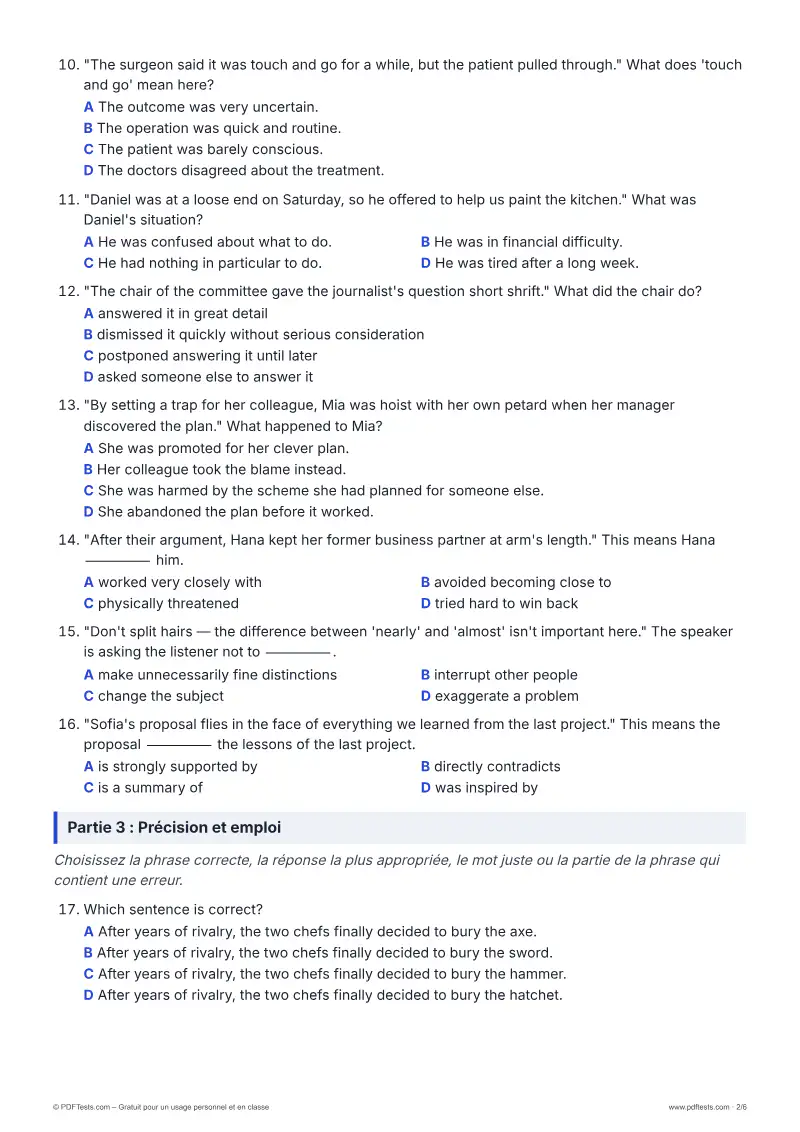
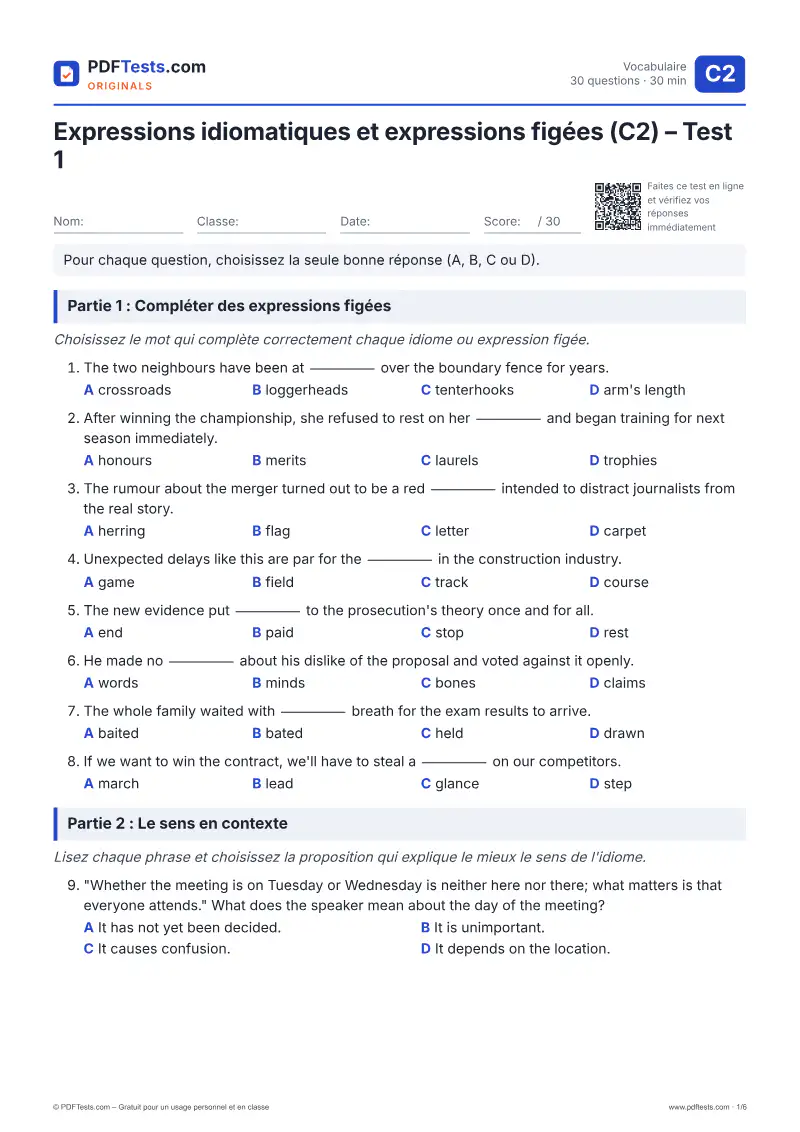
Aperçu de la page 1 : Expressions idiomatiques et expressions figées (C2) – Test 1 Ouvrir le PDF

Faire le test en ligne

Pour chaque question, choisissez la seule bonne réponse (A, B, C ou D). Choisissez vos réponses, puis cliquez sur « Vérifier mes réponses ».

Partie 1 : Compléter des expressions figées

Choisissez le mot qui complète correctement chaque idiome ou expression figée.

  1. The two neighbours have been at _____ over the boundary fence for years.

  2. After winning the championship, she refused to rest on her _____ and began training for next season immediately.

  3. The rumour about the merger turned out to be a red _____ intended to distract journalists from the real story.

  4. Unexpected delays like this are par for the _____ in the construction industry.

  5. The new evidence put _____ to the prosecution's theory once and for all.

  6. He made no _____ about his dislike of the proposal and voted against it openly.

  7. The whole family waited with _____ breath for the exam results to arrive.

  8. If we want to win the contract, we'll have to steal a _____ on our competitors.

Partie 2 : Le sens en contexte

Lisez chaque phrase et choisissez la proposition qui explique le mieux le sens de l'idiome.

  1. "Whether the meeting is on Tuesday or Wednesday is neither here nor there; what matters is that everyone attends." What does the speaker mean about the day of the meeting?

  2. "The surgeon said it was touch and go for a while, but the patient pulled through." What does 'touch and go' mean here?

  3. "Daniel was at a loose end on Saturday, so he offered to help us paint the kitchen." What was Daniel's situation?

  4. "The chair of the committee gave the journalist's question short shrift." What did the chair do?

  5. "By setting a trap for her colleague, Mia was hoist with her own petard when her manager discovered the plan." What happened to Mia?

  6. "After their argument, Hana kept her former business partner at arm's length." This means Hana _____ him.

  7. "Don't split hairs — the difference between 'nearly' and 'almost' isn't important here." The speaker is asking the listener not to _____.

  8. "Sofia's proposal flies in the face of everything we learned from the last project." This means the proposal _____ the lessons of the last project.

Partie 3 : Précision et emploi

Choisissez la phrase correcte, la réponse la plus appropriée, le mot juste ou la partie de la phrase qui contient une erreur.

  1. Which sentence is correct?

  2. Which part of the sentence contains an error? "She has / a chip in her shoulder / about not having / gone to university."

  3. In which sentence is 'sail close to the wind' used correctly?

  4. The team won a _____ victory: the cost of winning was so high that it was hardly worth it.

  5. A: "I've been putting off telling the client about the delay for weeks." B: "_____"

  6. Which part of the sentence contains an error? "The plan went down / like a lead balloon / with the staff, who thought it was / a damp squid."

  7. In which sentence is 'cut the mustard' used correctly?

Partie 4 : Les idiomes dans un texte

Lisez le texte. Choisissez le mot qui complète le mieux chaque blanc numéroté, puis répondez aux questions sur le sens.

When Amara Osei took over the struggling design studio, few people gave her much chance of success. The business had been (1) ___ water for years, and its most talented designers were already thinking about jumping (2) ___.

Amara didn't mince her words. At her first staff meeting, she explained that the studio had its work (3) ___ out and that cutting corners would no longer be tolerated. Some long-serving employees felt she was throwing the baby out with the (4) ___, scrapping systems that had worked perfectly well for decades.

Within a year, however, the tide had (5) ___. Two major clients signed long-term contracts, and the studio's reputation as a safe pair of hands began to spread. Rather than letting success go to her head, Amara invested the profits in training, arguing that complacency was the surest way to end up back at square one.

Today the studio is thriving, and even those who once doubted her are the first to admit that she has more than earned her stripes.

  1. Gap (1): The business had been _____ water for years.

  2. Gap (2): Its most talented designers were already thinking about jumping _____.

  3. Gap (3): The studio had its work _____ out.

  4. Gap (4): She was throwing the baby out with the _____.

  5. Gap (5): Within a year, however, the tide had _____.

  6. In paragraph 2, 'Amara didn't mince her words' suggests that she _____.

  7. In the final paragraph, 'she has more than earned her stripes' means that Amara has _____.

Aperçu

À propos de ce test

Ce test de vocabulaire de niveau C2 évalue votre capacité à comprendre et à employer des expressions idiomatiques et des expressions figées avancées en anglais. Il propose de compléter des idiomes, d'en saisir le sens en contexte, de repérer les expressions mal employées ou déformées, et de reconnaître des idiomes dans un texte de lecture. Il s'adresse aux apprenants confirmés, aux candidats aux examens et aux enseignants qui souhaitent vérifier rapidement, sur papier, la maîtrise de l'anglais idiomatique.

Thèmes abordés

Expressions idiomatiquesExpressions figéesSens en contexteCollocationsErreurs fréquentes avec les idiomesCompréhension écrite

Comment utiliser ce test

  1. Téléchargez le PDF et imprimez-le, ou faites le test en ligne ci-dessous.
  2. Répondez à toutes les questions sans dictionnaire et sans vous presser.
  3. Vérifiez vos réponses et notez les points à revoir.

Notes pour l’enseignant

Utilisez ce test comme outil de diagnostic ou de révision avec des apprenants confirmés qui préparent des examens de niveau avancé. De nombreux distracteurs ciblent des erreurs typiques du niveau C2 : mot clé mal mémorisé (damp squid, baited breath), mauvaise préposition (a chip in your shoulder) et idiomes employés dans un sens erroné (sailing close to the wind, cutting the mustard). En prolongement, demandez aux élèves de rédiger une courte histoire ou un e-mail utilisant correctement au moins six de ces idiomes, ou de les retrouver dans des articles authentiques.