PDFTests Originals

Prueba de nivel de inglés A2 (ESL) – Test 1

A2 Elemental Prueba de nivelInglés

Esta prueba de nivel de inglés A2 evalúa la gramática, el vocabulario y la comprensión lectora que necesitan los estudiantes adultos y universitarios de inglés como segunda lengua (ESL) en la vida diaria, los estudios y el trabajo en Estados Unidos. Consta de 36 preguntas de opción múltiple que van del significado de frases y el uso de la lengua a dos textos breves de lectura. Docentes y estudiantes pueden usar la puntuación para comprobar si el alumno domina con seguridad el nivel A2.
Preguntas
36
Tiempo
45 min
PDF
6 páginas
Soluciones
Incluidas
  • 100 % gratis
  • Sin registro
  • PDF A4 listo para imprimir
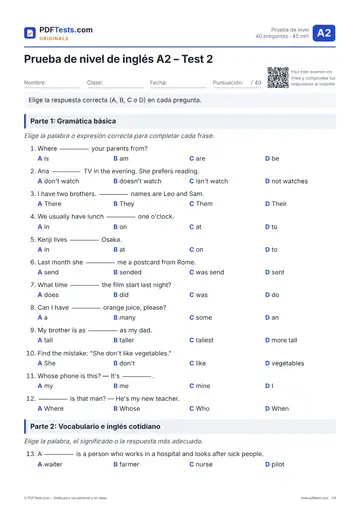
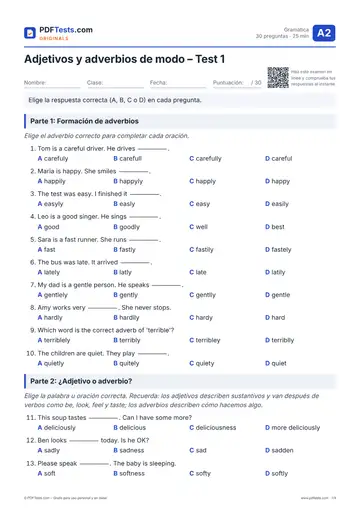
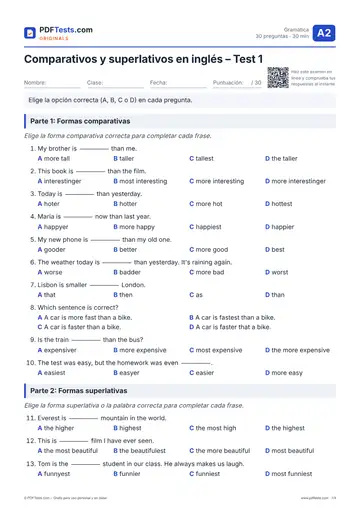
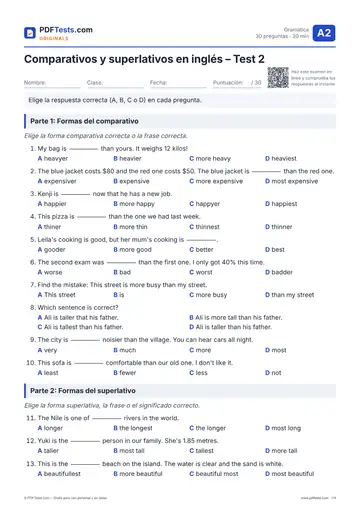
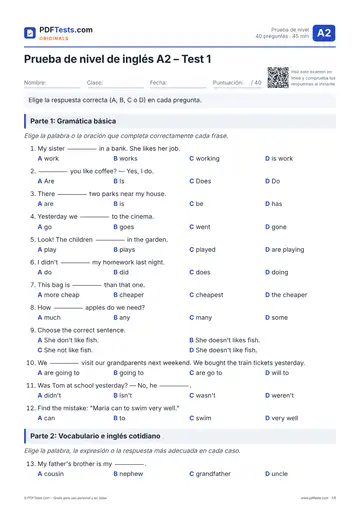
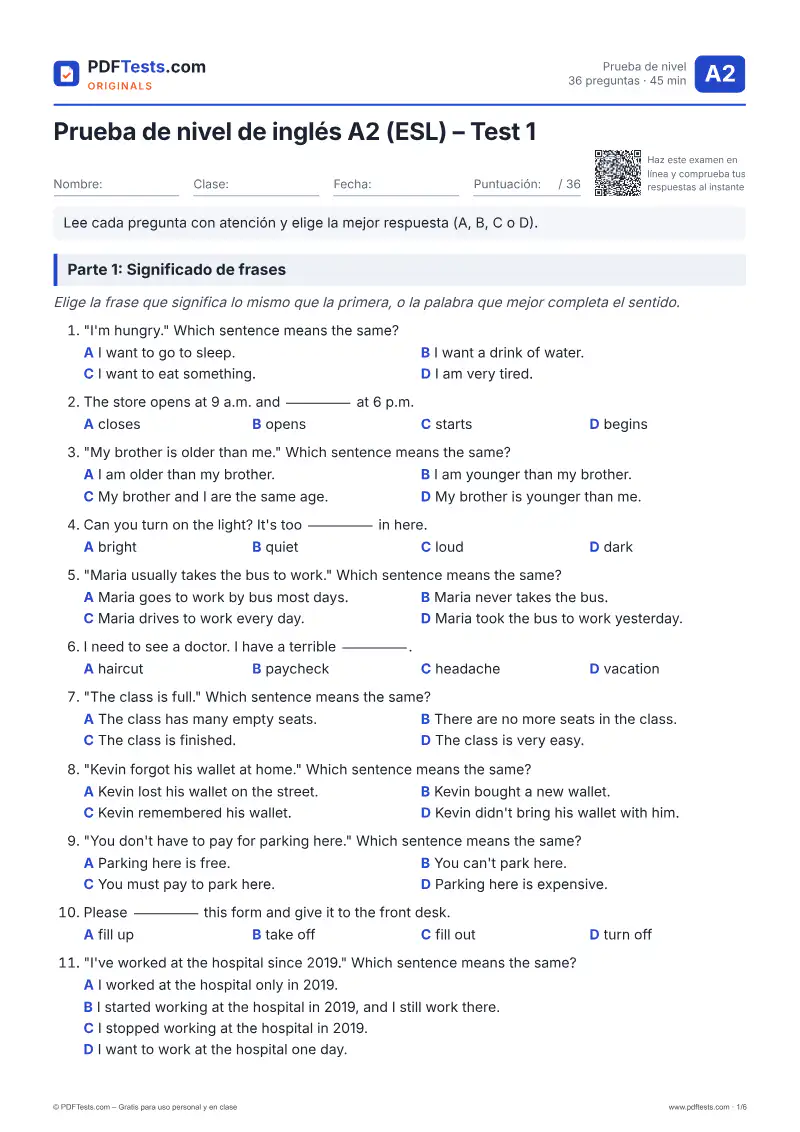
Vista previa de la página 1: Prueba de nivel de inglés A2 (ESL) – Test 1 Abrir PDF
Examen de ubicación ESL · todos los exámenes de práctica, niveles y consejos

Haz el examen en línea

Lee cada pregunta con atención y elige la mejor respuesta (A, B, C o D). Elige tus respuestas y pulsa «Comprobar respuestas».

Parte 1: Significado de frases

Elige la frase que significa lo mismo que la primera, o la palabra que mejor completa el sentido.

  1. "I'm hungry." Which sentence means the same?

  2. The store opens at 9 a.m. and _____ at 6 p.m.

  3. "My brother is older than me." Which sentence means the same?

  4. Can you turn on the light? It's too _____ in here.

  5. "Maria usually takes the bus to work." Which sentence means the same?

  6. I need to see a doctor. I have a terrible _____.

  7. "The class is full." Which sentence means the same?

  8. "Kevin forgot his wallet at home." Which sentence means the same?

  9. "You don't have to pay for parking here." Which sentence means the same?

  10. Please _____ this form and give it to the front desk.

  11. "I've worked at the hospital since 2019." Which sentence means the same?

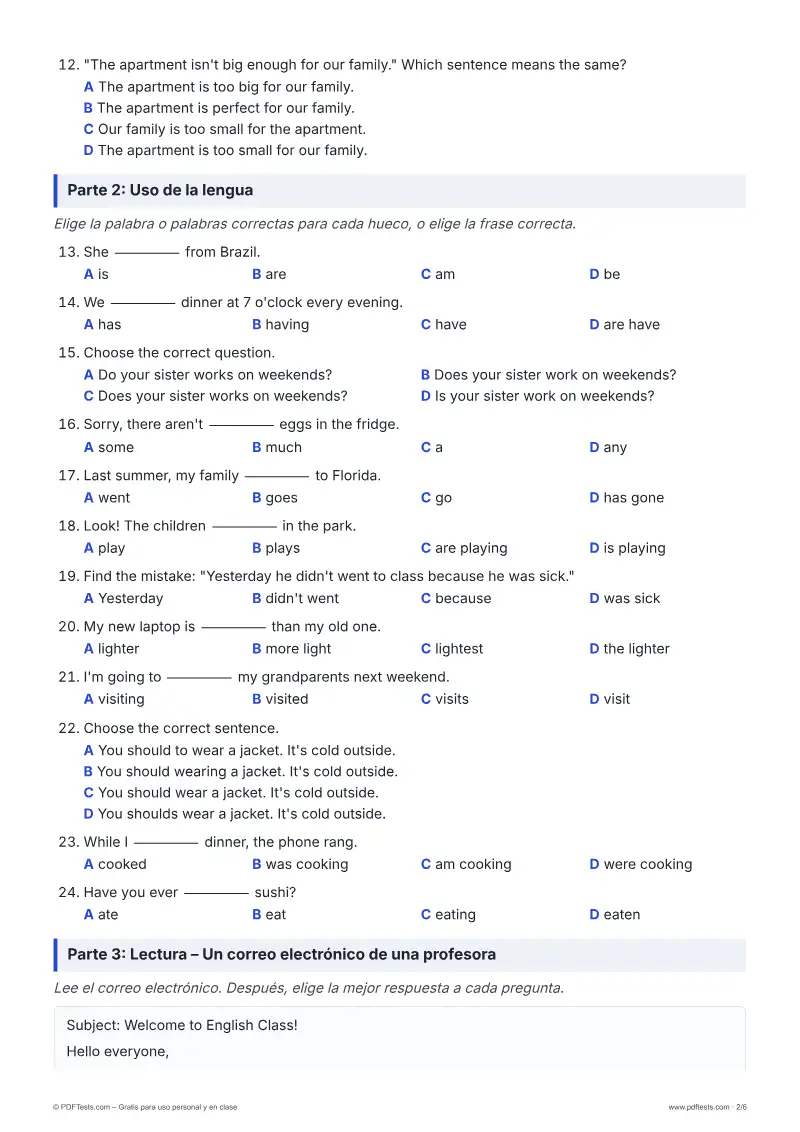
  12. "The apartment isn't big enough for our family." Which sentence means the same?

Parte 2: Uso de la lengua

Elige la palabra o palabras correctas para cada hueco, o elige la frase correcta.

  1. She _____ from Brazil.

  2. We _____ dinner at 7 o'clock every evening.

  3. Choose the correct question.

  4. Sorry, there aren't _____ eggs in the fridge.

  5. Last summer, my family _____ to Florida.

  6. Look! The children _____ in the park.

  7. Find the mistake: "Yesterday he didn't went to class because he was sick."

  8. My new laptop is _____ than my old one.

  9. I'm going to _____ my grandparents next weekend.

  10. Choose the correct sentence.

  11. While I _____ dinner, the phone rang.

  12. Have you ever _____ sushi?

Parte 3: Lectura – Un correo electrónico de una profesora

Lee el correo electrónico. Después, elige la mejor respuesta a cada pregunta.

Subject: Welcome to English Class!

Hello everyone,

Welcome to the evening English class at Riverside Community Center. Our class meets on Mondays and Wednesdays from 6:30 to 8:30 p.m. in Room 12, on the second floor.

Please bring a notebook and a pen to every class. You don't need to buy a book. I will give you all the papers you need.

The parking lot behind the building is free after 5 p.m. You can also take the number 14 bus. It stops right in front of the center.

If you can't come to class, please send me an email or call the front office at (555) 201-3344. After three absences, you may lose your place in the class.

See you on Monday!

Ms. Linda Park

  1. How many times a week does the class meet?

  2. Where is Room 12?

  3. What do students need to bring to class?

  4. "The parking lot behind the building is free after 5 p.m." What does this mean for students?

  5. What should a student do if he or she can't come to class?

  6. What can happen if a student misses three classes?

Parte 4: Lectura – Un trabajo nuevo

Lee el texto. Después, elige la mejor respuesta a cada pregunta.

Ahmed moved to Chicago with his wife and two children six months ago. In his home country, he was an engineer, but in the United States he needed to improve his English before he could find a job in engineering.

Three months ago, Ahmed started working at a large supermarket. He works in the produce section, where he puts fruit and vegetables on the shelves. He also helps customers find things in the store. His shift starts at 5 a.m., so he has to get up very early. It is hard, but he likes his coworkers. They are friendly, and they often help him with new words.

In the afternoons, Ahmed takes English classes at a community college. He wants to take a computer course next year too. His manager, Rosa, is happy with his work. Last week, she asked him to train two new employees. Ahmed was surprised, but he felt proud.

Ahmed hopes to work as an engineer again one day. For now, he is learning a lot, and his family is happy in their new home.

  1. What was Ahmed's job in his home country?

  2. What does Ahmed do at the supermarket?

  3. Why does Ahmed get up very early?

  4. Which word in paragraph 2 means "people you work with"?

  5. Why did Ahmed feel proud last week?

  6. Which sentence is true?

¿Te ha resultado útil esta página?

Informar de un error

¿Has visto una respuesta incorrecta, una errata o una explicación poco clara? Avísanos y lo corregiremos.

Vista previa

Sobre este examen

Esta prueba de nivel de inglés A2 evalúa la gramática, el vocabulario y la comprensión lectora que necesitan los estudiantes adultos y universitarios de inglés como segunda lengua (ESL) en la vida diaria, los estudios y el trabajo en Estados Unidos. Consta de 36 preguntas de opción múltiple que van del significado de frases y el uso de la lengua a dos textos breves de lectura. Docentes y estudiantes pueden usar la puntuación para comprobar si el alumno domina con seguridad el nivel A2.

Temas

Significado de frasesPresente simple y presente continuo (Present Simple / Present Continuous)Pasado simple y pasado continuo (Past Simple / Past Continuous)Presente perfecto (Present Perfect)Comparativos y verbos modalesVocabulario cotidianoComprensión lectora

Cómo usar este examen

  1. Descarga el PDF e imprímelo, o haz el examen en línea más abajo.
  2. Responde todas las preguntas sin diccionario y sin prisas.
  3. Comprueba tus respuestas y apunta los temas que debes repasar.

Notas para el profesor

Aplica la prueba en una sola sesión de unos 45 minutos, sin diccionario. Una puntuación de 29/36 o más indica que el alumno domina el nivel A2; entre 20 y 28 significa que está dentro del A2 pero necesita más práctica; por debajo de 20, conviene ubicarlo en A1. Las preguntas se centran en errores frecuentes como el doble pasado (didn't went), «should to», «more light», la falta de auxiliar en las preguntas y la confusión de phrasal verbs como fill out/fill up. Como actividad de seguimiento, pide a los alumnos que corrijan sus respuestas erróneas en parejas y expliquen la regla.