PDFTests Originals

Comprensión lectora – Test 2

C1 Avanzado Comprensión lectoraInglés

Este test de comprensión lectora de nivel C1 incluye tres textos originales de unas 400–500 palabras cada uno: un artículo de fondo sobre los arcenes de carretera más silvestres, un relato literario breve y una reseña de una exposición. Sus 20 preguntas de opción múltiple evalúan la idea general, los detalles, las inferencias, la actitud del autor y el vocabulario en contexto. Está pensado para alumnos de nivel avanzado que preparan exámenes de nivel C1 y para profesores que necesitan una evaluación lista para usar.

Preguntas
20
Tiempo
40 min
PDF
6 páginas
Soluciones
Incluidas
  • 100 % gratis
  • Sin registro
  • PDF A4 listo para imprimir
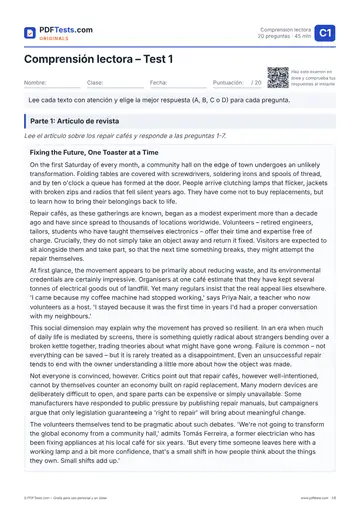
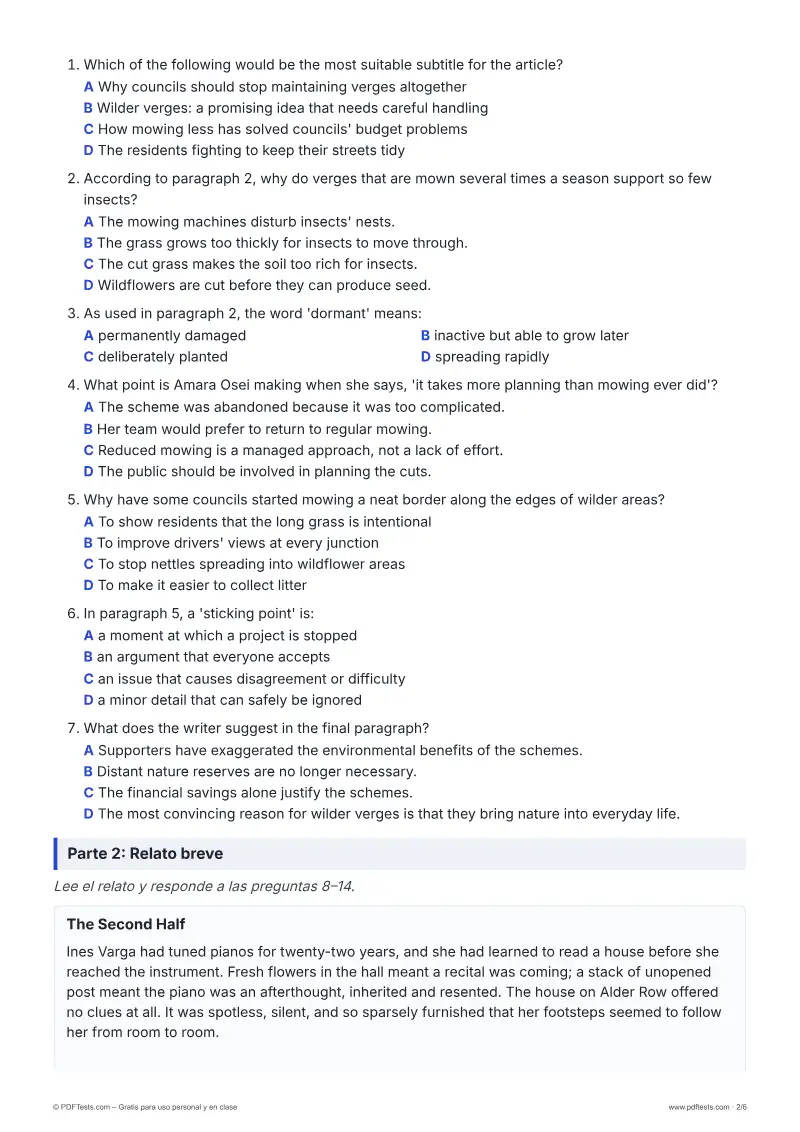
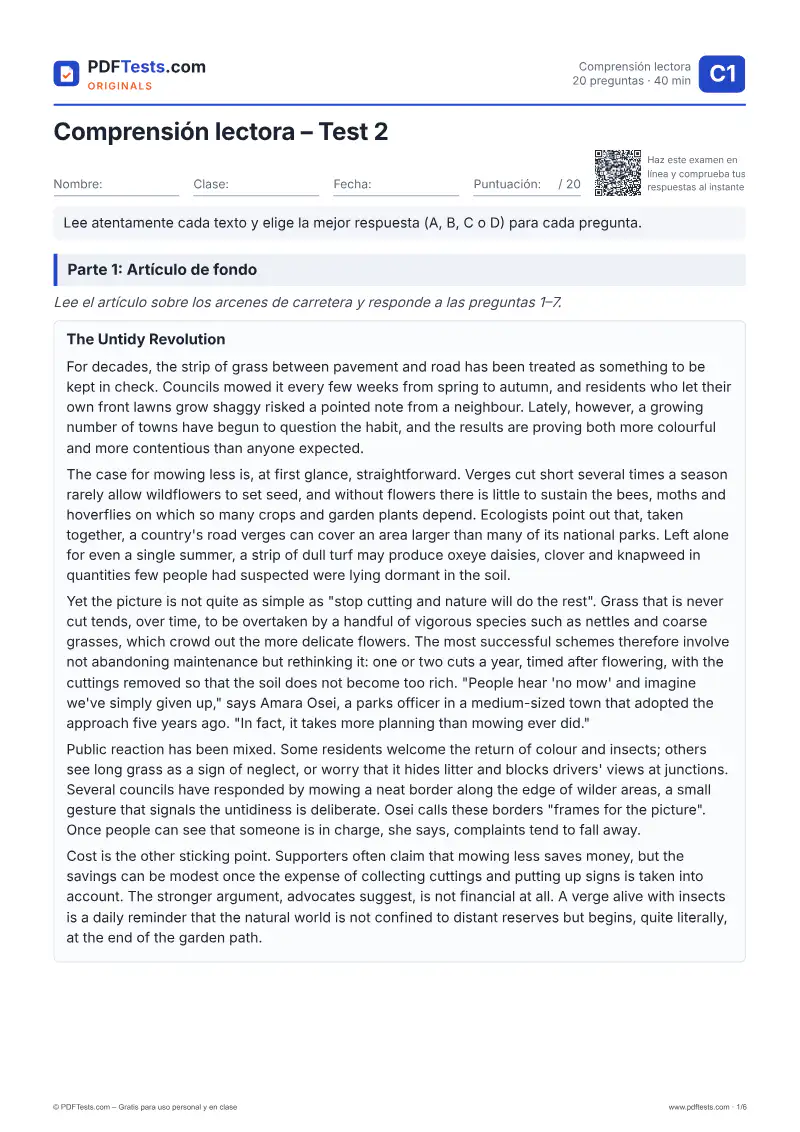
Vista previa de la página 1: Comprensión lectora – Test 2 Abrir PDF

Haz el examen en línea

Lee atentamente cada texto y elige la mejor respuesta (A, B, C o D) para cada pregunta. Elige tus respuestas y pulsa «Comprobar respuestas».

Parte 1: Artículo de fondo

Lee el artículo sobre los arcenes de carretera y responde a las preguntas 1–7.

The Untidy Revolution

For decades, the strip of grass between pavement and road has been treated as something to be kept in check. Councils mowed it every few weeks from spring to autumn, and residents who let their own front lawns grow shaggy risked a pointed note from a neighbour. Lately, however, a growing number of towns have begun to question the habit, and the results are proving both more colourful and more contentious than anyone expected.

The case for mowing less is, at first glance, straightforward. Verges cut short several times a season rarely allow wildflowers to set seed, and without flowers there is little to sustain the bees, moths and hoverflies on which so many crops and garden plants depend. Ecologists point out that, taken together, a country's road verges can cover an area larger than many of its national parks. Left alone for even a single summer, a strip of dull turf may produce oxeye daisies, clover and knapweed in quantities few people had suspected were lying dormant in the soil.

Yet the picture is not quite as simple as "stop cutting and nature will do the rest". Grass that is never cut tends, over time, to be overtaken by a handful of vigorous species such as nettles and coarse grasses, which crowd out the more delicate flowers. The most successful schemes therefore involve not abandoning maintenance but rethinking it: one or two cuts a year, timed after flowering, with the cuttings removed so that the soil does not become too rich. "People hear 'no mow' and imagine we've simply given up," says Amara Osei, a parks officer in a medium-sized town that adopted the approach five years ago. "In fact, it takes more planning than mowing ever did."

Public reaction has been mixed. Some residents welcome the return of colour and insects; others see long grass as a sign of neglect, or worry that it hides litter and blocks drivers' views at junctions. Several councils have responded by mowing a neat border along the edge of wilder areas, a small gesture that signals the untidiness is deliberate. Osei calls these borders "frames for the picture". Once people can see that someone is in charge, she says, complaints tend to fall away.

Cost is the other sticking point. Supporters often claim that mowing less saves money, but the savings can be modest once the expense of collecting cuttings and putting up signs is taken into account. The stronger argument, advocates suggest, is not financial at all. A verge alive with insects is a daily reminder that the natural world is not confined to distant reserves but begins, quite literally, at the end of the garden path.

  1. Which of the following would be the most suitable subtitle for the article?

  2. According to paragraph 2, why do verges that are mown several times a season support so few insects?

  3. As used in paragraph 2, the word 'dormant' means:

  4. What point is Amara Osei making when she says, 'it takes more planning than mowing ever did'?

  5. Why have some councils started mowing a neat border along the edges of wilder areas?

  6. In paragraph 5, a 'sticking point' is:

  7. What does the writer suggest in the final paragraph?

Parte 2: Relato breve

Lee el relato y responde a las preguntas 8–14.

The Second Half

Ines Varga had tuned pianos for twenty-two years, and she had learned to read a house before she reached the instrument. Fresh flowers in the hall meant a recital was coming; a stack of unopened post meant the piano was an afterthought, inherited and resented. The house on Alder Row offered no clues at all. It was spotless, silent, and so sparsely furnished that her footsteps seemed to follow her from room to room.

Mr Okafor led her into a back room where an upright piano stood against the wall, its lid closed, a lace runner laid across the top as carefully as a tablecloth set for guests. "It hasn't been touched in some time," he said, which Ines soon discovered was an understatement. Several keys stuck, and the middle register had drifted so far flat that a simple chord sounded like an argument. She told him, gently, that it would take two visits, perhaps three.

"Whatever it needs," he said, and withdrew to the kitchen.

She worked for most of the afternoon. Tuning is not, as people imagine, a matter of a good ear alone; it is a long negotiation between tension and patience, each string coaxed a fraction at a time towards a pitch it would rather not hold. Ines liked the solitude of it. Clients usually hovered at first and then lost interest, but Mr Okafor did not reappear once. Only the occasional clink of a cup told her he was still in the house.

When she had finished the rough tuning, she played a few scales to test the instrument. Then, almost without deciding to, she played the opening bars of a slow waltz she had learned as a girl. Behind her, the door creaked. Mr Okafor was standing in the doorway, one hand on the frame, as though he needed it.

"My wife used to play that," he said. "Not well. She always rushed the second half."

Ines stopped. "I'm sorry. I didn't mean to—"

"No." He shook his head. "Please. I haven't heard it in this house for nine years. I kept meaning to have the piano sold. Then I kept meaning to have it tuned. I think I was waiting to find out which I meant."

She did not ask which he had decided. She turned back to the keys and played the waltz through to the end, and when she reached the second half, she rushed it, just slightly, the way she imagined someone else once had.

He did not speak when she had finished. But before she left, he booked the second appointment, and the third, and wrote them both on the calendar by the door in careful capitals.

  1. What does the first paragraph suggest about Ines?

  2. What is meant by 'which Ines soon discovered was an understatement'?

  3. The description of tuning as 'a long negotiation between tension and patience' suggests that tuning…

  4. Mr Okafor stands 'one hand on the frame, as though he needed it'. This suggests that he…

  5. What does Mr Okafor mean when he says, 'I think I was waiting to find out which I meant'?

  6. Why does Ines rush the second half of the waltz?

  7. What does the final paragraph imply?

Parte 3: Reseña de una exposición

Lee la reseña y responde a las preguntas 15–20.

Exhibition review: The Edges of the Map

Exhibitions about maps face a peculiar problem. Their subject is, by definition, designed to be useful rather than beautiful, and visitors who have found their way to the gallery using a phone may wonder why anyone would linger over a chart of a coastline drawn three centuries ago. "The Edges of the Map", showing at the Riverside Gallery until the end of March, answers that question more convincingly than most, though not without the occasional misstep.

The premise is a clever one. Rather than presenting maps as triumphs of accuracy, the curators have chosen to focus on what each map leaves out, distorts or simply invents. The first room sets the tone: a series of early sea charts in which confidently drawn harbours give way, a few centimetres inland, to blank space, decorative creatures and the occasional optimistic guess at a mountain range. A wall caption notes, drily, that one of these imaginary ranges remained on published maps for almost a hundred years, copied faithfully from one atlas to the next by mapmakers who had never been anywhere near it.

It is in the second and third rooms that the exhibition really finds its voice. Here, the focus shifts from ignorance to choice. A pair of city plans drawn a decade apart show the same neighbourhood, but in the later version an entire district of small workshops has vanished. It was not demolished; the authority that commissioned the map simply no longer considered it worth recording. Nearby, a transport map is displayed beside a satellite image of the same area, revealing how much the familiar diagram stretches, straightens and simplifies in the interests of clarity. The effect is quietly unsettling. One leaves with the sense that every map, however neutral it appears, is an argument about what matters.

The final room is less successful. Devoted to digital mapping, it relies heavily on touchscreens and projections that feel rushed compared with the carefully paced galleries before it. A wall of screens showing real-time location data is striking for a moment, but the accompanying text gestures at questions of privacy without ever properly engaging with them. Given the thoughtfulness elsewhere, this is a missed opportunity rather than a fatal flaw.

These reservations aside, the exhibition is a genuine pleasure, and it rewards slow viewing. Visitors expecting a celebration of human ingenuity will certainly find one. They may also find themselves looking at the map on their phone a little differently on the way home.

  1. According to the first paragraph, what 'peculiar problem' do exhibitions about maps face?

  2. Why does the reviewer mention the imaginary mountain range?

  3. According to the review, why is the district of workshops missing from the later city plan?

  4. What does the reviewer mean by 'every map, however neutral it appears, is an argument about what matters'?

  5. The phrase 'gestures at questions of privacy' in paragraph 4 suggests that the text in the final room…

  6. Which best summarises the reviewer's overall opinion of the exhibition?

Vista previa

Sobre este examen

Este test de comprensión lectora de nivel C1 incluye tres textos originales de unas 400–500 palabras cada uno: un artículo de fondo sobre los arcenes de carretera más silvestres, un relato literario breve y una reseña de una exposición. Sus 20 preguntas de opción múltiple evalúan la idea general, los detalles, las inferencias, la actitud del autor y el vocabulario en contexto. Está pensado para alumnos de nivel avanzado que preparan exámenes de nivel C1 y para profesores que necesitan una evaluación lista para usar.

Temas

Comprensión global (idea general)Comprensión detalladaInferenciaVocabulario en contextoActitud y tono del autorInterpretación literaria

Cómo usar este examen

  1. Descarga el PDF e imprímelo, o haz el examen en línea más abajo.
  2. Responde todas las preguntas sin diccionario y sin prisas.
  3. Comprueba tus respuestas y apunta los temas que debes repasar.

Notas para el profesor

Puede utilizar el test como evaluación cronometrada o trabajar una parte por clase como práctica de lectura intensiva. Muchos distractores son afirmaciones parcialmente ciertas o que repiten palabras del texto. Están pensados para detectar a los alumnos que se limitan a buscar coincidencias de vocabulario en lugar de seguir el razonamiento del autor, o que interpretan literalmente el lenguaje figurado. Como actividad de seguimiento, pida a los alumnos que subrayen en el texto la prueba de cada respuesta y comenten después cómo el artículo, el relato y la reseña transmiten la actitud de forma distinta.