PDFTests Originals

Vocabulario académico – Test 1

C1 Avanzado VocabularioInglés

Este test de nivel C1 evalúa el vocabulario necesario para leer y redactar textos académicos en inglés. Abarca el significado en contexto, las colocaciones académicas más habituales y la formación de palabras dentro de una misma familia léxica. Está pensado para estudiantes avanzados que se preparan para estudiar en la universidad o para exámenes como IELTS y C1 Advanced, así como para profesores de cursos de inglés académico (EAP).
Preguntas
30
Tiempo
30 min
PDF
5 páginas
Soluciones
Incluidas
  • 100 % gratis
  • Sin registro
  • PDF A4 listo para imprimir
Vista previa de la página 1: Vocabulario académico – Test 1 Abrir PDF

Haz el examen en línea

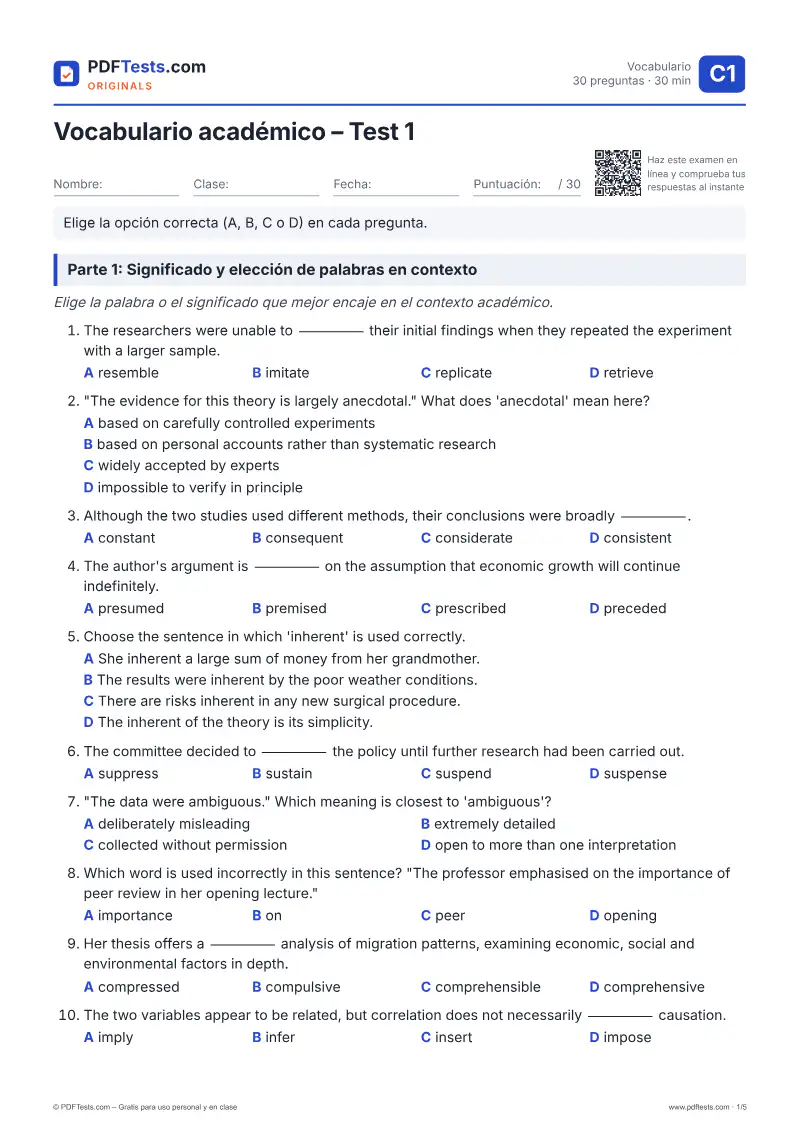
Elige la opción correcta (A, B, C o D) en cada pregunta. Elige tus respuestas y pulsa «Comprobar respuestas».

Parte 1: Significado y elección de palabras en contexto

Elige la palabra o el significado que mejor encaje en el contexto académico.

  1. The researchers were unable to _____ their initial findings when they repeated the experiment with a larger sample.

  2. "The evidence for this theory is largely anecdotal." What does 'anecdotal' mean here?

  3. Although the two studies used different methods, their conclusions were broadly _____.

  4. The author's argument is _____ on the assumption that economic growth will continue indefinitely.

  5. Choose the sentence in which 'inherent' is used correctly.

  6. The committee decided to _____ the policy until further research had been carried out.

  7. "The data were ambiguous." Which meaning is closest to 'ambiguous'?

  8. Which word is used incorrectly in this sentence? "The professor emphasised on the importance of peer review in her opening lecture."

  9. Her thesis offers a _____ analysis of migration patterns, examining economic, social and environmental factors in depth.

  10. The two variables appear to be related, but correlation does not necessarily _____ causation.

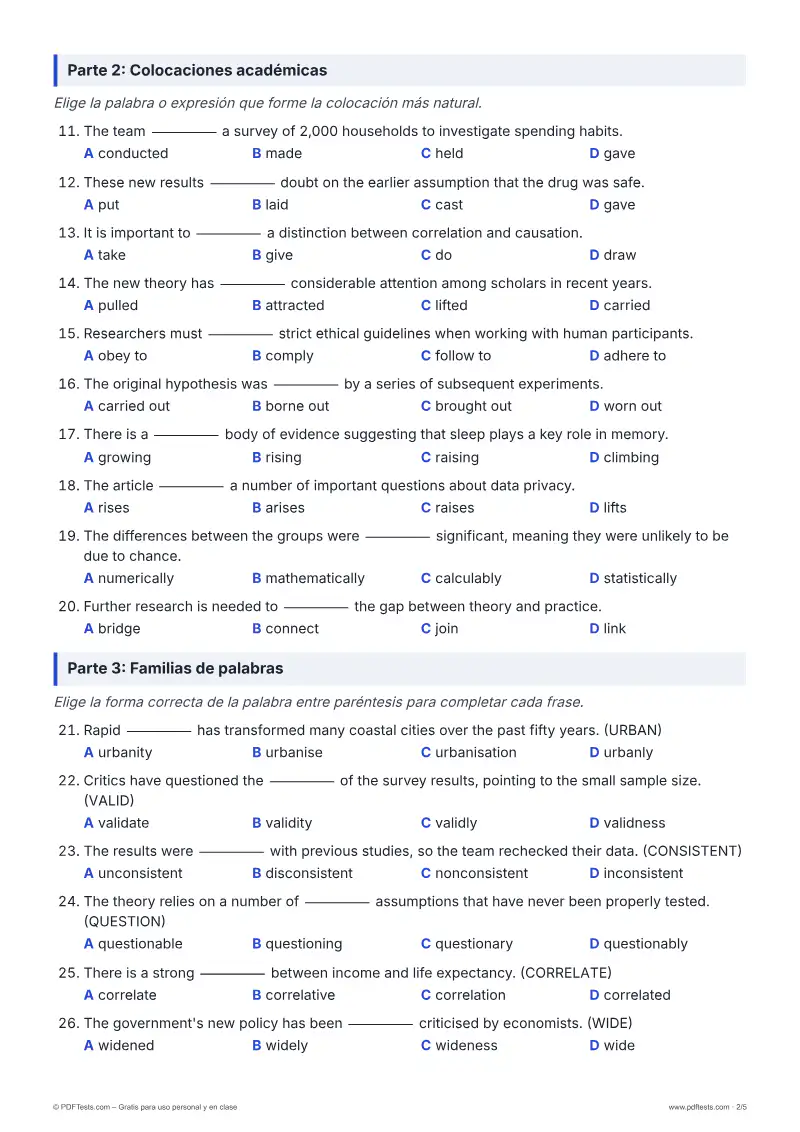
Parte 2: Colocaciones académicas

Elige la palabra o expresión que forme la colocación más natural.

  1. The team _____ a survey of 2,000 households to investigate spending habits.

  2. These new results _____ doubt on the earlier assumption that the drug was safe.

  3. It is important to _____ a distinction between correlation and causation.

  4. The new theory has _____ considerable attention among scholars in recent years.

  5. Researchers must _____ strict ethical guidelines when working with human participants.

  6. The original hypothesis was _____ by a series of subsequent experiments.

  7. There is a _____ body of evidence suggesting that sleep plays a key role in memory.

  8. The article _____ a number of important questions about data privacy.

  9. The differences between the groups were _____ significant, meaning they were unlikely to be due to chance.

  10. Further research is needed to _____ the gap between theory and practice.

Parte 3: Familias de palabras

Elige la forma correcta de la palabra entre paréntesis para completar cada frase.

  1. Rapid _____ has transformed many coastal cities over the past fifty years. (URBAN)

  2. Critics have questioned the _____ of the survey results, pointing to the small sample size. (VALID)

  3. The results were _____ with previous studies, so the team rechecked their data. (CONSISTENT)

  4. The theory relies on a number of _____ assumptions that have never been properly tested. (QUESTION)

  5. There is a strong _____ between income and life expectancy. (CORRELATE)

  6. The government's new policy has been _____ criticised by economists. (WIDE)

  7. Researchers must ensure the _____ of participants' personal data. (CONFIDENTIAL)

  8. Her findings _____ the claim that bilingual children develop better problem-solving skills. (STRONG)

  9. The sample was not _____ of the wider population, so the conclusions cannot be generalised. (REPRESENT)

  10. The author's argument is rather _____ because it ignores several key factors. (SIMPLE)

Vista previa

Sobre este examen

Este test de nivel C1 evalúa el vocabulario necesario para leer y redactar textos académicos en inglés. Abarca el significado en contexto, las colocaciones académicas más habituales y la formación de palabras dentro de una misma familia léxica. Está pensado para estudiantes avanzados que se preparan para estudiar en la universidad o para exámenes como IELTS y C1 Advanced, así como para profesores de cursos de inglés académico (EAP).

Temas

Vocabulario académicoSignificado en contextoColocaciones (collocations)Familias de palabras (word families)Formación de palabrasPalabras que se confunden

Cómo usar este examen

  1. Descarga el PDF e imprímelo, o haz el examen en línea más abajo.
  2. Responde todas las preguntas sin diccionario y sin prisas.
  3. Comprueba tus respuestas y apunta los temas que debes repasar.

Notas para el profesor

Puede usar el test como prueba diagnóstica al comienzo de un curso de inglés académico (EAP) o como repaso tras trabajar la redacción académica. Se centra en errores típicos del nivel C1, como confundir palabras de forma parecida (imply/infer, comprehensive/comprehensible), añadir preposiciones innecesarias (emphasise on) o elegir el verbo equivocado en colocaciones fijas (cast doubt, draw a distinction). Como actividad de seguimiento, pida a los alumnos que redacten sus propias frases académicas con las colocaciones de la Parte 2. También pueden elaborar tablas completas de familias de palabras con los términos de la Parte 3.