PDFTests Originals

Comprensión lectora – Test 1

C1 Avanzado Comprensión lectoraInglés

Este test de comprensión lectora de nivel C1 incluye tres textos originales de géneros distintos: un artículo de revista, un relato literario y un correo electrónico formal del ámbito laboral. Las 20 preguntas de opción múltiple evalúan la comprensión global, los detalles, la inferencia, la actitud del autor y el vocabulario en contexto. Es ideal para estudiantes avanzados que preparan exámenes de nivel C1 y para docentes que necesitan una prueba lista para imprimir.

Preguntas
20
Tiempo
45 min
PDF
6 páginas
Soluciones
Incluidas
  • 100 % gratis
  • Sin registro
  • PDF A4 listo para imprimir
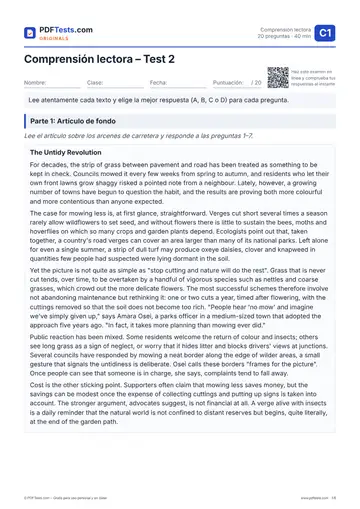
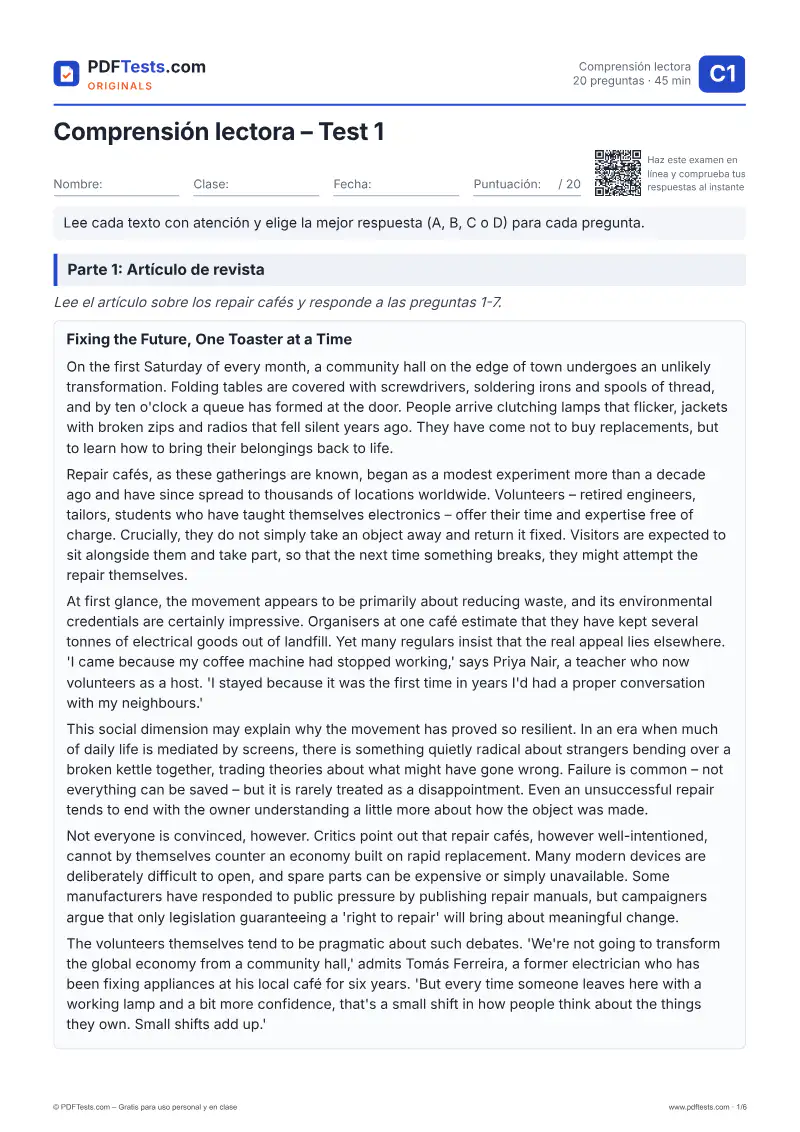
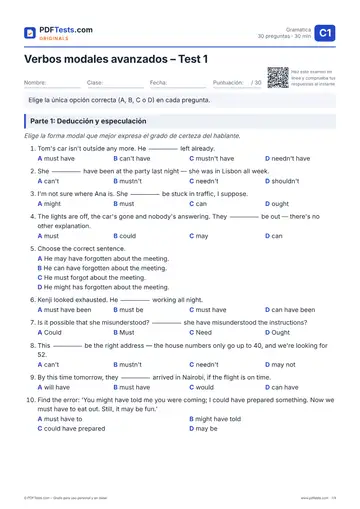
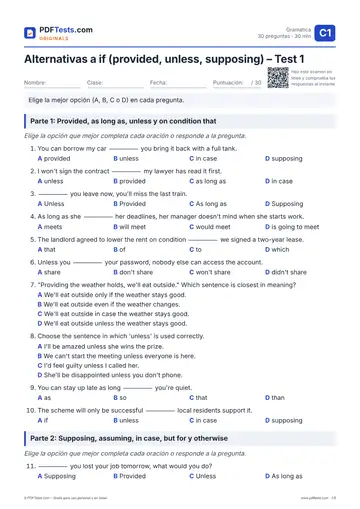
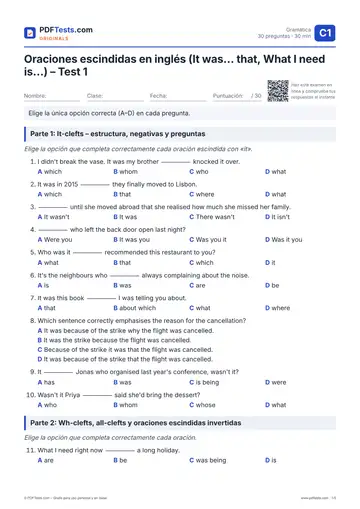
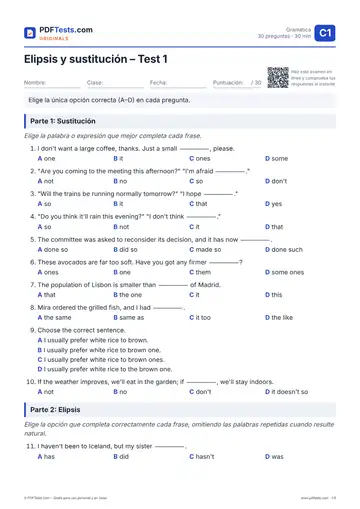
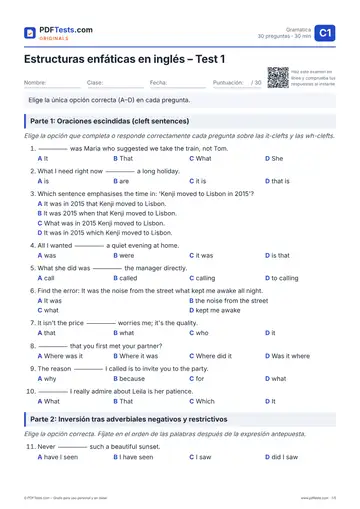
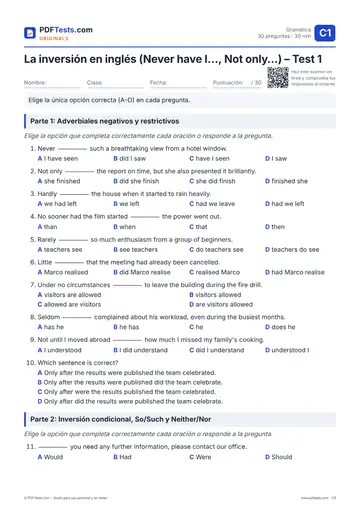
Vista previa de la página 1: Comprensión lectora – Test 1 Abrir PDF

Haz el examen en línea

Lee cada texto con atención y elige la mejor respuesta (A, B, C o D) para cada pregunta. Elige tus respuestas y pulsa «Comprobar respuestas».

Parte 1: Artículo de revista

Lee el artículo sobre los repair cafés y responde a las preguntas 1-7.

Fixing the Future, One Toaster at a Time

On the first Saturday of every month, a community hall on the edge of town undergoes an unlikely transformation. Folding tables are covered with screwdrivers, soldering irons and spools of thread, and by ten o'clock a queue has formed at the door. People arrive clutching lamps that flicker, jackets with broken zips and radios that fell silent years ago. They have come not to buy replacements, but to learn how to bring their belongings back to life.

Repair cafés, as these gatherings are known, began as a modest experiment more than a decade ago and have since spread to thousands of locations worldwide. Volunteers – retired engineers, tailors, students who have taught themselves electronics – offer their time and expertise free of charge. Crucially, they do not simply take an object away and return it fixed. Visitors are expected to sit alongside them and take part, so that the next time something breaks, they might attempt the repair themselves.

At first glance, the movement appears to be primarily about reducing waste, and its environmental credentials are certainly impressive. Organisers at one café estimate that they have kept several tonnes of electrical goods out of landfill. Yet many regulars insist that the real appeal lies elsewhere. 'I came because my coffee machine had stopped working,' says Priya Nair, a teacher who now volunteers as a host. 'I stayed because it was the first time in years I'd had a proper conversation with my neighbours.'

This social dimension may explain why the movement has proved so resilient. In an era when much of daily life is mediated by screens, there is something quietly radical about strangers bending over a broken kettle together, trading theories about what might have gone wrong. Failure is common – not everything can be saved – but it is rarely treated as a disappointment. Even an unsuccessful repair tends to end with the owner understanding a little more about how the object was made.

Not everyone is convinced, however. Critics point out that repair cafés, however well-intentioned, cannot by themselves counter an economy built on rapid replacement. Many modern devices are deliberately difficult to open, and spare parts can be expensive or simply unavailable. Some manufacturers have responded to public pressure by publishing repair manuals, but campaigners argue that only legislation guaranteeing a 'right to repair' will bring about meaningful change.

The volunteers themselves tend to be pragmatic about such debates. 'We're not going to transform the global economy from a community hall,' admits Tomás Ferreira, a former electrician who has been fixing appliances at his local café for six years. 'But every time someone leaves here with a working lamp and a bit more confidence, that's a small shift in how people think about the things they own. Small shifts add up.'

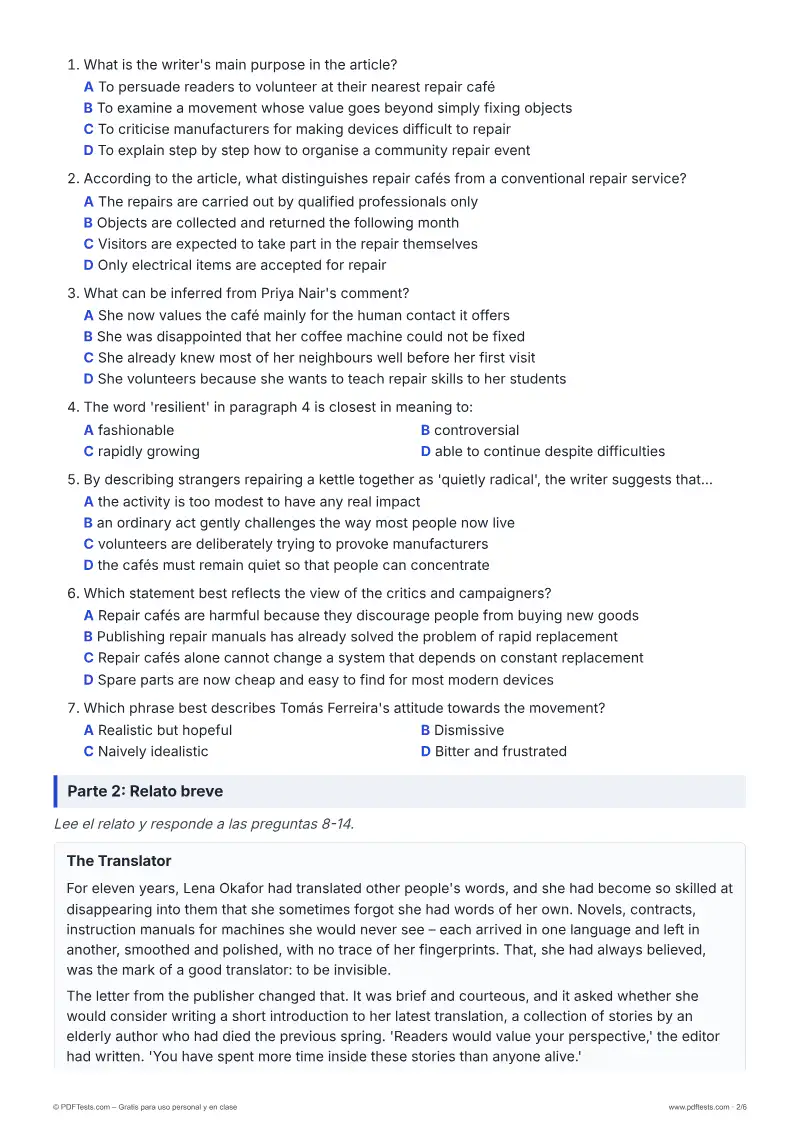
  1. What is the writer's main purpose in the article?

  2. According to the article, what distinguishes repair cafés from a conventional repair service?

  3. What can be inferred from Priya Nair's comment?

  4. The word 'resilient' in paragraph 4 is closest in meaning to:

  5. By describing strangers repairing a kettle together as 'quietly radical', the writer suggests that…

  6. Which statement best reflects the view of the critics and campaigners?

  7. Which phrase best describes Tomás Ferreira's attitude towards the movement?

Parte 2: Relato breve

Lee el relato y responde a las preguntas 8-14.

The Translator

For eleven years, Lena Okafor had translated other people's words, and she had become so skilled at disappearing into them that she sometimes forgot she had words of her own. Novels, contracts, instruction manuals for machines she would never see – each arrived in one language and left in another, smoothed and polished, with no trace of her fingerprints. That, she had always believed, was the mark of a good translator: to be invisible.

The letter from the publisher changed that. It was brief and courteous, and it asked whether she would consider writing a short introduction to her latest translation, a collection of stories by an elderly author who had died the previous spring. 'Readers would value your perspective,' the editor had written. 'You have spent more time inside these stories than anyone alive.'

Lena read the sentence several times. It was true, of course, and yet it unsettled her. She had spent eight months with those stories, arguing with their author in her head over the meaning of a single verb, waking at night convinced she had misjudged the tone of an ending. She knew the author's habits as intimately as she knew her own: his fondness for weather, his reluctance to let any character be entirely happy, the way his sentences grew longer whenever he wrote about the sea. But to set all that down under her own name felt like stepping onto a stage after years in the prompter's box.

She began the introduction four times. The first draft was a dry list of facts – dates, titles, prizes – that could have been written by anyone. The second was so full of praise that it read like an advertisement. The third, which she abandoned halfway through, was mostly about herself, and she deleted it with a shiver of embarrassment.

On the fourth attempt, she stopped trying to explain the author and wrote instead about a single problem she had never solved. In one story, a fisherman's wife says a word to her husband that, in the original, means both 'stay' and 'wait'. There was no equivalent in English. Lena had chosen 'wait', and for eight months she had wondered whether the woman was really asking her husband to stay.

She wrote about that word for two pages. She admitted that she did not know the answer, and that perhaps the author had not known either. When she had finished, she read it aloud in her empty kitchen, and for the first time in eleven years she heard a voice that was unmistakably her own.

She sent it to the editor before she could change her mind.

  1. At the beginning of the story, Lena believes that a good translator should…

  2. Why did the editor's sentence unsettle Lena?

  3. What does the phrase 'stepping onto a stage after years in the prompter's box' suggest about Lena?

  4. Why did Lena delete her third draft?

  5. Which of the following is true about the author's writing, according to the story?

  6. What made the fourth draft different from the others?

  7. The final sentence, 'She sent it to the editor before she could change her mind', implies that Lena…

Parte 3: Correo electrónico laboral

Lee el correo electrónico y responde a las preguntas 15-20.

Subject: Proposed changes to the shared project space

Dear colleagues,

As many of you will be aware, the working group set up in the spring to review how we use the third-floor project space has now completed its consultation. I'd like to thank everyone who completed the survey or attended one of the drop-in sessions; over seventy of you took part, which is considerably more than we had anticipated.

The headline finding will probably come as no surprise. While the open layout was originally intended to encourage collaboration between departments, most respondents told us that it now does the opposite. Noise levels make focused work difficult, meeting rooms are booked weeks in advance, and several people admitted that they now avoid the space altogether, preferring to work from home on days when they need to concentrate. In other words, a facility designed to bring people together has, in practice, been driving some of them away.

On the basis of these findings, the working group is proposing three changes, which we intend to trial for an initial period of three months from the start of next term.

First, the eastern end of the floor will be designated a quiet zone, where phone calls and conversations will not be permitted. Second, two of the larger meeting rooms will no longer be available for advance booking and will instead operate on a first-come, first-served basis, so that informal discussions can take place without weeks of planning. Third, we will introduce a 'collaboration morning' every Wednesday, during which teams are encouraged to be on site at the same time.

I should stress that none of these measures is final. The trial is precisely that – an opportunity to test our assumptions before committing to any permanent alterations, some of which would involve significant cost. We are particularly keen to hear from colleagues whose working patterns may not fit neatly into the proposed arrangements, such as those with caring responsibilities or those who work part-time, as we are conscious that a single approach is unlikely to suit everyone.

A short feedback form will be circulated at the end of each month of the trial. In the meantime, if you have any immediate concerns, please don't hesitate to contact me directly or to raise them with your department's representative on the working group.

I recognise that changes to a shared space can be unsettling, and that some of you have grown used to working in particular ways. I hope, however, that you will approach the trial in a spirit of openness. If it doesn't work, we will say so and try something else.

With best wishes,

Amara Lindqvist

Facilities and Workplace Coordinator

  1. What is the main purpose of the email?

  2. According to the email, what was the key problem identified by the consultation?

  3. Why will two of the larger meeting rooms no longer be bookable in advance?

  4. In paragraph 4, the word 'designated' is closest in meaning to:

  5. Why does the writer mention colleagues with caring responsibilities or part-time contracts?

  6. Which best describes the tone of the final paragraph?

Vista previa

Sobre este examen

Este test de comprensión lectora de nivel C1 incluye tres textos originales de géneros distintos: un artículo de revista, un relato literario y un correo electrónico formal del ámbito laboral. Las 20 preguntas de opción múltiple evalúan la comprensión global, los detalles, la inferencia, la actitud del autor y el vocabulario en contexto. Es ideal para estudiantes avanzados que preparan exámenes de nivel C1 y para docentes que necesitan una prueba lista para imprimir.

Temas

Comprensión lectoraIdea general e idea principalInferenciaVocabulario en contextoActitud y tono del autorLenguaje figurado

Cómo usar este examen

  1. Descarga el PDF e imprímelo, o haz el examen en línea más abajo.
  2. Responde todas las preguntas sin diccionario y sin prisas.
  3. Comprueba tus respuestas y apunta los temas que debes repasar.

Notas para el profesor

Dé a los alumnos unos 15 minutos por texto, o utilice una sola parte como actividad breve en clase. Muchas preguntas se centran en trampas típicas del nivel C1: opciones que repiten palabras del texto pero distorsionan su sentido, y lecturas literales de lenguaje figurado como 'quietly radical' o 'the prompter's box'. Después, pida a los alumnos que localicen y subrayen la evidencia exacta que justifica cada respuesta. Como actividad de ampliación, pueden redactar una respuesta al correo electrónico o un breve párrafo de opinión sobre la cultura de la reparación.