PDFTests Originals

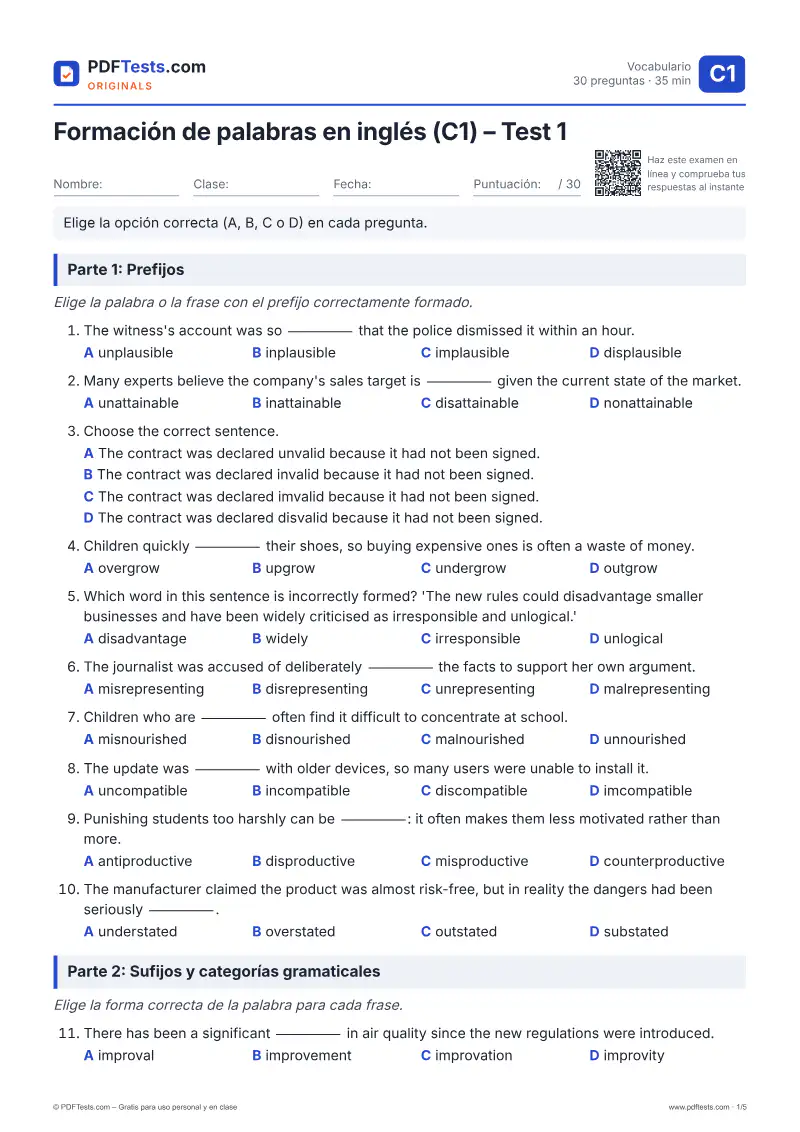
Formación de palabras en inglés (C1) – Test 1

C1 Avanzado VocabularioInglés

Este test de vocabulario de nivel C1 evalúa tu capacidad para formar y elegir la forma correcta de una palabra en inglés. Abarca prefijos negativos y prefijos que cambian el significado, sufijos de sustantivos, adjetivos, verbos y adverbios, así como la formación de palabras dentro de un texto completo. Está pensado para estudiantes de nivel avanzado que preparan exámenes de nivel C1 y para profesores que buscan un test listo para usar en clase o como tarea.
Preguntas
30
Tiempo
35 min
PDF
5 páginas
Soluciones
Incluidas
  • 100 % gratis
  • Sin registro
  • PDF A4 listo para imprimir
Vista previa de la página 1: Formación de palabras en inglés (C1) – Test 1 Abrir PDF

Haz el examen en línea

Elige la opción correcta (A, B, C o D) en cada pregunta. Elige tus respuestas y pulsa «Comprobar respuestas».

Parte 1: Prefijos

Elige la palabra o la frase con el prefijo correctamente formado.

  1. The witness's account was so _____ that the police dismissed it within an hour.

  2. Many experts believe the company's sales target is _____ given the current state of the market.

  3. Choose the correct sentence.

  4. Children quickly _____ their shoes, so buying expensive ones is often a waste of money.

  5. Which word in this sentence is incorrectly formed? 'The new rules could disadvantage smaller businesses and have been widely criticised as irresponsible and unlogical.'

  6. The journalist was accused of deliberately _____ the facts to support her own argument.

  7. Children who are _____ often find it difficult to concentrate at school.

  8. The update was _____ with older devices, so many users were unable to install it.

  9. Punishing students too harshly can be _____: it often makes them less motivated rather than more.

  10. The manufacturer claimed the product was almost risk-free, but in reality the dangers had been seriously _____.

Parte 2: Sufijos y categorías gramaticales

Elige la forma correcta de la palabra para cada frase.

  1. There has been a significant _____ in air quality since the new regulations were introduced.

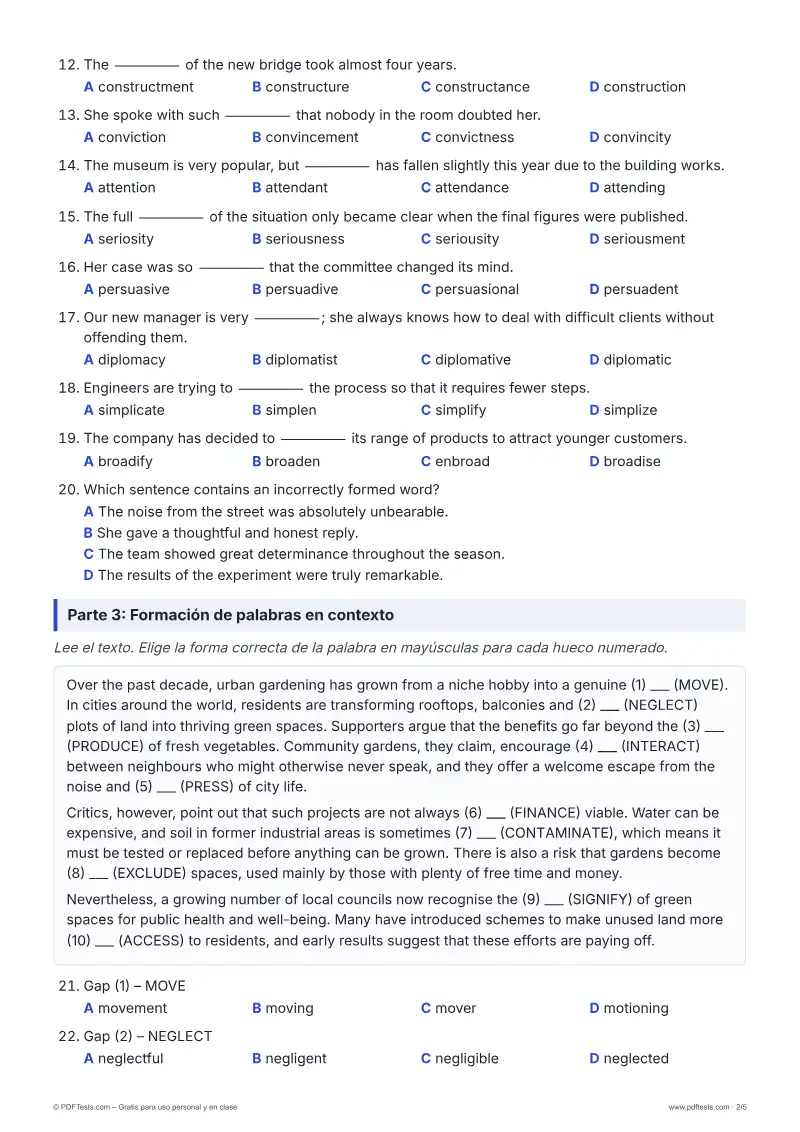
  2. The _____ of the new bridge took almost four years.

  3. She spoke with such _____ that nobody in the room doubted her.

  4. The museum is very popular, but _____ has fallen slightly this year due to the building works.

  5. The full _____ of the situation only became clear when the final figures were published.

  6. Her case was so _____ that the committee changed its mind.

  7. Our new manager is very _____; she always knows how to deal with difficult clients without offending them.

  8. Engineers are trying to _____ the process so that it requires fewer steps.

  9. The company has decided to _____ its range of products to attract younger customers.

  10. Which sentence contains an incorrectly formed word?

Parte 3: Formación de palabras en contexto

Lee el texto. Elige la forma correcta de la palabra en mayúsculas para cada hueco numerado.

Over the past decade, urban gardening has grown from a niche hobby into a genuine (1) ___ (MOVE). In cities around the world, residents are transforming rooftops, balconies and (2) ___ (NEGLECT) plots of land into thriving green spaces. Supporters argue that the benefits go far beyond the (3) ___ (PRODUCE) of fresh vegetables. Community gardens, they claim, encourage (4) ___ (INTERACT) between neighbours who might otherwise never speak, and they offer a welcome escape from the noise and (5) ___ (PRESS) of city life.

Critics, however, point out that such projects are not always (6) ___ (FINANCE) viable. Water can be expensive, and soil in former industrial areas is sometimes (7) ___ (CONTAMINATE), which means it must be tested or replaced before anything can be grown. There is also a risk that gardens become (8) ___ (EXCLUDE) spaces, used mainly by those with plenty of free time and money.

Nevertheless, a growing number of local councils now recognise the (9) ___ (SIGNIFY) of green spaces for public health and well-being. Many have introduced schemes to make unused land more (10) ___ (ACCESS) to residents, and early results suggest that these efforts are paying off.

  1. Gap (1) – MOVE

  2. Gap (2) – NEGLECT

  3. Gap (3) – PRODUCE

  4. Gap (4) – INTERACT

  5. Gap (5) – PRESS

  6. Gap (6) – FINANCE

  7. Gap (7) – CONTAMINATE

  8. Gap (8) – EXCLUDE

  9. Gap (9) – SIGNIFY

  10. Gap (10) – ACCESS

Vista previa

Sobre este examen

Este test de vocabulario de nivel C1 evalúa tu capacidad para formar y elegir la forma correcta de una palabra en inglés. Abarca prefijos negativos y prefijos que cambian el significado, sufijos de sustantivos, adjetivos, verbos y adverbios, así como la formación de palabras dentro de un texto completo. Está pensado para estudiantes de nivel avanzado que preparan exámenes de nivel C1 y para profesores que buscan un test listo para usar en clase o como tarea.

Temas

Prefijos negativosPrefijos que cambian el significadoSufijos de sustantivosSufijos de adjetivos y verbosFamilias de palabrasFormación de palabras en contexto

Cómo usar este examen

  1. Descarga el PDF e imprímelo, o haz el examen en línea más abajo.
  2. Responde todas las preguntas sin diccionario y sin prisas.
  3. Comprueba tus respuestas y apunta los temas que debes repasar.

Notas para el profesor

Utiliza este test después de trabajar los patrones de prefijos y sufijos, o como prueba diagnóstica antes de empezar la preparación de un examen C1. Se centra en errores típicos de los alumnos avanzados, como elegir el prefijo negativo equivocado (unlogical, inplausible), inventar sustantivos (determinance, improval) o confundir palabras de la misma familia (neglectful/negligent/negligible, exclusive/excluded). Como actividad de seguimiento, pide a los alumnos que elaboren tablas de familias de palabras con las palabras base de la Parte 3 y que escriban sus propias frases con huecos.