PDFTests Originals

Relative Clauses – Test 1

B1 Intermediate GrammarGerman

This 30-question B1 test practises German relative clauses. It covers relative pronouns in the nominative, accusative and dative, prepositions with relative pronouns, dessen/deren, was, wo and wer, and verb-final word order, including negation. It suits learners who are preparing for B1 exams and teachers who need a ready-made check of this topic.
Questions
30
Time
30 min
PDF
5 pages
Answer key
Included
  • 100% free
  • No sign-up or email
  • Print-ready A4 PDF
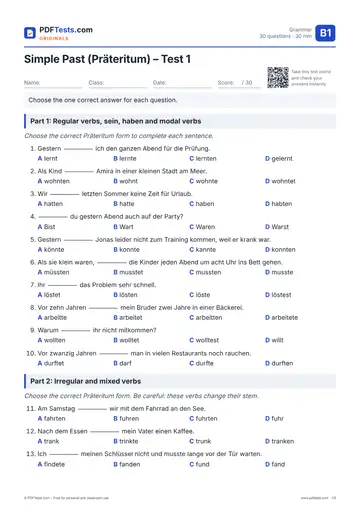
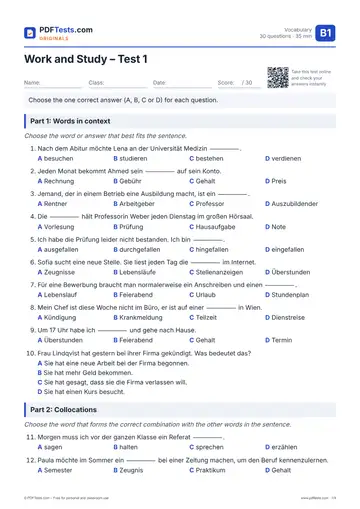
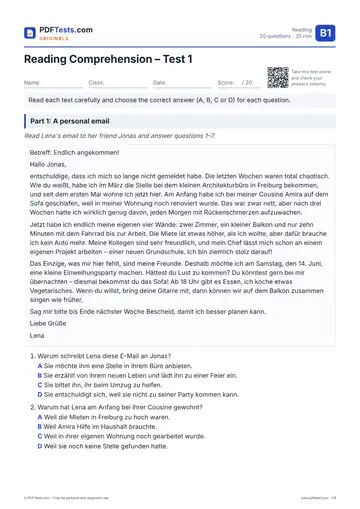
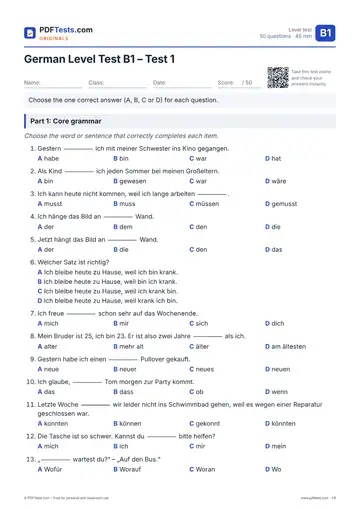
Preview of page 1 of Relative Clauses – Test 1 Open PDF

Take the test online

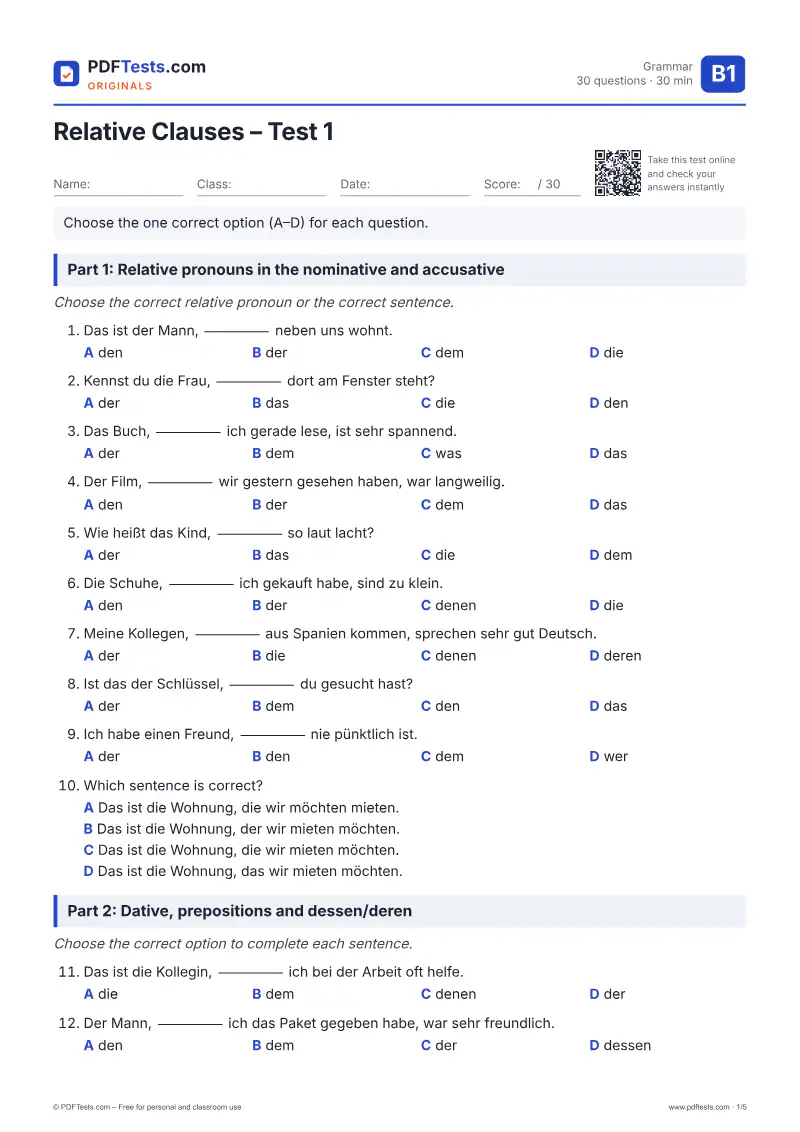
Choose the one correct option (A–D) for each question. Choose your answers, then press “Check my answers”.

Part 1: Relative pronouns in the nominative and accusative

Choose the correct relative pronoun or the correct sentence.

  1. Das ist der Mann, _____ neben uns wohnt.

  2. Kennst du die Frau, _____ dort am Fenster steht?

  3. Das Buch, _____ ich gerade lese, ist sehr spannend.

  4. Der Film, _____ wir gestern gesehen haben, war langweilig.

  5. Wie heißt das Kind, _____ so laut lacht?

  6. Die Schuhe, _____ ich gekauft habe, sind zu klein.

  7. Meine Kollegen, _____ aus Spanien kommen, sprechen sehr gut Deutsch.

  8. Ist das der Schlüssel, _____ du gesucht hast?

  9. Ich habe einen Freund, _____ nie pünktlich ist.

  10. Which sentence is correct?

Part 2: Dative, prepositions and dessen/deren

Choose the correct option to complete each sentence.

  1. Das ist die Kollegin, _____ ich bei der Arbeit oft helfe.

  2. Der Mann, _____ ich das Paket gegeben habe, war sehr freundlich.

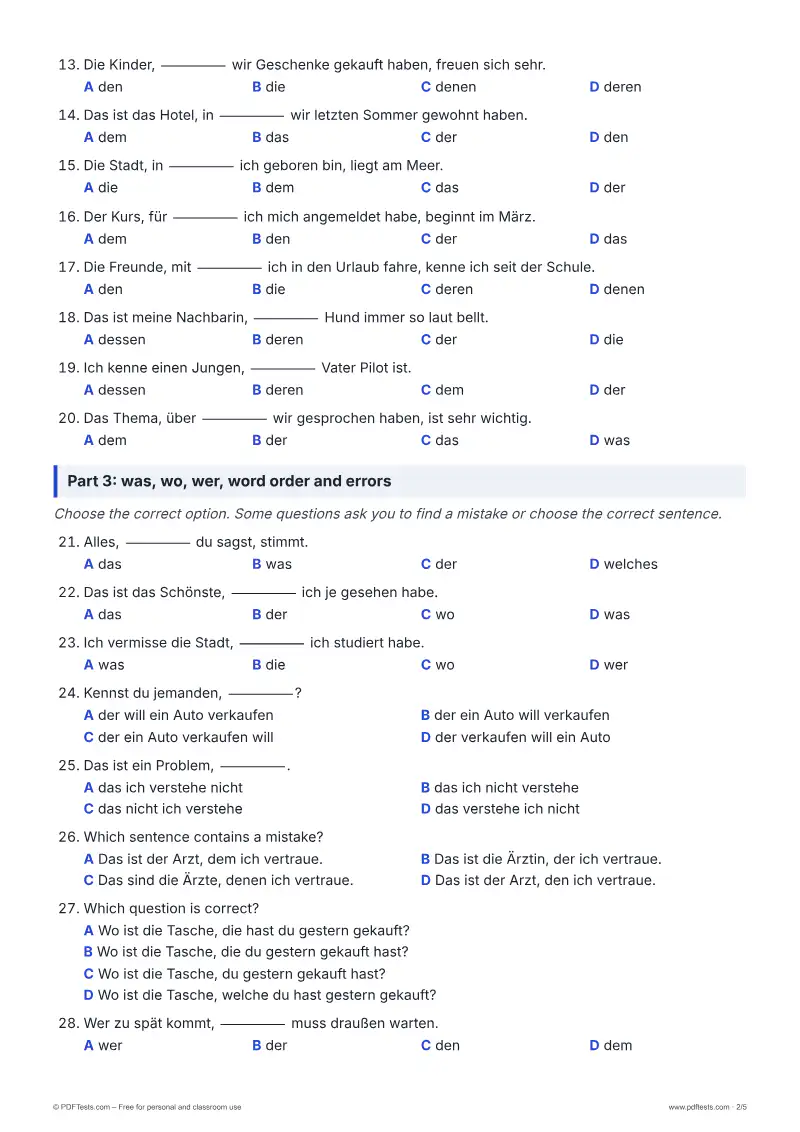
  3. Die Kinder, _____ wir Geschenke gekauft haben, freuen sich sehr.

  4. Das ist das Hotel, in _____ wir letzten Sommer gewohnt haben.

  5. Die Stadt, in _____ ich geboren bin, liegt am Meer.

  6. Der Kurs, für _____ ich mich angemeldet habe, beginnt im März.

  7. Die Freunde, mit _____ ich in den Urlaub fahre, kenne ich seit der Schule.

  8. Das ist meine Nachbarin, _____ Hund immer so laut bellt.

  9. Ich kenne einen Jungen, _____ Vater Pilot ist.

  10. Das Thema, über _____ wir gesprochen haben, ist sehr wichtig.

Part 3: was, wo, wer, word order and errors

Choose the correct option. Some questions ask you to find a mistake or choose the correct sentence.

  1. Alles, _____ du sagst, stimmt.

  2. Das ist das Schönste, _____ ich je gesehen habe.

  3. Ich vermisse die Stadt, _____ ich studiert habe.

  4. Kennst du jemanden, _____?

  5. Das ist ein Problem, _____.

  6. Which sentence contains a mistake?

  7. Which question is correct?

  8. Wer zu spät kommt, _____ muss draußen warten.

  9. „Welche Frau meinst du?“ – „_____“

  10. Join the sentences: „Ich habe eine Kollegin. Ihr Mann arbeitet in Wien.“ – Ich habe eine Kollegin, _____.

Preview

About this test

This 30-question B1 test practises German relative clauses. It covers relative pronouns in the nominative, accusative and dative, prepositions with relative pronouns, dessen/deren, was, wo and wer, and verb-final word order, including negation. It suits learners who are preparing for B1 exams and teachers who need a ready-made check of this topic.

Topics covered

Relative pronouns: nominative and accusativeDative relative pronounsPrepositions + relative pronounGenitive: dessen / derenwas, wo and werWord order and negation in relative clauses

How to use this test

  1. Download the PDF and print it, or take the test online below.
  2. Answer every question without a dictionary or time pressure.
  3. Check your answers and note the topics you need to review.

Notes for teachers

Use this test after teaching relative pronouns in all cases, or as a diagnostic before revising the topic. It targets common errors. These include using the nominative form when the accusative or dative is needed, using den or die instead of denen and der, confusing dessen and deren, using das instead of was after alles or superlatives, and putting the verb in second position instead of at the end. As a follow-up, students can describe classmates or objects in the room using relative clauses. Another option is to join pairs of simple sentences into one sentence with a relative clause.