PDFTests Originals

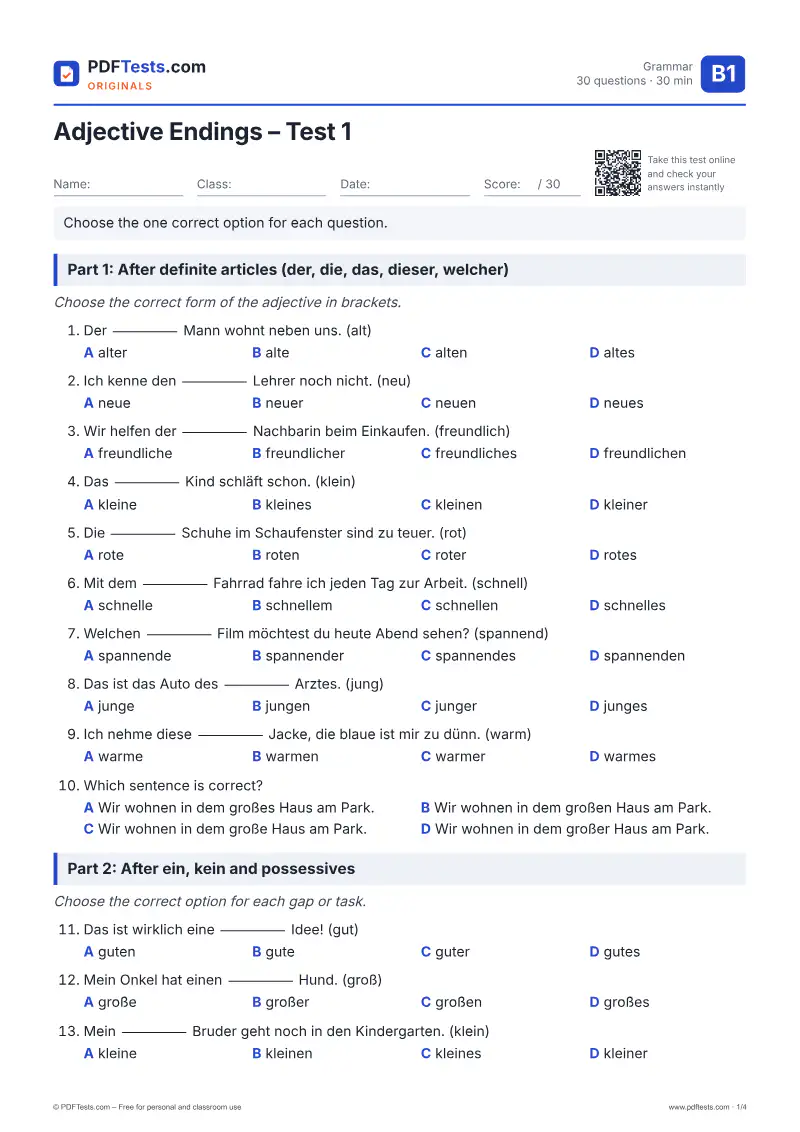
Adjective Endings – Test 1

B1 Intermediate GrammarGerman

This 30-question B1 grammar test checks German adjective endings after definite articles, indefinite articles, kein, possessives and with no article. It suits learners at intermediate level and teachers who want a quick, printable check of weak, mixed and strong declension in everyday contexts.
Questions
30
Time
30 min
PDF
4 pages
Answer key
Included
  • 100% free
  • No sign-up or email
  • Print-ready A4 PDF
Preview of page 1 of Adjective Endings – Test 1 Open PDF

Take the test online

Choose the one correct option for each question. Choose your answers, then press “Check my answers”.

Part 1: After definite articles (der, die, das, dieser, welcher)

Choose the correct form of the adjective in brackets.

  1. Der _____ Mann wohnt neben uns. (alt)

  2. Ich kenne den _____ Lehrer noch nicht. (neu)

  3. Wir helfen der _____ Nachbarin beim Einkaufen. (freundlich)

  4. Das _____ Kind schläft schon. (klein)

  5. Die _____ Schuhe im Schaufenster sind zu teuer. (rot)

  6. Mit dem _____ Fahrrad fahre ich jeden Tag zur Arbeit. (schnell)

  7. Welchen _____ Film möchtest du heute Abend sehen? (spannend)

  8. Das ist das Auto des _____ Arztes. (jung)

  9. Ich nehme diese _____ Jacke, die blaue ist mir zu dünn. (warm)

  10. Which sentence is correct?

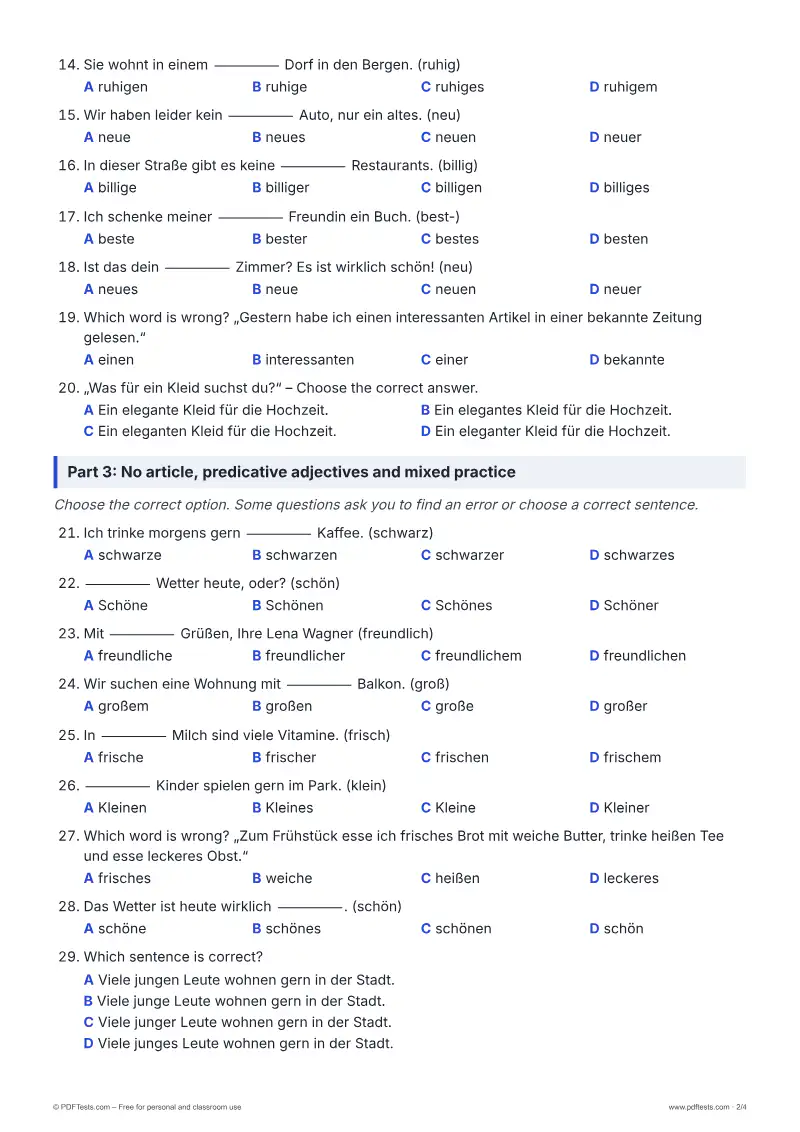
Part 2: After ein, kein and possessives

Choose the correct option for each gap or task.

  1. Das ist wirklich eine _____ Idee! (gut)

  2. Mein Onkel hat einen _____ Hund. (groß)

  3. Mein _____ Bruder geht noch in den Kindergarten. (klein)

  4. Sie wohnt in einem _____ Dorf in den Bergen. (ruhig)

  5. Wir haben leider kein _____ Auto, nur ein altes. (neu)

  6. In dieser Straße gibt es keine _____ Restaurants. (billig)

  7. Ich schenke meiner _____ Freundin ein Buch. (best-)

  8. Ist das dein _____ Zimmer? Es ist wirklich schön! (neu)

  9. Which word is wrong? „Gestern habe ich einen interessanten Artikel in einer bekannte Zeitung gelesen.“

  10. „Was für ein Kleid suchst du?“ – Choose the correct answer.

Part 3: No article, predicative adjectives and mixed practice

Choose the correct option. Some questions ask you to find an error or choose a correct sentence.

  1. Ich trinke morgens gern _____ Kaffee. (schwarz)

  2. _____ Wetter heute, oder? (schön)

  3. Mit _____ Grüßen, Ihre Lena Wagner (freundlich)

  4. Wir suchen eine Wohnung mit _____ Balkon. (groß)

  5. In _____ Milch sind viele Vitamine. (frisch)

  6. _____ Kinder spielen gern im Park. (klein)

  7. Which word is wrong? „Zum Frühstück esse ich frisches Brot mit weiche Butter, trinke heißen Tee und esse leckeres Obst.“

  8. Das Wetter ist heute wirklich _____. (schön)

  9. Which sentence is correct?

  10. Im Winter trägt Amira einen _____ Mantel und eine _____ Mütze. (lang / warm)

Preview

About this test

This 30-question B1 grammar test checks German adjective endings after definite articles, indefinite articles, kein, possessives and with no article. It suits learners at intermediate level and teachers who want a quick, printable check of weak, mixed and strong declension in everyday contexts.

Topics covered

Adjective endingsDefinite article (weak declension)Indefinite article and kein (mixed declension)Possessive determinersNo article (strong declension)Predicative adjectivesCases: nominative, accusative, dative, genitive

How to use this test

  1. Download the PDF and print it, or take the test online below.
  2. Answer every question without a dictionary or time pressure.
  3. Check your answers and note the topics you need to review.

Notes for teachers

The test moves from weak endings after der/die/das, to mixed endings after ein/kein/mein, to strong endings with no article, so you can see exactly where learners' problems lie. It targets common errors such as overusing -e, confusing dative -en with -em, forgetting the -es/-er signal after ein/mein, and adding endings to predicative adjectives. As a follow-up, have students write a short description of their home or clothes using at least ten adjectives, then peer-check the endings using a table of articles.