PDFTests Originals

Possessive Adjectives – Test 1

A1 Beginner GrammarSpanish

This A1 grammar test checks how well learners use Spanish possessive adjectives (mi, tu, su, nuestro, vuestro) in singular and plural, masculine and feminine. It covers agreement with the noun, the formal su for usted, tu versus tú, and possessives in questions, answers and negative sentences. It is ideal for beginners and for teachers who need a quick, printable check.
Questions
30
Time
25 min
PDF
3 pages
Answer key
Included
  • 100% free
  • No sign-up or email
  • Print-ready A4 PDF
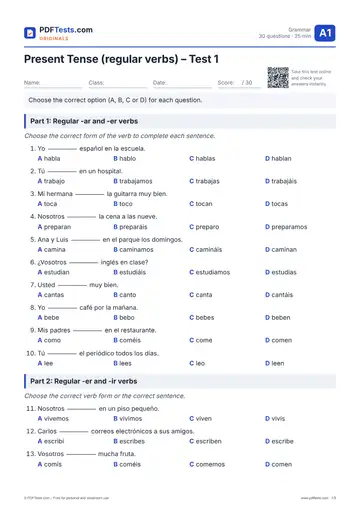
Preview of page 1 of Possessive Adjectives – Test 1 Open PDF

Take the test online

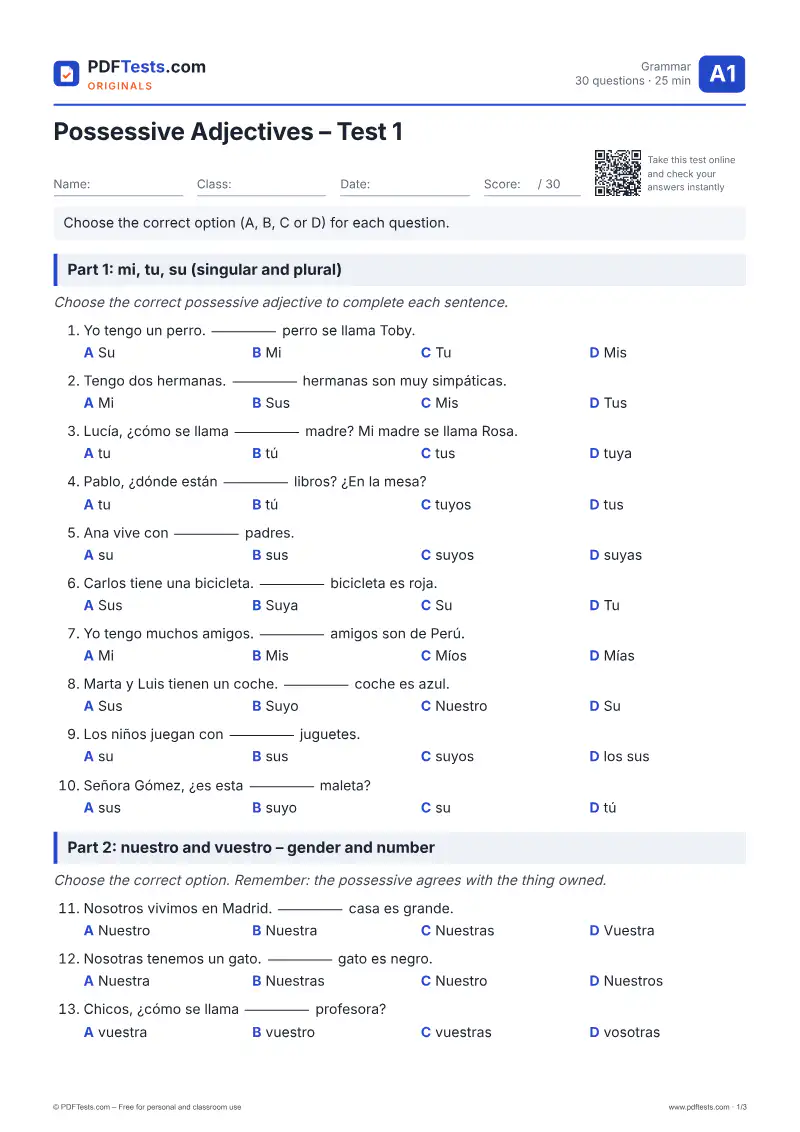
Choose the correct option (A, B, C or D) for each question. Choose your answers, then press “Check my answers”.

Part 1: mi, tu, su (singular and plural)

Choose the correct possessive adjective to complete each sentence.

  1. Yo tengo un perro. _____ perro se llama Toby.

  2. Tengo dos hermanas. _____ hermanas son muy simpáticas.

  3. Lucía, ¿cómo se llama _____ madre? Mi madre se llama Rosa.

  4. Pablo, ¿dónde están _____ libros? ¿En la mesa?

  5. Ana vive con _____ padres.

  6. Carlos tiene una bicicleta. _____ bicicleta es roja.

  7. Yo tengo muchos amigos. _____ amigos son de Perú.

  8. Marta y Luis tienen un coche. _____ coche es azul.

  9. Los niños juegan con _____ juguetes.

  10. Señora Gómez, ¿es esta _____ maleta?

Part 2: nuestro and vuestro – gender and number

Choose the correct option. Remember: the possessive agrees with the thing owned.

  1. Nosotros vivimos en Madrid. _____ casa es grande.

  2. Nosotras tenemos un gato. _____ gato es negro.

  3. Chicos, ¿cómo se llama _____ profesora?

  4. Nosotros tenemos dos hijas. _____ hijas estudian en la universidad.

  5. Vosotros tenéis muchos libros. ¿Dónde están _____ libros?

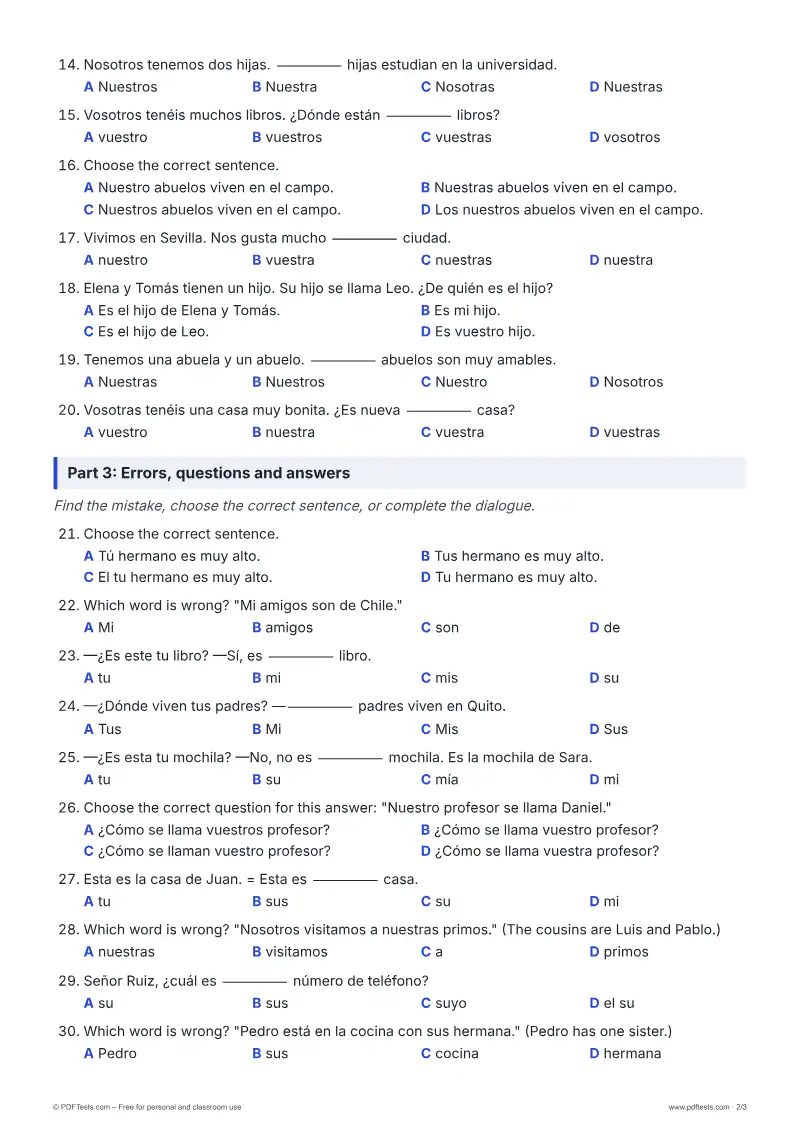
  6. Choose the correct sentence.

  7. Vivimos en Sevilla. Nos gusta mucho _____ ciudad.

  8. Elena y Tomás tienen un hijo. Su hijo se llama Leo. ¿De quién es el hijo?

  9. Tenemos una abuela y un abuelo. _____ abuelos son muy amables.

  10. Vosotras tenéis una casa muy bonita. ¿Es nueva _____ casa?

Part 3: Errors, questions and answers

Find the mistake, choose the correct sentence, or complete the dialogue.

  1. Choose the correct sentence.

  2. Which word is wrong? "Mi amigos son de Chile."

  3. —¿Es este tu libro? —Sí, es _____ libro.

  4. —¿Dónde viven tus padres? —_____ padres viven en Quito.

  5. —¿Es esta tu mochila? —No, no es _____ mochila. Es la mochila de Sara.

  6. Choose the correct question for this answer: "Nuestro profesor se llama Daniel."

  7. Esta es la casa de Juan. = Esta es _____ casa.

  8. Which word is wrong? "Nosotros visitamos a nuestras primos." (The cousins are Luis and Pablo.)

  9. Señor Ruiz, ¿cuál es _____ número de teléfono?

  10. Which word is wrong? "Pedro está en la cocina con sus hermana." (Pedro has one sister.)

Preview

About this test

This A1 grammar test checks how well learners use Spanish possessive adjectives (mi, tu, su, nuestro, vuestro) in singular and plural, masculine and feminine. It covers agreement with the noun, the formal su for usted, tu versus tú, and possessives in questions, answers and negative sentences. It is ideal for beginners and for teachers who need a quick, printable check.

Topics covered

mi / mistu / tussu / susnuestro / nuestravuestro / vuestraAgreement with the nountu vs. túFormal su (usted)

How to use this test

  1. Download the PDF and print it, or take the test online below.
  2. Answer every question without a dictionary or time pressure.
  3. Check your answers and note the topics you need to review.

Notes for teachers

Use Part 1 for basic forms, Part 2 for gender and number agreement, and Part 3 to check error spotting and use in dialogues. The test targets typical A1 mistakes: making the possessive agree with the owner instead of the noun (sus coche, nuestra gato), writing tú instead of tu, and adding an article before the possessive (el mi libro). As a follow-up, ask students to describe their family using five different possessive adjectives.