PDFTests Originals

Everyday Vocabulary: Family, Home and Daily Routine – Test 1

A1 Beginner VocabularySpanish

This A1 Spanish vocabulary test checks key everyday words for family members, rooms and objects in the home, and common daily routine verbs. It uses gap fills, odd-one-out items, word meaning in context and a short reading text. It suits beginners, adult learners and school classes who are building their first core vocabulary.
Questions
30
Time
30 min
PDF
4 pages
Answer key
Included
  • 100% free
  • No sign-up or email
  • Print-ready A4 PDF
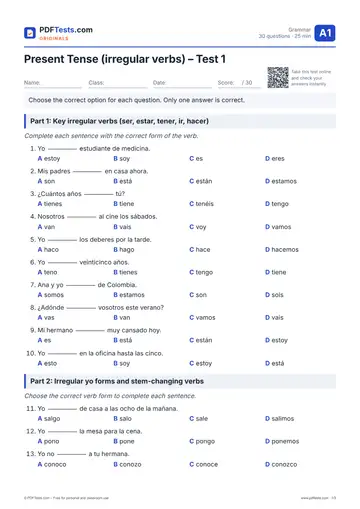
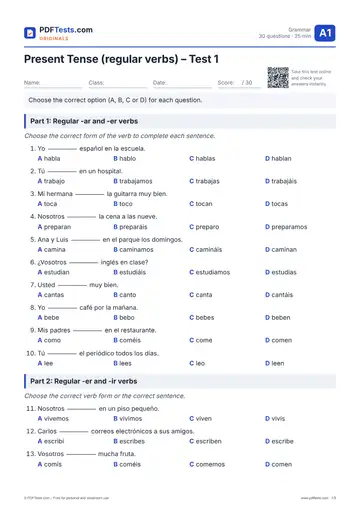
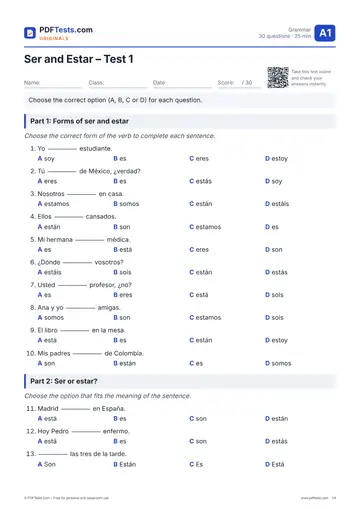
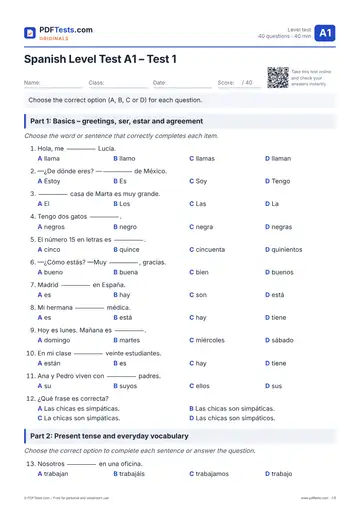
Preview of page 1 of Everyday Vocabulary: Family, Home and Daily Routine – Test 1 Open PDF

Take the test online

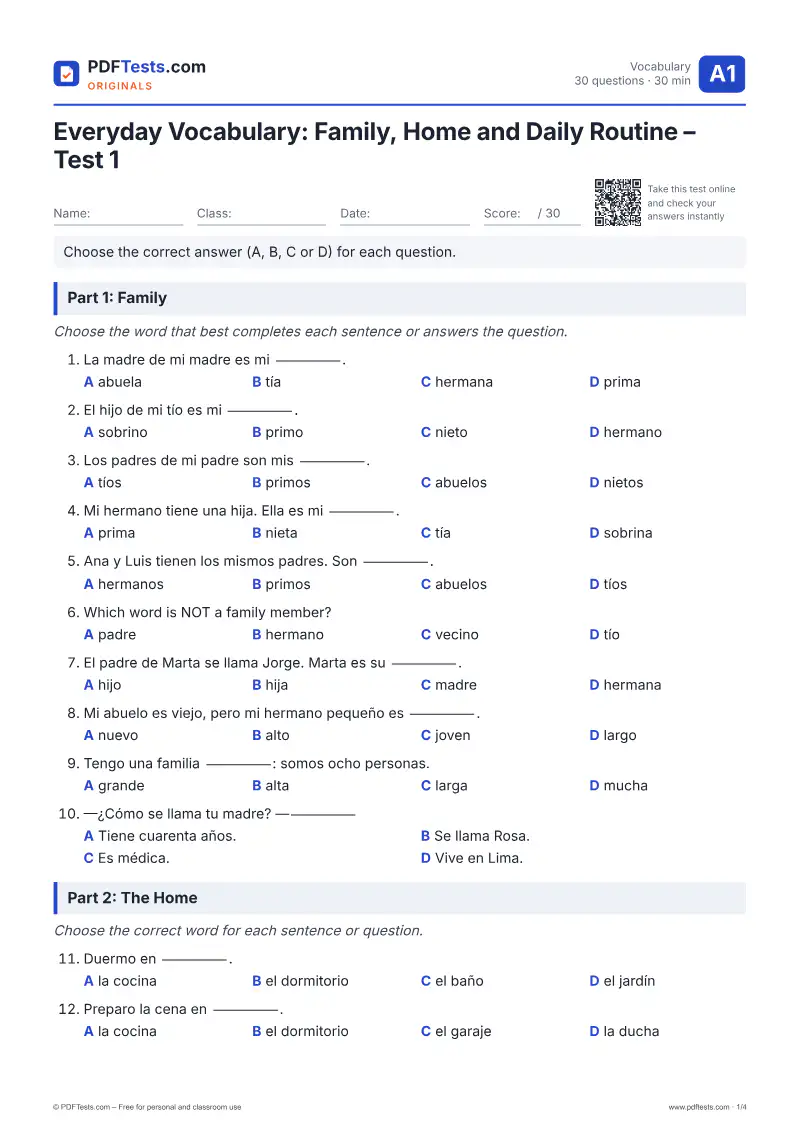
Choose the correct answer (A, B, C or D) for each question. Choose your answers, then press “Check my answers”.

Part 1: Family

Choose the word that best completes each sentence or answers the question.

  1. La madre de mi madre es mi _____.

  2. El hijo de mi tío es mi _____.

  3. Los padres de mi padre son mis _____.

  4. Mi hermano tiene una hija. Ella es mi _____.

  5. Ana y Luis tienen los mismos padres. Son _____.

  6. Which word is NOT a family member?

  7. El padre de Marta se llama Jorge. Marta es su _____.

  8. Mi abuelo es viejo, pero mi hermano pequeño es _____.

  9. Tengo una familia _____: somos ocho personas.

  10. —¿Cómo se llama tu madre? —_____

Part 2: The Home

Choose the correct word for each sentence or question.

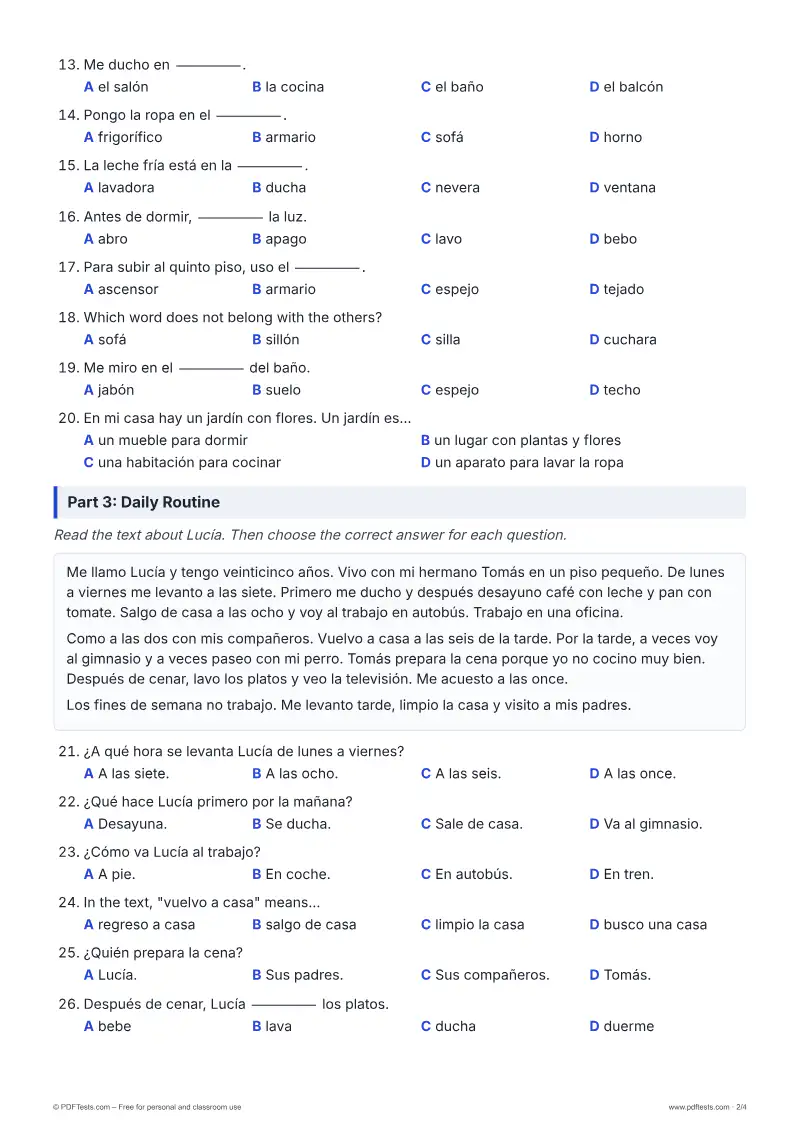
  1. Duermo en _____.

  2. Preparo la cena en _____.

  3. Me ducho en _____.

  4. Pongo la ropa en el _____.

  5. La leche fría está en la _____.

  6. Antes de dormir, _____ la luz.

  7. Para subir al quinto piso, uso el _____.

  8. Which word does not belong with the others?

  9. Me miro en el _____ del baño.

  10. En mi casa hay un jardín con flores. Un jardín es...

Part 3: Daily Routine

Read the text about Lucía. Then choose the correct answer for each question.

Me llamo Lucía y tengo veinticinco años. Vivo con mi hermano Tomás en un piso pequeño. De lunes a viernes me levanto a las siete. Primero me ducho y después desayuno café con leche y pan con tomate. Salgo de casa a las ocho y voy al trabajo en autobús. Trabajo en una oficina.

Como a las dos con mis compañeros. Vuelvo a casa a las seis de la tarde. Por la tarde, a veces voy al gimnasio y a veces paseo con mi perro. Tomás prepara la cena porque yo no cocino muy bien. Después de cenar, lavo los platos y veo la televisión. Me acuesto a las once.

Los fines de semana no trabajo. Me levanto tarde, limpio la casa y visito a mis padres.

  1. ¿A qué hora se levanta Lucía de lunes a viernes?

  2. ¿Qué hace Lucía primero por la mañana?

  3. ¿Cómo va Lucía al trabajo?

  4. In the text, "vuelvo a casa" means...

  5. ¿Quién prepara la cena?

  6. Después de cenar, Lucía _____ los platos.

  7. What is the opposite of "me levanto"?

  8. ¿Qué hace Lucía los fines de semana?

  9. El _____ de Lucía es café con leche y pan con tomate.

  10. Los fines de semana, Lucía _____ la casa.

Preview

About this test

This A1 Spanish vocabulary test checks key everyday words for family members, rooms and objects in the home, and common daily routine verbs. It uses gap fills, odd-one-out items, word meaning in context and a short reading text. It suits beginners, adult learners and school classes who are building their first core vocabulary.

Topics covered

Family membersRooms of the houseFurniture and household objectsDaily routine verbsReflexive routine verbsCollocationsReading for vocabulary

How to use this test

  1. Download the PDF and print it, or take the test online below.
  2. Answer every question without a dictionary or time pressure.
  3. Check your answers and note the topics you need to review.

Notes for teachers

Use this test after a unit on family, the home and daily routines, or as a quick diagnostic for A1 learners. It targets common confusions such as primo/sobrino, tío/abuelo, cocina/cocinar and levantarse/acostarse, as well as everyday collocations like apagar la luz and lavar los platos. As a follow-up, students can draw their family tree or write a short text about their own daily routine using the words from Part 3.