PDFTests Originals

Preterite (pretérito indefinido) – Test 1

A2 Elementary GrammarSpanish

This 30-question A2 test checks how well learners form and use the Spanish preterite (pretérito indefinido) to talk about finished actions in the past. It covers regular -ar, -er and -ir verbs, key irregular verbs, spelling changes, negatives, questions and a short reading text. It suits learners in their first or second year of Spanish, for self-study or classroom use.
Questions
30
Time
30 min
PDF
4 pages
Answer key
Included
  • 100% free
  • No sign-up or email
  • Print-ready A4 PDF
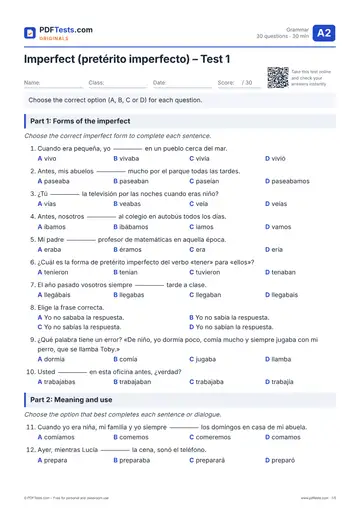
Preview of page 1 of Preterite (pretérito indefinido) – Test 1 Open PDF

Take the test online

Choose the correct option (A, B, C or D) for each question. Choose your answers, then press “Check my answers”.

Part 1: Regular verbs

Choose the correct preterite form to complete each sentence, or answer the question.

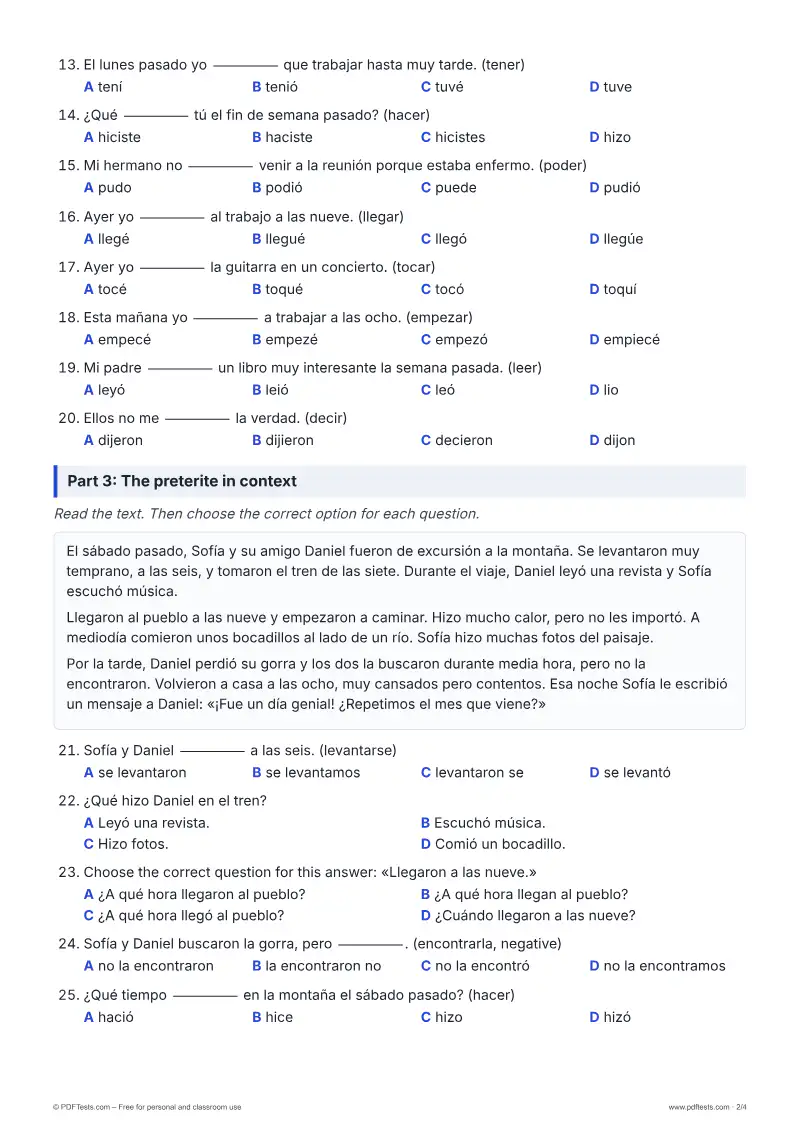
  1. Ayer por la tarde yo _____ con mi abuela por teléfono. (hablar)

  2. ¿A qué hora _____ tú la cena anoche? (preparar)

  3. Mis hermanos _____ en un restaurante italiano el sábado pasado. (comer)

  4. Nosotros _____ en Valencia durante dos años. (vivir)

  5. La semana pasada Laura _____ una carta muy bonita a su profesora. (escribir)

  6. ¿_____ vosotros el examen de matemáticas? (aprobar)

  7. ¿Qué frase es correcta?

  8. Ayer por la mañana Pedro _____ con Marta en la biblioteca. (hablar)

  9. Anoche yo _____ la televisión. (mirar, negative)

  10. Find the mistake: «Ayer mis amigos y yo bebieron café en la plaza.»

Part 2: Irregular verbs and spelling changes

Choose the correct preterite form to complete each sentence.

  1. El verano pasado nosotros _____ a la playa con nuestros primos. (ir)

  2. El sábado pasado la fiesta de Carmen _____ fantástica. (ser)

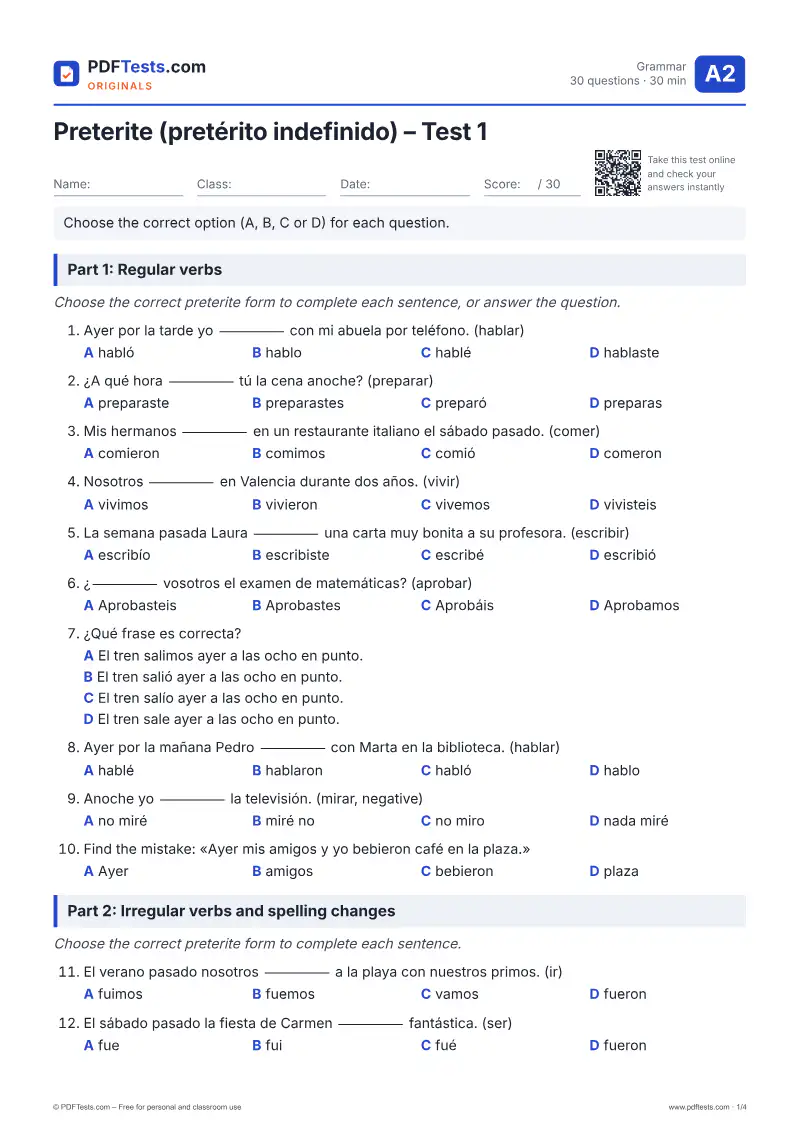
  3. El lunes pasado yo _____ que trabajar hasta muy tarde. (tener)

  4. ¿Qué _____ tú el fin de semana pasado? (hacer)

  5. Mi hermano no _____ venir a la reunión porque estaba enfermo. (poder)

  6. Ayer yo _____ al trabajo a las nueve. (llegar)

  7. Ayer yo _____ la guitarra en un concierto. (tocar)

  8. Esta mañana yo _____ a trabajar a las ocho. (empezar)

  9. Mi padre _____ un libro muy interesante la semana pasada. (leer)

  10. Ellos no me _____ la verdad. (decir)

Part 3: The preterite in context

Read the text. Then choose the correct option for each question.

El sábado pasado, Sofía y su amigo Daniel fueron de excursión a la montaña. Se levantaron muy temprano, a las seis, y tomaron el tren de las siete. Durante el viaje, Daniel leyó una revista y Sofía escuchó música.

Llegaron al pueblo a las nueve y empezaron a caminar. Hizo mucho calor, pero no les importó. A mediodía comieron unos bocadillos al lado de un río. Sofía hizo muchas fotos del paisaje.

Por la tarde, Daniel perdió su gorra y los dos la buscaron durante media hora, pero no la encontraron. Volvieron a casa a las ocho, muy cansados pero contentos. Esa noche Sofía le escribió un mensaje a Daniel: «¡Fue un día genial! ¿Repetimos el mes que viene?»

  1. Sofía y Daniel _____ a las seis. (levantarse)

  2. ¿Qué hizo Daniel en el tren?

  3. Choose the correct question for this answer: «Llegaron a las nueve.»

  4. Sofía y Daniel buscaron la gorra, pero _____. (encontrarla, negative)

  5. ¿Qué tiempo _____ en la montaña el sábado pasado? (hacer)

  6. Find the mistake: «Sofía hició muchas fotos del paisaje.»

  7. A friend asks Sofía: «¿Qué comisteis a mediodía?» Choose the best answer.

  8. Los dos _____ a casa a las ocho. (volver)

  9. Todos los días Daniel camina por el parque, pero ayer _____ por la montaña. (caminar)

  10. En la frase «¡Fue un día genial!», «fue» es una forma del verbo...

Preview

About this test

This 30-question A2 test checks how well learners form and use the Spanish preterite (pretérito indefinido) to talk about finished actions in the past. It covers regular -ar, -er and -ir verbs, key irregular verbs, spelling changes, negatives, questions and a short reading text. It suits learners in their first or second year of Spanish, for self-study or classroom use.

Topics covered

Regular preterite formsIrregular verbs (ser, ir, hacer, tener, poder, decir)Spelling changes (-car, -gar, -zar, leer)Written accentsNegatives and questionsPast time expressions

How to use this test

  1. Download the PDF and print it, or take the test online below.
  2. Answer every question without a dictionary or time pressure.
  3. Check your answers and note the topics you need to review.

Notes for teachers

Part 1 targets regular endings and missing or wrong written accents (hablo/habló, the non-standard form *preparastes). Part 2 focuses on irregular stems and spelling changes, where learners often produce forms like *hació, *tuvé or *llegé. Part 3 uses a short reading text to check the preterite in context, including questions, negatives and contrasts with the present. As a follow-up, ask students to write five sentences about their last weekend, using at least two irregular verbs.