PDFTests Originals

Verbal Periphrases (perífrasis verbales) – Test 1

C1 Advanced GrammarSpanish

This C1 grammar test covers Spanish verbal periphrases (perífrasis verbales), including their form, meaning and use. It covers infinitive, gerund and participle periphrases, their prepositions, agreement and nuances such as probability vs. obligation. It is designed for advanced learners and teachers who want to check accurate, natural control of these structures, including negatives and questions.
Questions
30
Time
30 min
PDF
4 pages
Answer key
Included
  • 100% free
  • No sign-up or email
  • Print-ready A4 PDF
Preview of page 1 of Verbal Periphrases (perífrasis verbales) – Test 1 Open PDF

Take the test online

Choose the one correct option (A–D) for each question. Choose your answers, then press “Check my answers”.

Part 1: Form – auxiliaries, prepositions and non-finite forms

Complete each sentence with the correct option.

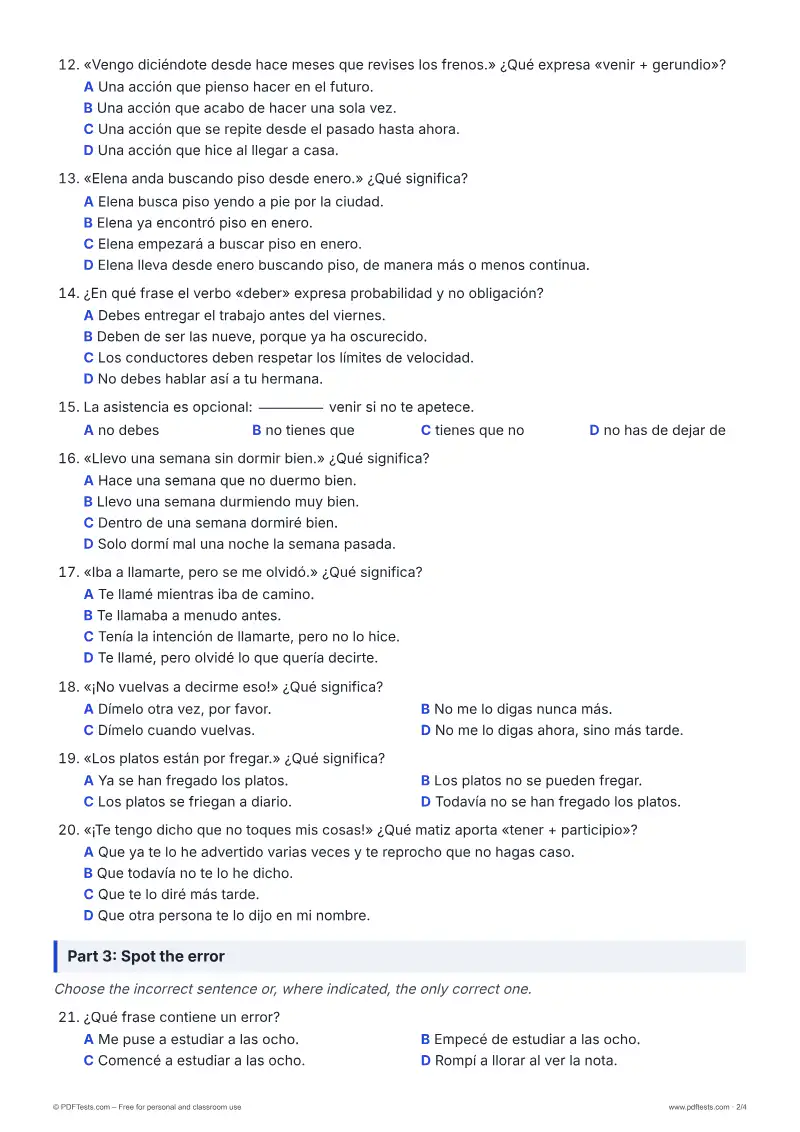
  1. ¿Cuánto tiempo llevas _____ en este barrio?

  2. Acabo _____ enterarme de que han aplazado la reunión; nadie me había avisado.

  3. Al final, después de tantas dudas, la empresa acabó _____ el contrato.

  4. No contesta al teléfono; _____ estar durmiendo todavía.

  5. Si quieres aprobar el examen oficial, _____ que estudiar mucho más.

  6. Después de la operación, tardó meses en _____ correr con normalidad.

  7. Ya tengo _____ veinte páginas de la tesis, así que voy bien de plazos.

  8. Todavía quedan tres capítulos _____ revisar antes de enviar el manuscrito.

  9. Date prisa, que el tren está _____ salir.

  10. Por favor, no dejes _____ escribirme cuando llegues.

Part 2: Meaning and nuance

Choose the option that best explains the meaning, or that correctly completes the sentence.

  1. «Juan dejó de fumar hace dos años.» ¿Qué significa?

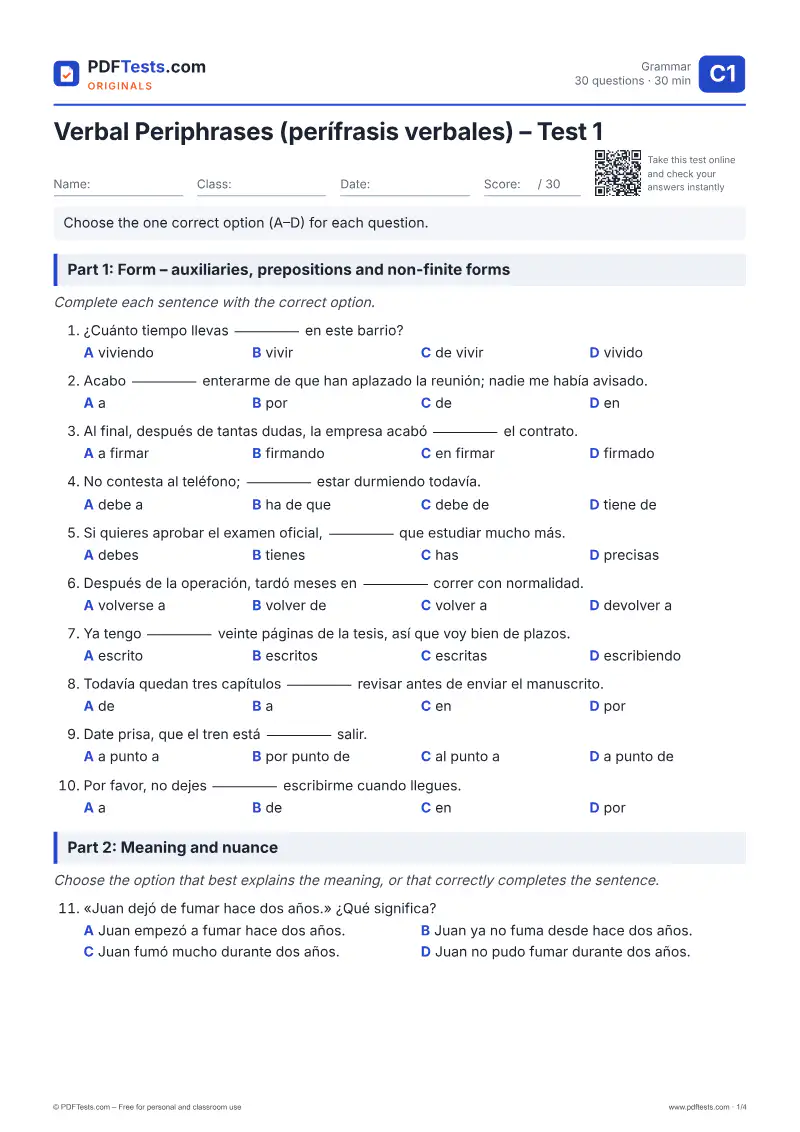
  2. «Vengo diciéndote desde hace meses que revises los frenos.» ¿Qué expresa «venir + gerundio»?

  3. «Elena anda buscando piso desde enero.» ¿Qué significa?

  4. ¿En qué frase el verbo «deber» expresa probabilidad y no obligación?

  5. La asistencia es opcional: _____ venir si no te apetece.

  6. «Llevo una semana sin dormir bien.» ¿Qué significa?

  7. «Iba a llamarte, pero se me olvidó.» ¿Qué significa?

  8. «¡No vuelvas a decirme eso!» ¿Qué significa?

  9. «Los platos están por fregar.» ¿Qué significa?

  10. «¡Te tengo dicho que no toques mis cosas!» ¿Qué matiz aporta «tener + participio»?

Part 3: Spot the error

Choose the incorrect sentence or, where indicated, the only correct one.

  1. ¿Qué frase contiene un error?

  2. ¿Qué frase contiene un error según la norma culta?

  3. ¿Qué frase es correcta?

  4. ¿Qué frase contiene un error?

  5. ¿Qué frase contiene un error?

Part 4: Periphrases in context

Read the text and choose the correct option for each numbered gap.

Marta lleva casi diez años (1) ___ como traductora autónoma. Al principio no fue fácil: tuvo que aprender a organizarse sola y, más de una vez, estuvo (2) ___ abandonarlo todo y buscar un empleo fijo.

Sin embargo, poco a poco fue (3) ___ clientes fieles y, hoy en día, tiene (4) ___ más de doscientos proyectos. Aunque a veces le toca trabajar hasta tarde, no piensa renunciar a su independencia.

«Si algo he aprendido en esta profesión», explica, «es que no hay que (5) ___ formarse nunca. Los idiomas van cambiando, y nosotros tenemos que ir cambiando con ellos».

  1. (1) Marta lleva casi diez años _____ como traductora autónoma.

  2. (2) Más de una vez, estuvo _____ abandonarlo todo y buscar un empleo fijo.

  3. (3) Poco a poco fue _____ clientes fieles.

  4. (4) Hoy en día, tiene _____ más de doscientos proyectos.

  5. (5) No hay que _____ formarse nunca.

Preview

About this test

This C1 grammar test covers Spanish verbal periphrases (perífrasis verbales), including their form, meaning and use. It covers infinitive, gerund and participle periphrases, their prepositions, agreement and nuances such as probability vs. obligation. It is designed for advanced learners and teachers who want to check accurate, natural control of these structures, including negatives and questions.

Topics covered

Infinitive periphrasesGerund periphrasesParticiple periphrasesDeber vs. deber deTener + participle agreementAspect and modalityError correction

How to use this test

  1. Download the PDF and print it, or take the test online below.
  2. Answer every question without a dictionary or time pressure.
  3. Check your answers and note the topics you need to review.

Notes for teachers

Use Parts 1 and 2 to check form and meaning before moving on to the error-spotting and text-based tasks. The test targets typical C1 errors: wrong prepositions (empezar de, seguir a), missing participle agreement with tener (tengo preparado las maletas), normative deber vs. deber de, and literal readings of andar or venir + gerund. As follow-up, ask students to rewrite sentences with alternative periphrases (e.g. acabar + gerund vs. acabar por + infinitive) and to discuss the shifts in nuance.