PDFTests Originals

Spanish Idioms and Expressions (C1) – Test 1

C1 Advanced VocabularySpanish

This C1 vocabulary test checks your command of common Spanish idioms and fixed expressions. You will interpret idioms in context, complete set phrases and choose the most natural expression for a situation. It is suitable for advanced learners preparing for C1 exams and for teachers who need a ready-made idiom review.

Questions
30
Time
30 min
PDF
4 pages
Answer key
Included
  • 100% free
  • No sign-up or email
  • Print-ready A4 PDF
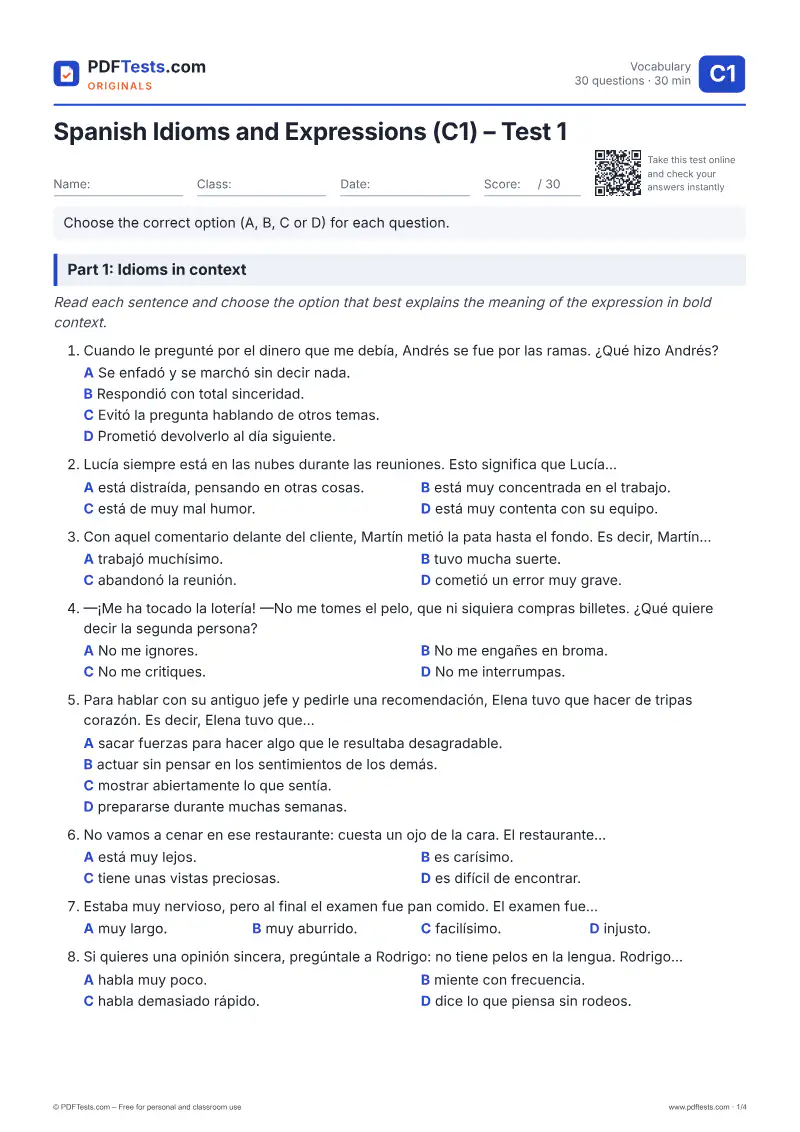
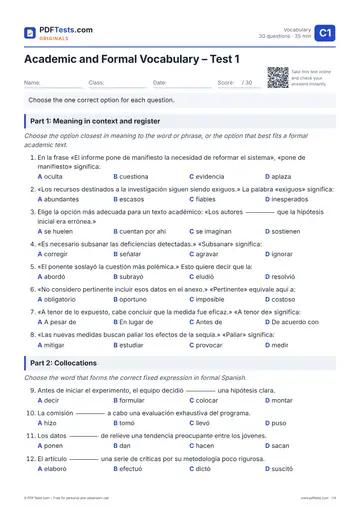
Preview of page 1 of Spanish Idioms and Expressions (C1) – Test 1 Open PDF

Take the test online

Choose the correct option (A, B, C or D) for each question. Choose your answers, then press “Check my answers”.

Part 1: Idioms in context

Read each sentence and choose the option that best explains the meaning of the expression in bold context.

  1. Cuando le pregunté por el dinero que me debía, Andrés se fue por las ramas. ¿Qué hizo Andrés?

  2. Lucía siempre está en las nubes durante las reuniones. Esto significa que Lucía…

  3. Con aquel comentario delante del cliente, Martín metió la pata hasta el fondo. Es decir, Martín…

  4. —¡Me ha tocado la lotería! —No me tomes el pelo, que ni siquiera compras billetes. ¿Qué quiere decir la segunda persona?

  5. Para hablar con su antiguo jefe y pedirle una recomendación, Elena tuvo que hacer de tripas corazón. Es decir, Elena tuvo que…

  6. No vamos a cenar en ese restaurante: cuesta un ojo de la cara. El restaurante…

  7. Estaba muy nervioso, pero al final el examen fue pan comido. El examen fue…

  8. Si quieres una opinión sincera, pregúntale a Rodrigo: no tiene pelos en la lengua. Rodrigo…

  9. Estoy hasta las narices de tanto ruido en el edificio. ¿Cómo se siente esta persona?

  10. No sé por qué, pero esa oferta de trabajo me da mala espina. La oferta…

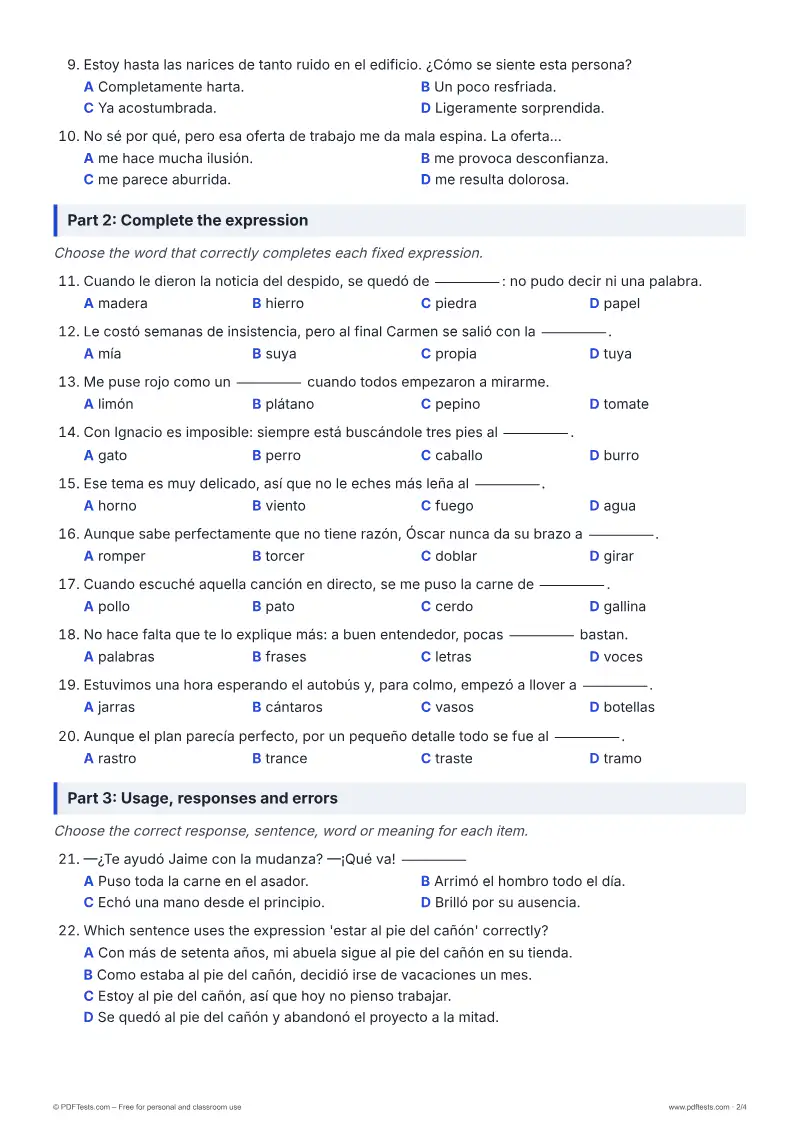
Part 2: Complete the expression

Choose the word that correctly completes each fixed expression.

  1. Cuando le dieron la noticia del despido, se quedó de _____: no pudo decir ni una palabra.

  2. Le costó semanas de insistencia, pero al final Carmen se salió con la _____.

  3. Me puse rojo como un _____ cuando todos empezaron a mirarme.

  4. Con Ignacio es imposible: siempre está buscándole tres pies al _____.

  5. Ese tema es muy delicado, así que no le eches más leña al _____.

  6. Aunque sabe perfectamente que no tiene razón, Óscar nunca da su brazo a _____.

  7. Cuando escuché aquella canción en directo, se me puso la carne de _____.

  8. No hace falta que te lo explique más: a buen entendedor, pocas _____ bastan.

  9. Estuvimos una hora esperando el autobús y, para colmo, empezó a llover a _____.

  10. Aunque el plan parecía perfecto, por un pequeño detalle todo se fue al _____.

Part 3: Usage, responses and errors

Choose the correct response, sentence, word or meaning for each item.

  1. —¿Te ayudó Jaime con la mudanza? —¡Qué va! _____

  2. Which sentence uses the expression 'estar al pie del cañón' correctly?

  3. Which word is incorrect in this sentence? «Cuando se enteró de la verdad, Julia puso el grito en el suelo.»

  4. Me vendió un coche de segunda mano como si fuera nuevo. ¡Menuda _____ de pelo!

  5. Which option is closest in meaning to the saying «No hay mal que por bien no venga»?

  6. Llevamos tres meses discutiendo lo mismo sin tomar ninguna decisión; estamos _____.

  7. En esta empresa, quien corta el bacalao es la directora financiera. Ella es…

  8. Which sentence is correct?

  9. —Al final no me han concedido la beca. —Bueno, _____; seguro que aparece otra oportunidad.

  10. Desde que llegó al nuevo departamento, Samuel está como pez en el agua. Samuel…

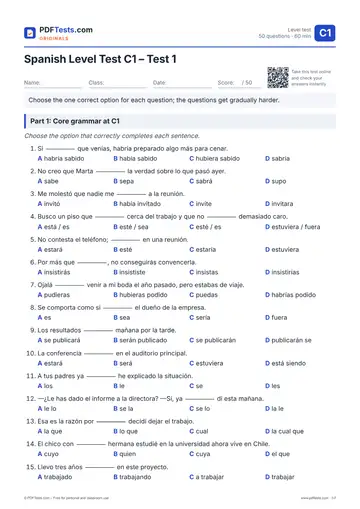
Preview

About this test

This C1 vocabulary test checks your command of common Spanish idioms and fixed expressions. You will interpret idioms in context, complete set phrases and choose the most natural expression for a situation. It is suitable for advanced learners preparing for C1 exams and for teachers who need a ready-made idiom review.

Topics covered

Spanish idiomsFixed expressionsProverbs and sayingsMeaning in contextCollocationsColloquial register

How to use this test

  1. Download the PDF and print it, or take the test online below.
  2. Answer every question without a dictionary or time pressure.
  3. Check your answers and note the topics you need to review.

Notes for teachers

Use the test as a diagnostic before an idioms unit or as a review afterwards. Distractors target typical learner errors such as literal interpretations, a wrong noun inside a fixed phrase (e.g. 'poner el grito en el suelo') and expressions with the opposite meaning. As follow-up, ask students to write short dialogues using five idioms they got wrong, or to find English equivalents and discuss where the images differ.