PDFTests Originals

Ser and Estar (advanced uses) – Test 1

C1 Advanced GrammarSpanish

This C1 grammar test checks advanced uses of ser and estar. It covers adjectives that change meaning, the location of events, the passive versus the resultative, dates and prices, cleft sentences and idiomatic expressions. It is designed for advanced learners and teachers who want to diagnose persistent errors at this level.
Questions
30
Time
30 min
PDF
4 pages
Answer key
Included
  • 100% free
  • No sign-up or email
  • Print-ready A4 PDF
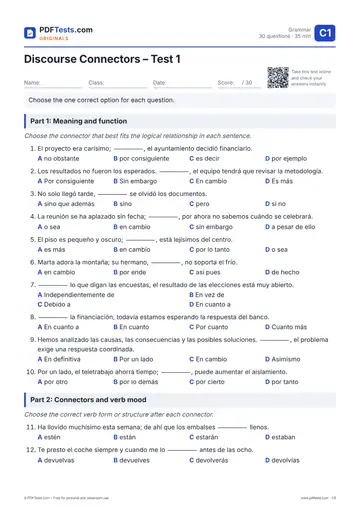
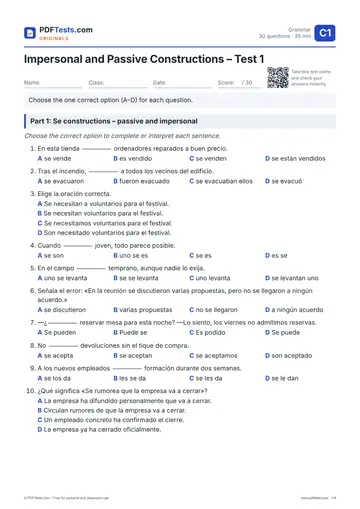
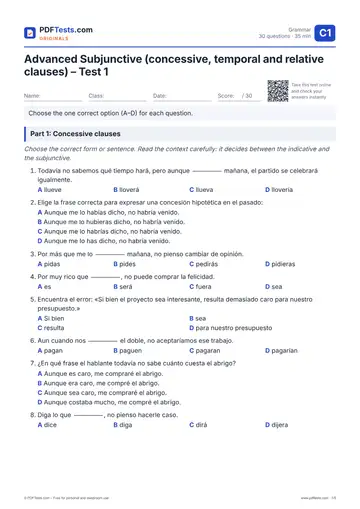
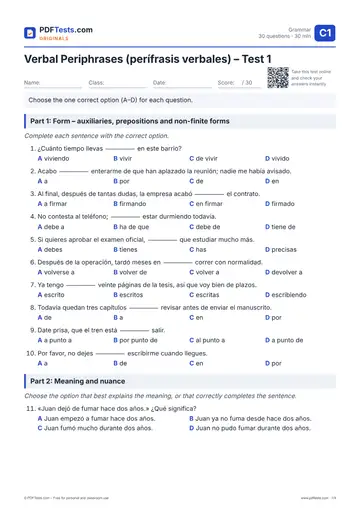
Preview of page 1 of Ser and Estar (advanced uses) – Test 1 Open PDF

Take the test online

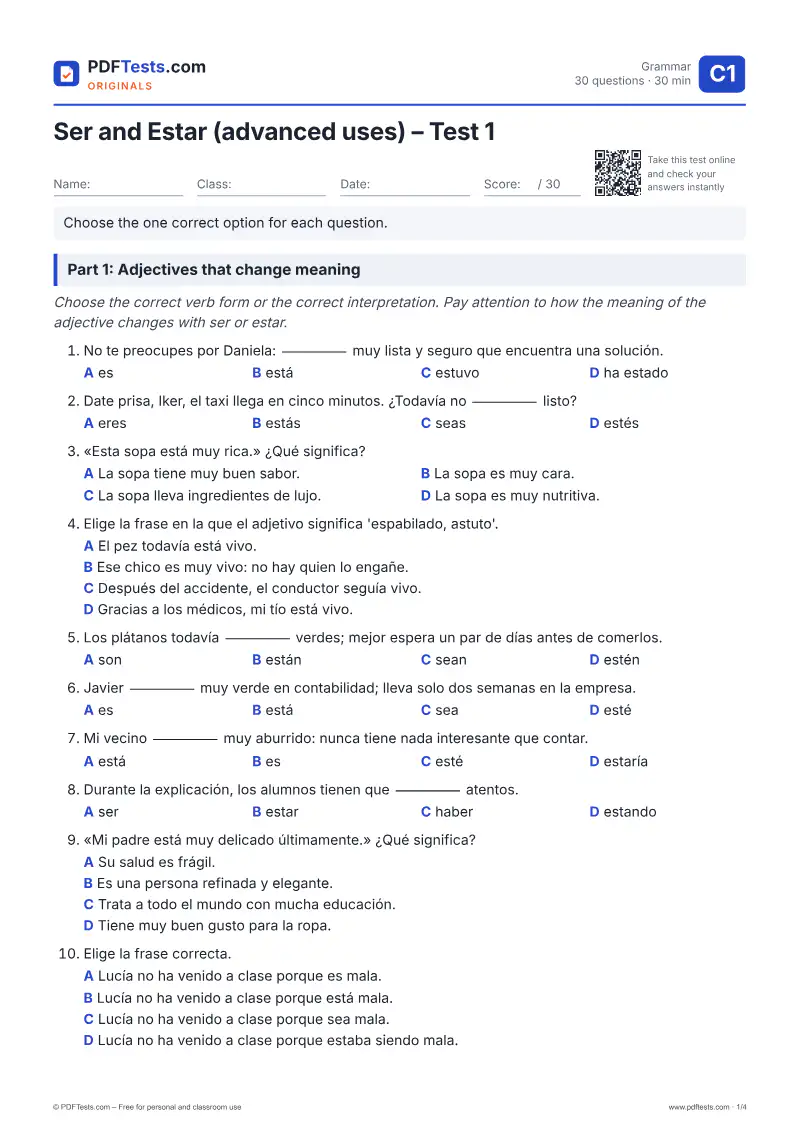
Choose the one correct option for each question. Choose your answers, then press “Check my answers”.

Part 1: Adjectives that change meaning

Choose the correct verb form or the correct interpretation. Pay attention to how the meaning of the adjective changes with ser or estar.

  1. No te preocupes por Daniela: _____ muy lista y seguro que encuentra una solución.

  2. Date prisa, Iker, el taxi llega en cinco minutos. ¿Todavía no _____ listo?

  3. «Esta sopa está muy rica.» ¿Qué significa?

  4. Elige la frase en la que el adjetivo significa 'espabilado, astuto'.

  5. Los plátanos todavía _____ verdes; mejor espera un par de días antes de comerlos.

  6. Javier _____ muy verde en contabilidad; lleva solo dos semanas en la empresa.

  7. Mi vecino _____ muy aburrido: nunca tiene nada interesante que contar.

  8. Durante la explicación, los alumnos tienen que _____ atentos.

  9. «Mi padre está muy delicado últimamente.» ¿Qué significa?

  10. Elige la frase correcta.

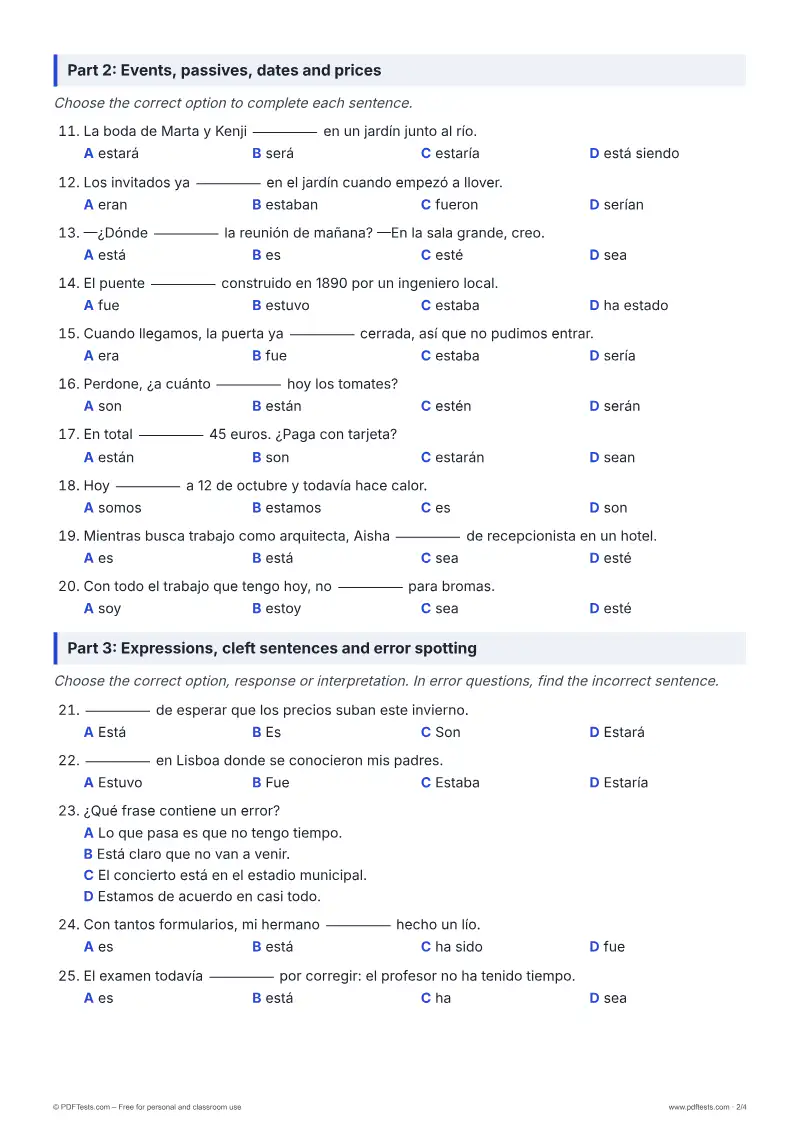
Part 2: Events, passives, dates and prices

Choose the correct option to complete each sentence.

  1. La boda de Marta y Kenji _____ en un jardín junto al río.

  2. Los invitados ya _____ en el jardín cuando empezó a llover.

  3. —¿Dónde _____ la reunión de mañana? —En la sala grande, creo.

  4. El puente _____ construido en 1890 por un ingeniero local.

  5. Cuando llegamos, la puerta ya _____ cerrada, así que no pudimos entrar.

  6. Perdone, ¿a cuánto _____ hoy los tomates?

  7. En total _____ 45 euros. ¿Paga con tarjeta?

  8. Hoy _____ a 12 de octubre y todavía hace calor.

  9. Mientras busca trabajo como arquitecta, Aisha _____ de recepcionista en un hotel.

  10. Con todo el trabajo que tengo hoy, no _____ para bromas.

Part 3: Expressions, cleft sentences and error spotting

Choose the correct option, response or interpretation. In error questions, find the incorrect sentence.

  1. _____ de esperar que los precios suban este invierno.

  2. _____ en Lisboa donde se conocieron mis padres.

  3. ¿Qué frase contiene un error?

  4. Con tantos formularios, mi hermano _____ hecho un lío.

  5. El examen todavía _____ por corregir: el profesor no ha tenido tiempo.

  6. «Llevo diez horas trabajando: estoy que no puedo más.» ¿Qué significa?

  7. —¿Qué tal está tu tía después de la operación? —_____

  8. No _____ yo quien rompió el jarrón ayer, te lo prometo.

  9. No te imaginas lo cansada que _____ después del viaje; me dormí en el sofá.

  10. Mis padres _____ muy orgullosos de ti por haber terminado la carrera.

Preview

About this test

This C1 grammar test checks advanced uses of ser and estar. It covers adjectives that change meaning, the location of events, the passive versus the resultative, dates and prices, cleft sentences and idiomatic expressions. It is designed for advanced learners and teachers who want to diagnose persistent errors at this level.

Topics covered

Adjectives that change meaningLocation of events vs objectsPassive (ser) vs result (estar)Dates, time and pricesEstar de / para / porCleft sentences with serIdiomatic expressions

How to use this test

  1. Download the PDF and print it, or take the test online below.
  2. Answer every question without a dictionary or time pressure.
  3. Check your answers and note the topics you need to review.

Notes for teachers

Use this test after revising the core contrast between ser and estar. It targets errors that persist at advanced level: using estar for the location of events, confusing the passive with the resultative, and misreading adjectives such as listo, verde, malo or delicado. Review the answers together and ask students to explain each choice. As a follow-up, have them write their own minimal pairs, for example 'es listo' and 'está listo'.