PDFTests Originals

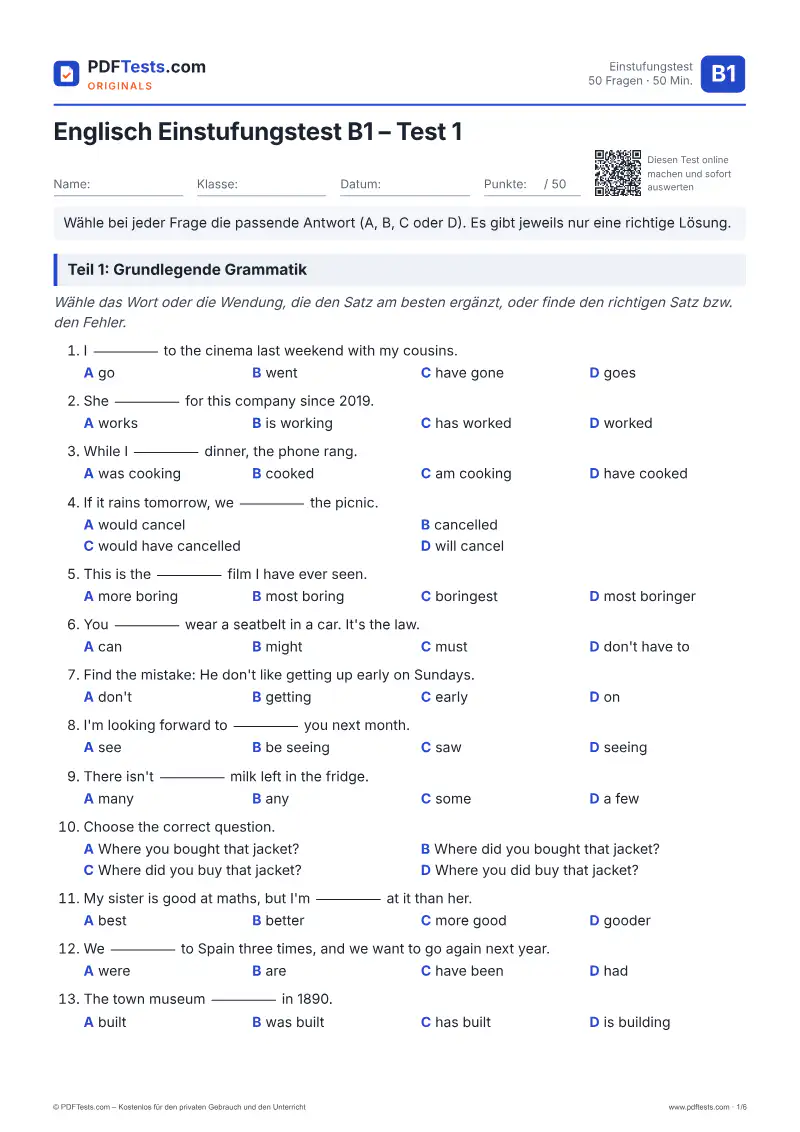
Englisch Einstufungstest B1 – Test 1

B1 Mittelstufe EinstufungstestEnglisch

Dieser Einstufungstest mit 50 Fragen prüft, ob Lernende das Niveau B1 des GER im Englischen sicher beherrschen. Er deckt die wichtigsten Grammatikthemen, den Wortschatz und die typischen Redemittel für Alltagssituationen auf diesem Niveau ab und endet mit einem kurzen Lesetext. Der Test eignet sich für Jugendliche und Erwachsene, für Lehrkräfte, die neue Schülerinnen und Schüler einstufen möchten, und für alle, die im Selbststudium ihren Lernstand überprüfen wollen.
Fragen
50
Zeit
50 Min.
PDF
6 Seiten
Lösungen
Enthalten
  • 100 % kostenlos
  • Ohne Anmeldung
  • Druckfertiges A4-PDF
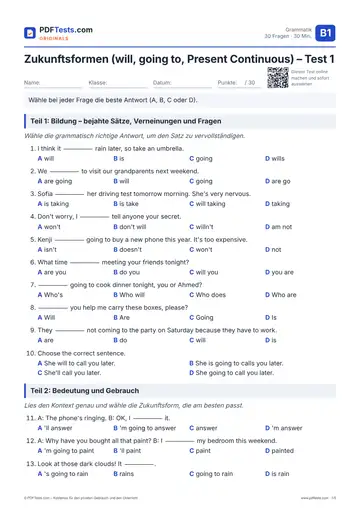
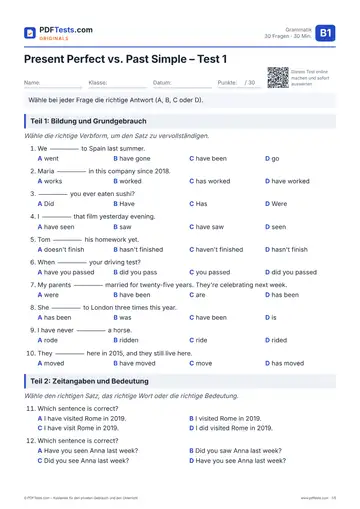
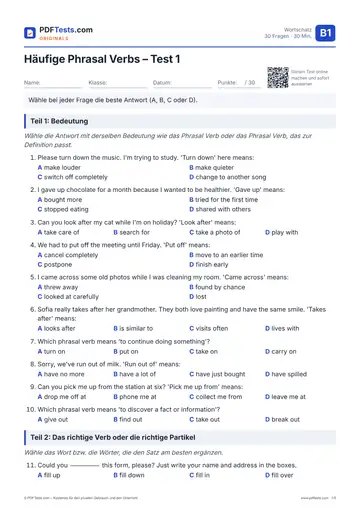
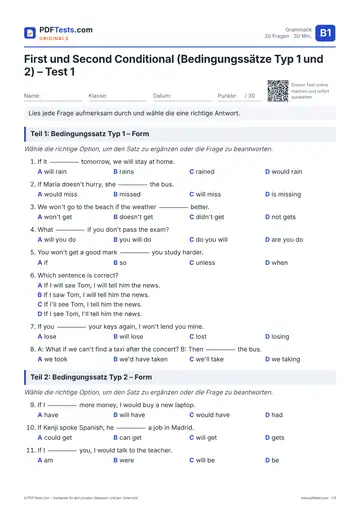
Vorschau von Seite 1: Englisch Einstufungstest B1 – Test 1 PDF öffnen

Test online machen

Wähle bei jeder Frage die passende Antwort (A, B, C oder D). Es gibt jeweils nur eine richtige Lösung. Wählen Sie Ihre Antworten und klicken Sie auf „Antworten prüfen“.

Teil 1: Grundlegende Grammatik

Wähle das Wort oder die Wendung, die den Satz am besten ergänzt, oder finde den richtigen Satz bzw. den Fehler.

  1. I _____ to the cinema last weekend with my cousins.

  2. She _____ for this company since 2019.

  3. While I _____ dinner, the phone rang.

  4. If it rains tomorrow, we _____ the picnic.

  5. This is the _____ film I have ever seen.

  6. You _____ wear a seatbelt in a car. It's the law.

  7. Find the mistake: He don't like getting up early on Sundays.

  8. I'm looking forward to _____ you next month.

  9. There isn't _____ milk left in the fridge.

  10. Choose the correct question.

  11. My sister is good at maths, but I'm _____ at it than her.

  12. We _____ to Spain three times, and we want to go again next year.

  13. The town museum _____ in 1890.

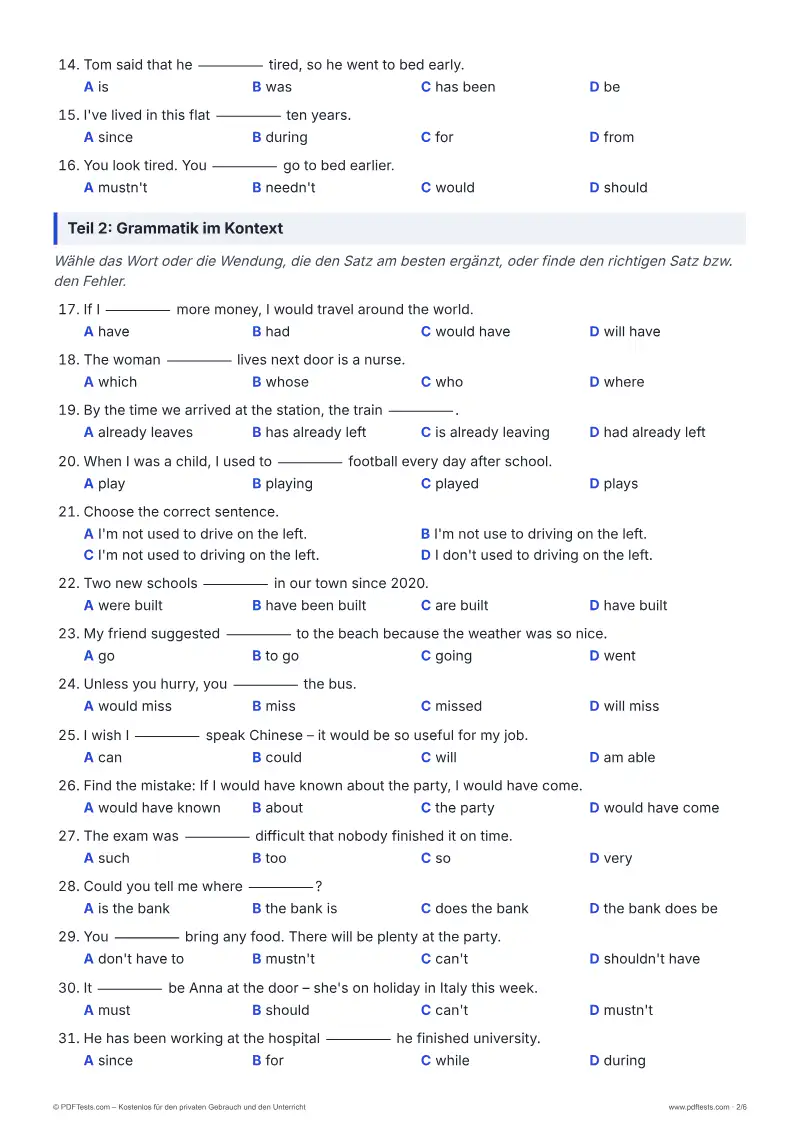
  14. Tom said that he _____ tired, so he went to bed early.

  15. I've lived in this flat _____ ten years.

  16. You look tired. You _____ go to bed earlier.

Teil 2: Grammatik im Kontext

Wähle das Wort oder die Wendung, die den Satz am besten ergänzt, oder finde den richtigen Satz bzw. den Fehler.

  1. If I _____ more money, I would travel around the world.

  2. The woman _____ lives next door is a nurse.

  3. By the time we arrived at the station, the train _____.

  4. When I was a child, I used to _____ football every day after school.

  5. Choose the correct sentence.

  6. Two new schools _____ in our town since 2020.

  7. My friend suggested _____ to the beach because the weather was so nice.

  8. Unless you hurry, you _____ the bus.

  9. I wish I _____ speak Chinese – it would be so useful for my job.

  10. Find the mistake: If I would have known about the party, I would have come.

  11. The exam was _____ difficult that nobody finished it on time.

  12. Could you tell me where _____?

  13. You _____ bring any food. There will be plenty at the party.

  14. It _____ be Anna at the door – she's on holiday in Italy this week.

  15. He has been working at the hospital _____ he finished university.

Teil 3: Wortschatz und Alltagssprache

Wähle für jede Frage das passende Wort, die passende Wendung oder die passende Antwort.

  1. Can you _____ me a favour and carry this bag?

  2. Could you _____ after my cat while I'm on holiday?

  3. Our flight was _____ for three hours because of fog, so we had to wait at the airport.

  4. The hotel staff were very _____ and helped us with everything. (HELP)

  5. I'm really _____ in learning about different cultures.

  6. A: Would you like some more tea? B: _____

  7. A: I've just passed my driving test! B: _____

  8. Sorry, I didn't _____ what you said. Could you repeat it, please?

  9. Lucy gave up sugar last year, and she feels much healthier now. What does 'gave up' mean here?

  10. I can't _____ to buy a new car at the moment – they're too expensive.

  11. Ben never shares anything or buys anyone a drink. He's quite _____.

  12. A: Do you mind if I open the window? B: _____ It's quite hot in here.

  13. My grandmother _____ me of my mother – they have exactly the same smile.

Teil 4: Leseverstehen

Lies den Text und wähle für jede Frage die beste Antwort.

When Priya moved to a new city for work two years ago, she didn't know anyone. Her flat was small and had no garden, and she spent most evenings alone watching TV. "I felt quite lonely at first," she says. "I missed my family and my friends back home."

One Saturday morning, while she was walking to the market, she noticed a group of people working on an empty piece of land behind the library. They were planting vegetables and building wooden boxes for flowers. A man called Daniel invited her to join them. He explained that the land had belonged to the city for years, but nobody had used it, so local residents had asked for permission to turn it into a community garden.

Priya had never grown anything before, but she decided to try. At first she made a lot of mistakes – she watered her tomatoes too much and planted her beans too close together. However, the other volunteers were patient and showed her what to do.

Now Priya goes to the garden three times a week. She is responsible for the herbs, and she has started a small cooking club where members prepare meals with the vegetables they grow. "The garden has changed my life," she says. "I've learned a new skill, I eat more healthily, and most importantly, I've made real friends."

  1. Why did Priya feel lonely when she first moved?

  2. How did Priya find out about the garden?

  3. Before it became a garden, the land behind the library _____.

  4. In paragraph 3, the word 'patient' means _____.

  5. Which mistake did Priya make when she started gardening?

  6. What is the main idea of the text?

Vorschau

Über diesen Test

Dieser Einstufungstest mit 50 Fragen prüft, ob Lernende das Niveau B1 des GER im Englischen sicher beherrschen. Er deckt die wichtigsten Grammatikthemen, den Wortschatz und die typischen Redemittel für Alltagssituationen auf diesem Niveau ab und endet mit einem kurzen Lesetext. Der Test eignet sich für Jugendliche und Erwachsene, für Lehrkräfte, die neue Schülerinnen und Schüler einstufen möchten, und für alle, die im Selbststudium ihren Lernstand überprüfen wollen.

Themen

Vergangenheits- und PerfektzeitenBedingungssätze und Wünsche (Conditionals, I wish)ModalverbenPassiv (Passive Voice)Gerundium und Infinitiv (Gerund and Infinitive)Wortschatz und KollokationenRedemittel für den AlltagLeseverstehen

So nutzen Sie diesen Test

  1. Laden Sie das PDF herunter und drucken Sie es aus – oder machen Sie den Test unten online.
  2. Beantworten Sie alle Fragen ohne Wörterbuch und ohne Zeitdruck.
  3. Prüfen Sie Ihre Antworten und notieren Sie, was Sie wiederholen sollten.

Hinweise für Lehrkräfte

Planen Sie etwa 50 Minuten ohne Wörterbuch ein. Ab 38 von 50 Punkten beherrschen die Lernenden das Niveau B1 sicher, bei 28–37 Punkten liegt B1 mit Lücken vor, unter 28 Punkten empfiehlt sich eine Wiederholung des Stoffs von A2 bis B1. Der Test zielt auf typische Fehler auf B1-Niveau, etwa Present Perfect vs. Past Simple, 'used to' vs. 'be used to', 'suggest + -ing', 'so/such', indirekte Fragen sowie 'mustn't' vs. 'don't have to'. Nutzen Sie die Ergebnisse der einzelnen Teile, um Schwachstellen zu erkennen, und lassen Sie die Lernenden zur Nachbereitung ihre falschen Antworten in Partnerarbeit erklären.