PDFTests Originals

English Level Test B1 – Test 1

B1 Intermediate Level testEnglish

This 50-question placement test checks whether a learner is secure at CEFR level B1 in English. It samples the key grammar, vocabulary and everyday functional language of the level and ends with a short reading text. It suits teenage and adult learners, teachers placing new students, and self-study learners checking their progress.
Questions
50
Time
50 min
PDF
6 pages
Answer key
Included
  • 100% free
  • No sign-up or email
  • Print-ready A4 PDF
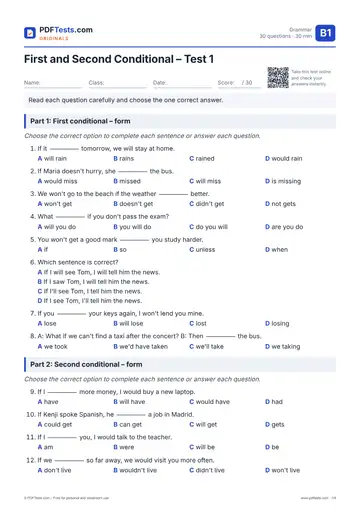
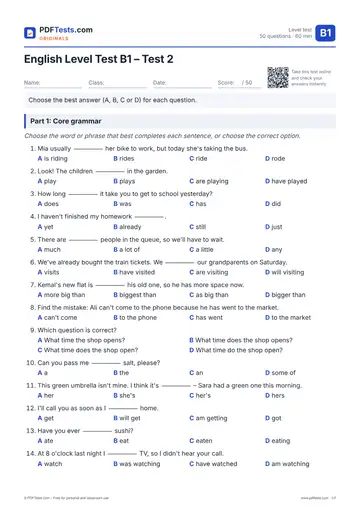
Preview of page 1 of English Level Test B1 – Test 1 Open PDF

Take the test online

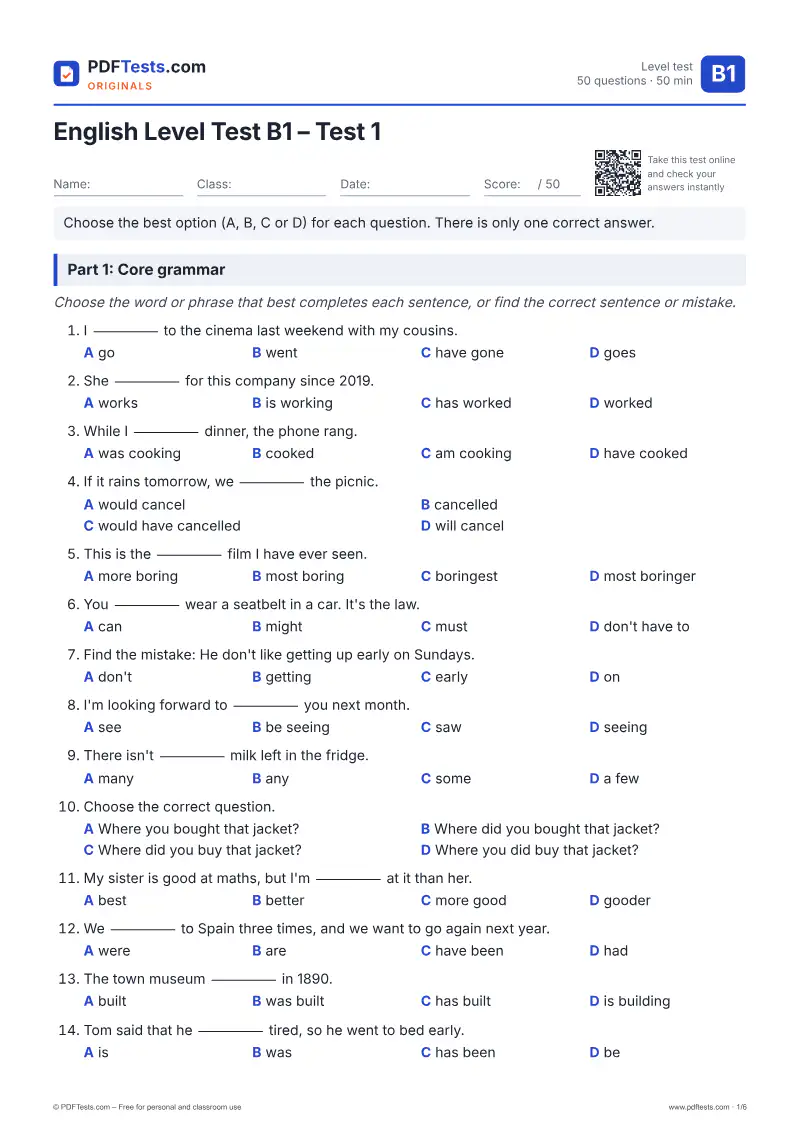
Choose the best option (A, B, C or D) for each question. There is only one correct answer. Choose your answers, then press “Check my answers”.

Part 1: Core grammar

Choose the word or phrase that best completes each sentence, or find the correct sentence or mistake.

  1. I _____ to the cinema last weekend with my cousins.

  2. She _____ for this company since 2019.

  3. While I _____ dinner, the phone rang.

  4. If it rains tomorrow, we _____ the picnic.

  5. This is the _____ film I have ever seen.

  6. You _____ wear a seatbelt in a car. It's the law.

  7. Find the mistake: He don't like getting up early on Sundays.

  8. I'm looking forward to _____ you next month.

  9. There isn't _____ milk left in the fridge.

  10. Choose the correct question.

  11. My sister is good at maths, but I'm _____ at it than her.

  12. We _____ to Spain three times, and we want to go again next year.

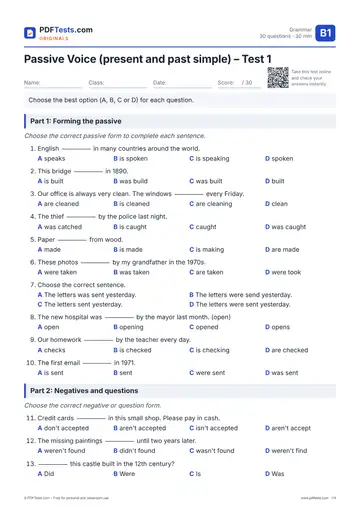
  13. The town museum _____ in 1890.

  14. Tom said that he _____ tired, so he went to bed early.

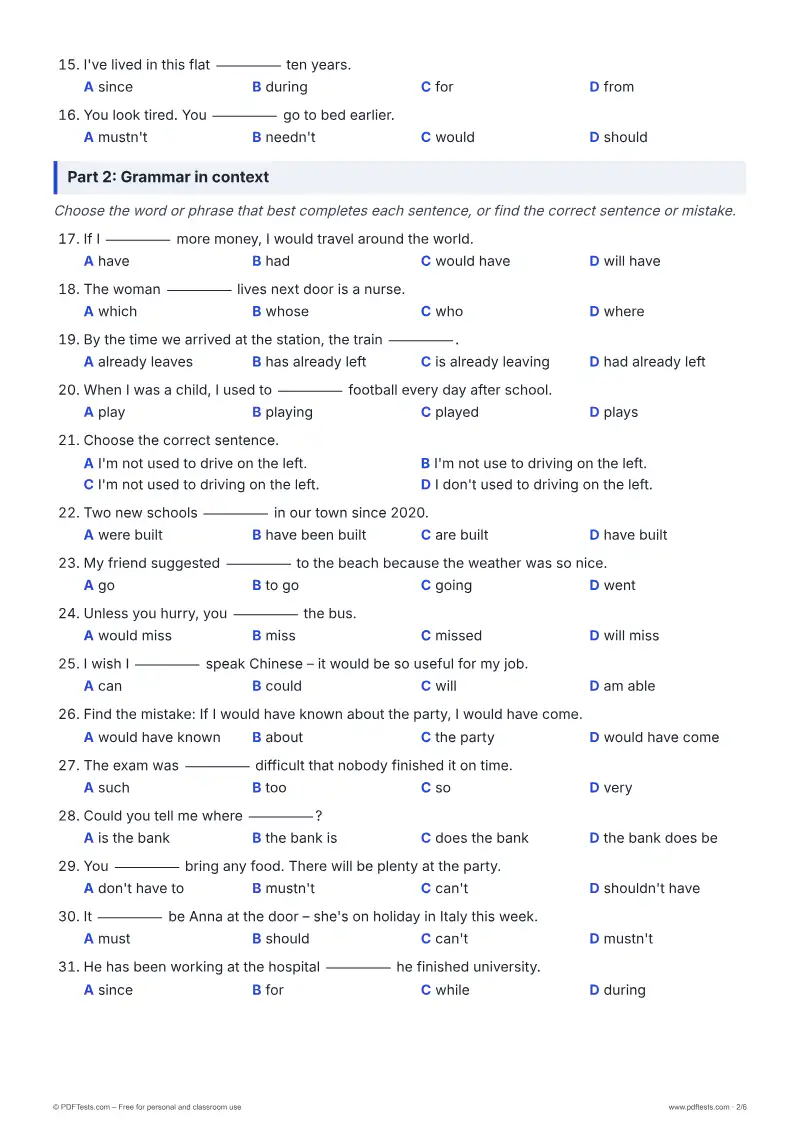
  15. I've lived in this flat _____ ten years.

  16. You look tired. You _____ go to bed earlier.

Part 2: Grammar in context

Choose the word or phrase that best completes each sentence, or find the correct sentence or mistake.

  1. If I _____ more money, I would travel around the world.

  2. The woman _____ lives next door is a nurse.

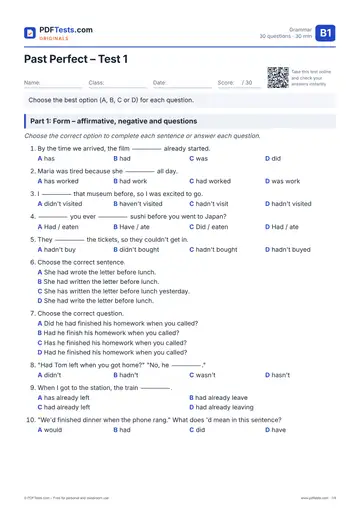
  3. By the time we arrived at the station, the train _____.

  4. When I was a child, I used to _____ football every day after school.

  5. Choose the correct sentence.

  6. Two new schools _____ in our town since 2020.

  7. My friend suggested _____ to the beach because the weather was so nice.

  8. Unless you hurry, you _____ the bus.

  9. I wish I _____ speak Chinese – it would be so useful for my job.

  10. Find the mistake: If I would have known about the party, I would have come.

  11. The exam was _____ difficult that nobody finished it on time.

  12. Could you tell me where _____?

  13. You _____ bring any food. There will be plenty at the party.

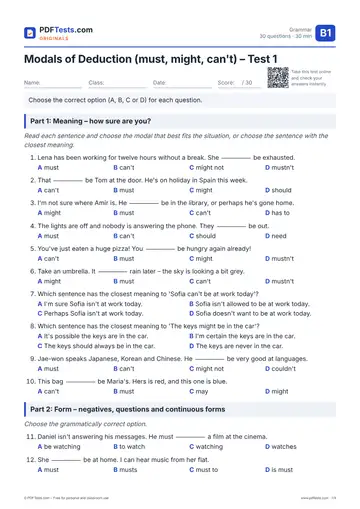
  14. It _____ be Anna at the door – she's on holiday in Italy this week.

  15. He has been working at the hospital _____ he finished university.

Part 3: Vocabulary and everyday language

Choose the best word, phrase or response for each question.

  1. Can you _____ me a favour and carry this bag?

  2. Could you _____ after my cat while I'm on holiday?

  3. Our flight was _____ for three hours because of fog, so we had to wait at the airport.

  4. The hotel staff were very _____ and helped us with everything. (HELP)

  5. I'm really _____ in learning about different cultures.

  6. A: Would you like some more tea? B: _____

  7. A: I've just passed my driving test! B: _____

  8. Sorry, I didn't _____ what you said. Could you repeat it, please?

  9. Lucy gave up sugar last year, and she feels much healthier now. What does 'gave up' mean here?

  10. I can't _____ to buy a new car at the moment – they're too expensive.

  11. Ben never shares anything or buys anyone a drink. He's quite _____.

  12. A: Do you mind if I open the window? B: _____ It's quite hot in here.

  13. My grandmother _____ me of my mother – they have exactly the same smile.

Part 4: Reading

Read the text and choose the best answer for each question.

When Priya moved to a new city for work two years ago, she didn't know anyone. Her flat was small and had no garden, and she spent most evenings alone watching TV. "I felt quite lonely at first," she says. "I missed my family and my friends back home."

One Saturday morning, while she was walking to the market, she noticed a group of people working on an empty piece of land behind the library. They were planting vegetables and building wooden boxes for flowers. A man called Daniel invited her to join them. He explained that the land had belonged to the city for years, but nobody had used it, so local residents had asked for permission to turn it into a community garden.

Priya had never grown anything before, but she decided to try. At first she made a lot of mistakes – she watered her tomatoes too much and planted her beans too close together. However, the other volunteers were patient and showed her what to do.

Now Priya goes to the garden three times a week. She is responsible for the herbs, and she has started a small cooking club where members prepare meals with the vegetables they grow. "The garden has changed my life," she says. "I've learned a new skill, I eat more healthily, and most importantly, I've made real friends."

  1. Why did Priya feel lonely when she first moved?

  2. How did Priya find out about the garden?

  3. Before it became a garden, the land behind the library _____.

  4. In paragraph 3, the word 'patient' means _____.

  5. Which mistake did Priya make when she started gardening?

  6. What is the main idea of the text?

Preview

About this test

This 50-question placement test checks whether a learner is secure at CEFR level B1 in English. It samples the key grammar, vocabulary and everyday functional language of the level and ends with a short reading text. It suits teenage and adult learners, teachers placing new students, and self-study learners checking their progress.

Topics covered

Past and perfect tensesConditionals and wishesModal verbsPassive voiceGerunds and infinitivesVocabulary and collocationsFunctional languageReading comprehension

How to use this test

  1. Download the PDF and print it, or take the test online below.
  2. Answer every question without a dictionary or time pressure.
  3. Check your answers and note the topics you need to review.

Notes for teachers

Give learners about 50 minutes without dictionaries; a score of 38/50 or more suggests the learner is secure at B1, 28–37 suggests B1 with gaps, and below 28 suggests reviewing A2–B1 material. The test targets common B1 errors such as present perfect vs past simple, 'used to' vs 'be used to', 'suggest + -ing', 'so/such', indirect questions and 'mustn't' vs 'don't have to'. Use the section scores to identify weak areas, and ask learners to explain their wrong answers in pairs as a follow-up.