PDFTests Originals

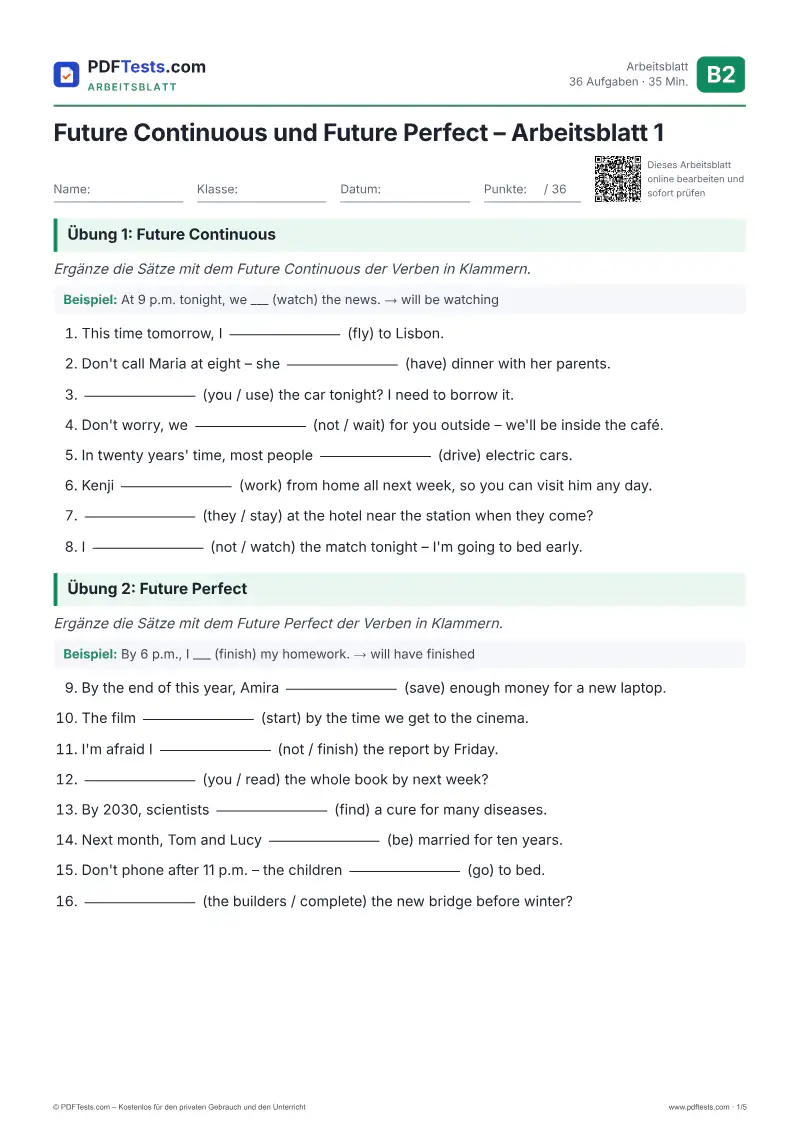
Future Continuous und Future Perfect – Arbeitsblatt 1

B2 Gute Mittelstufe ArbeitsblattEnglisch

Dieses Arbeitsblatt übt das Future Continuous (will be doing) für Handlungen, die zu einem bestimmten Zeitpunkt in der Zukunft gerade ablaufen. Außerdem wird das Future Perfect (will have done) für Handlungen geübt, die vor einem Zeitpunkt in der Zukunft abgeschlossen sein werden. Es richtet sich an Lernende auf Niveau B2 und behandelt bejahte Aussagesätze, Verneinungen und Fragen – von gelenkten Lückentexten bis hin zum Umformulieren von Sätzen und zur Fehlerkorrektur.
Aufgaben
36
Zeit
35 Min.
PDF
5 Seiten
Lösungen
Enthalten
  • 100 % kostenlos
  • Ohne Anmeldung
  • Druckfertiges A4-PDF
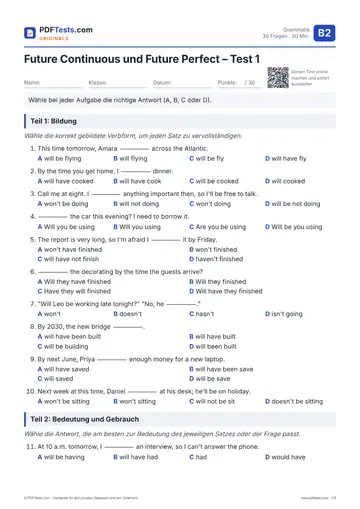
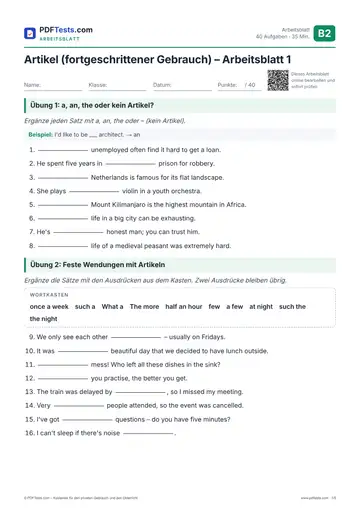
Vorschau von Seite 1: Future Continuous und Future Perfect – Arbeitsblatt 1 PDF öffnen

Arbeitsblatt online bearbeiten

Tippen Sie Ihre Antworten ein und klicken Sie auf „Antworten prüfen“. Alternative richtige Antworten werden akzeptiert.

Übung 1: Future Continuous

Ergänze die Sätze mit dem Future Continuous der Verben in Klammern.

Beispiel: At 9 p.m. tonight, we ___ (watch) the news. → will be watching

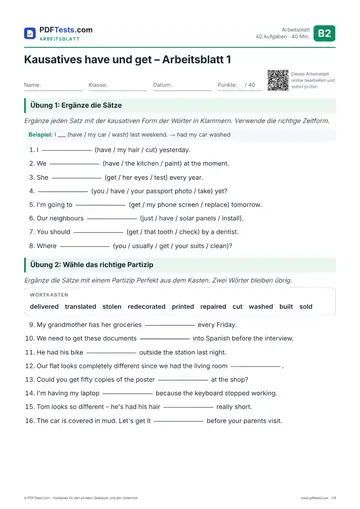
  1. This time tomorrow, I (fly) to Lisbon.

  2. Don't call Maria at eight – she (have) dinner with her parents.

  3. (you / use) the car tonight? I need to borrow it.

  4. Don't worry, we (not / wait) for you outside – we'll be inside the café.

  5. In twenty years' time, most people (drive) electric cars.

  6. Kenji (work) from home all next week, so you can visit him any day.

  7. (they / stay) at the hotel near the station when they come?

  8. I (not / watch) the match tonight – I'm going to bed early.

Übung 2: Future Perfect

Ergänze die Sätze mit dem Future Perfect der Verben in Klammern.

Beispiel: By 6 p.m., I ___ (finish) my homework. → will have finished

  1. By the end of this year, Amira (save) enough money for a new laptop.

  2. The film (start) by the time we get to the cinema.

  3. I'm afraid I (not / finish) the report by Friday.

  4. (you / read) the whole book by next week?

  5. By 2030, scientists (find) a cure for many diseases.

  6. Next month, Tom and Lucy (be) married for ten years.

  7. Don't phone after 11 p.m. – the children (go) to bed.

  8. (the builders / complete) the new bridge before winter?

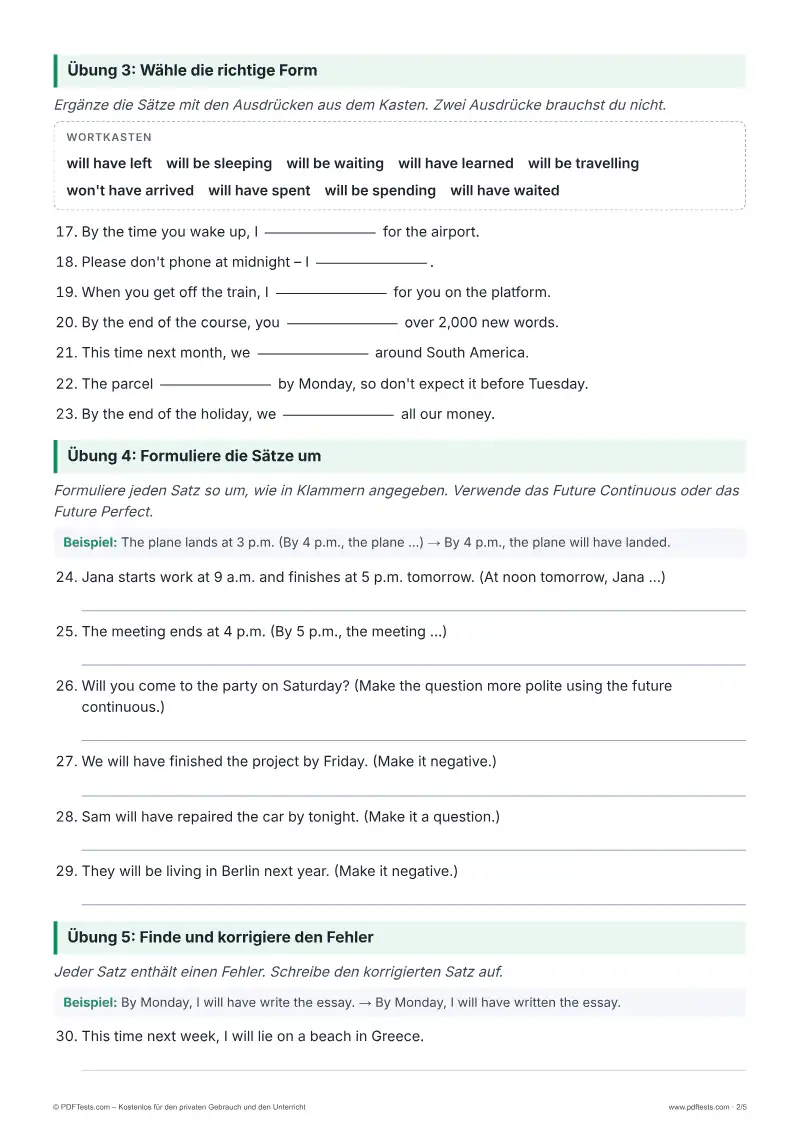
Übung 3: Wähle die richtige Form

Ergänze die Sätze mit den Ausdrücken aus dem Kasten. Zwei Ausdrücke brauchst du nicht.

Wortkasten will have leftwill be sleepingwill be waitingwill have learnedwill be travellingwon't have arrivedwill have spentwill be spendingwill have waited

  1. By the time you wake up, I for the airport.

  2. Please don't phone at midnight – I .

  3. When you get off the train, I for you on the platform.

  4. By the end of the course, you over 2,000 new words.

  5. This time next month, we around South America.

  6. The parcel by Monday, so don't expect it before Tuesday.

  7. By the end of the holiday, we all our money.

Übung 4: Formuliere die Sätze um

Formuliere jeden Satz so um, wie in Klammern angegeben. Verwende das Future Continuous oder das Future Perfect.

Beispiel: The plane lands at 3 p.m. (By 4 p.m., the plane ...) → By 4 p.m., the plane will have landed.

  1. Jana starts work at 9 a.m. and finishes at 5 p.m. tomorrow. (At noon tomorrow, Jana ...)

  2. The meeting ends at 4 p.m. (By 5 p.m., the meeting ...)

  3. Will you come to the party on Saturday? (Make the question more polite using the future continuous.)

  4. We will have finished the project by Friday. (Make it negative.)

  5. Sam will have repaired the car by tonight. (Make it a question.)

  6. They will be living in Berlin next year. (Make it negative.)

Übung 5: Finde und korrigiere den Fehler

Jeder Satz enthält einen Fehler. Schreibe den korrigierten Satz auf.

Beispiel: By Monday, I will have write the essay. → By Monday, I will have written the essay.

  1. This time next week, I will lie on a beach in Greece.

  2. By the time you arrive, we will have finish dinner.

  3. Will you been working late tonight?

  4. She won't have arrive by six o'clock.

  5. By next summer, I will be finished my degree.

  6. Don't worry, they won't be wait long.

  7. By the end of the month, how many books you will have read?

War diese Seite hilfreich?

Fehler melden

Falsche Lösung, Tippfehler oder unklare Erklärung? Schreiben Sie uns, wir korrigieren es.

Vorschau

Über diesen Test

Arbeitsblatt Englisch B2 als PDF: Future Continuous und Future Perfect – Bildung, Bedeutung, Verneinung und Fragen mit Übungen und Lösungen.

Themen

Future ContinuousFuture PerfectZeitangaben: by, by the time, this time next weekVerneinungen und FragenHöfliche Fragen nach Plänen

Hinweise für Lehrkräfte

Beginnen Sie mit einem Zeitstrahl an der Tafel. Markieren Sie einen Zeitpunkt in der Zukunft und stellen Sie eine Handlung, die zu diesem Zeitpunkt gerade abläuft (will be doing), einer Handlung gegenüber, die davor abgeschlossen ist (will have done). Lernende vergessen häufig die -ing-Form oder das Past Participle (will be wait, will have finish) und verwechseln nach „by“ die beiden Zeitformen. Weisen Sie darauf hin, dass „by“ und „by the time“ meist das Future Perfect anzeigen. Zur Vertiefung können Paare beschreiben, was sie nächstes Jahr um diese Zeit tun werden und was sie bis dahin erreicht haben werden.

Alle Englisch-Tests B2 →