PDFTests Originals

Englisch Einstufungstest B2 – Test 1

B2 Gute Mittelstufe EinstufungstestEnglisch

Mit diesem Einstufungstest prüfen Sie, ob jemand das Niveau B2 (obere Mittelstufe) sicher beherrscht. Er deckt die zentrale B2-Grammatik, Wortschatz, Phrasal Verbs, Wortbildung und Kollokationen ab und endet mit einem kurzen Lesetext. Der Test richtet sich an Lehrkräfte, die Lernende in passende Kurse einstufen möchten, und an alle, die ihr Niveau im Selbststudium überprüfen wollen.

Fragen
50
Zeit
60 Min.
PDF
6 Seiten
Lösungen
Enthalten
  • 100 % kostenlos
  • Ohne Anmeldung
  • Druckfertiges A4-PDF
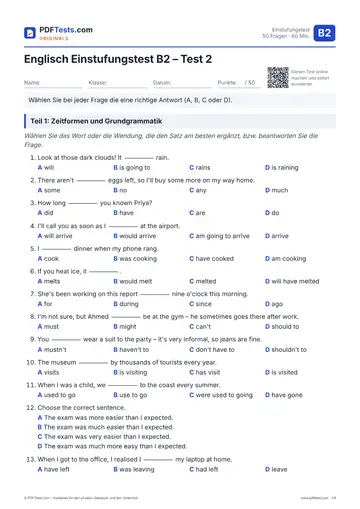
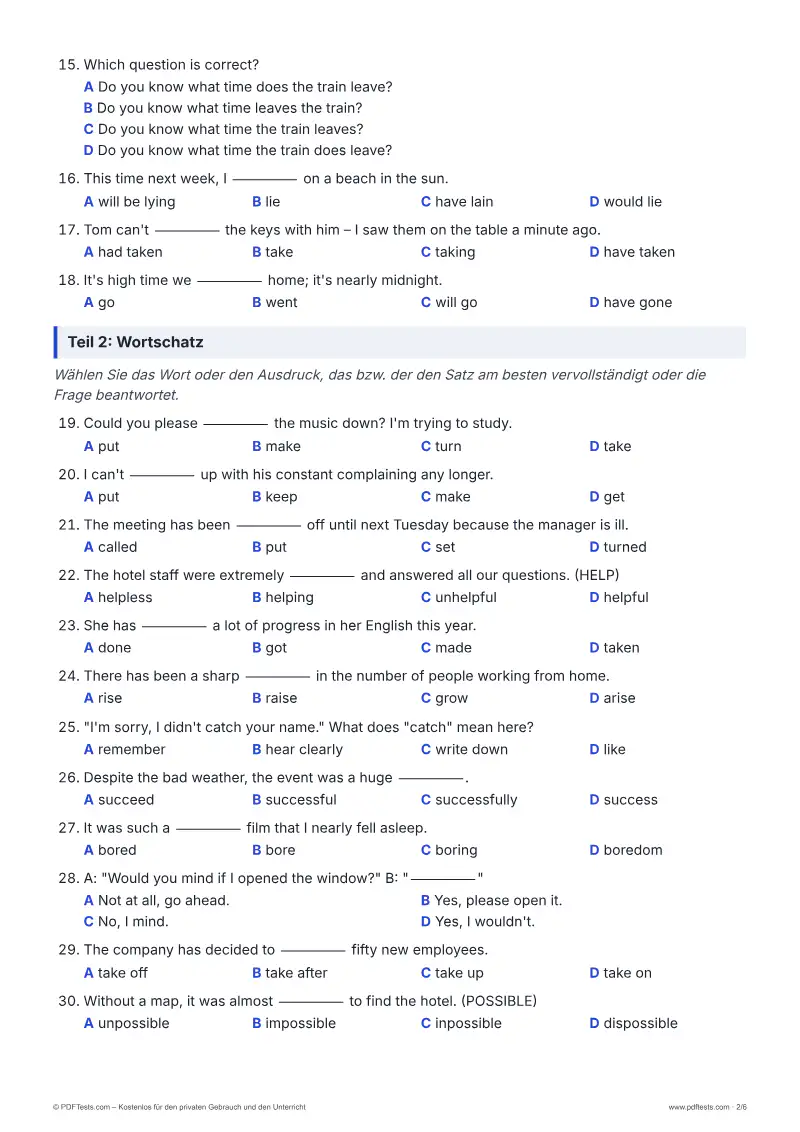
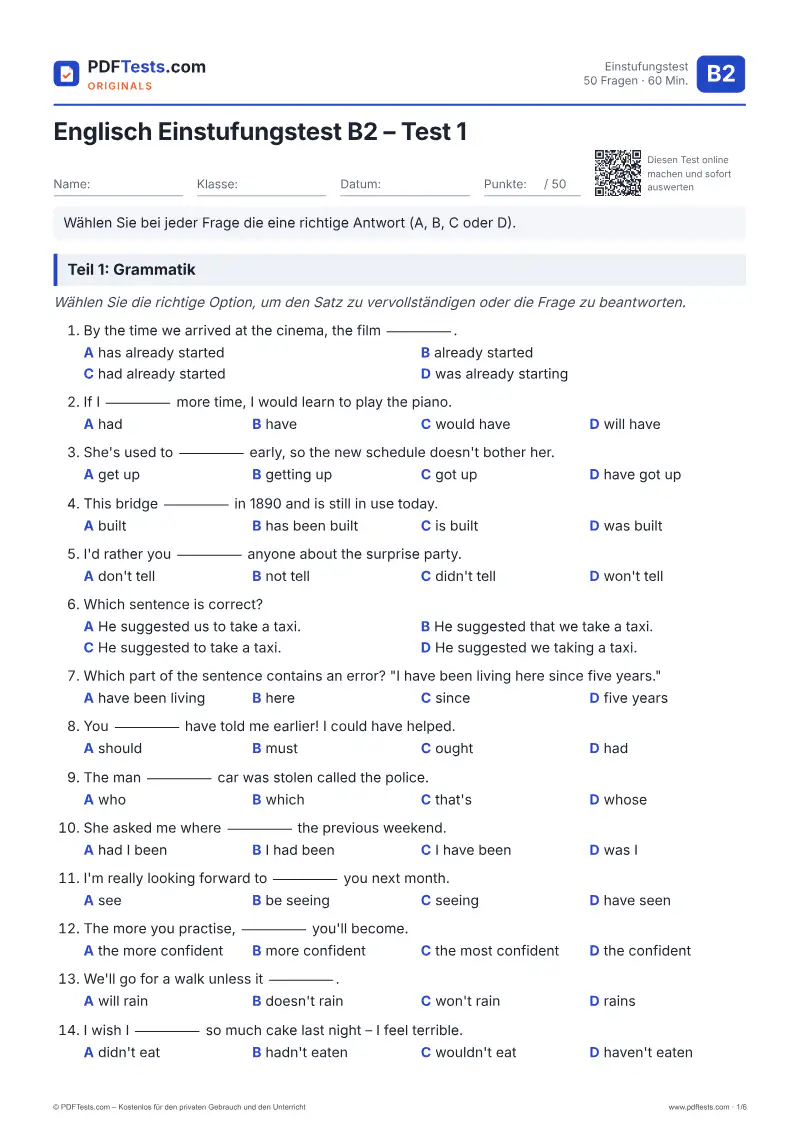
Vorschau von Seite 1: Englisch Einstufungstest B2 – Test 1 PDF öffnen

Test online machen

Wählen Sie bei jeder Frage die eine richtige Antwort (A, B, C oder D). Wählen Sie Ihre Antworten und klicken Sie auf „Antworten prüfen“.

Teil 1: Grammatik

Wählen Sie die richtige Option, um den Satz zu vervollständigen oder die Frage zu beantworten.

  1. By the time we arrived at the cinema, the film _____.

  2. If I _____ more time, I would learn to play the piano.

  3. She's used to _____ early, so the new schedule doesn't bother her.

  4. This bridge _____ in 1890 and is still in use today.

  5. I'd rather you _____ anyone about the surprise party.

  6. Which sentence is correct?

  7. Which part of the sentence contains an error? "I have been living here since five years."

  8. You _____ have told me earlier! I could have helped.

  9. The man _____ car was stolen called the police.

  10. She asked me where _____ the previous weekend.

  11. I'm really looking forward to _____ you next month.

  12. The more you practise, _____ you'll become.

  13. We'll go for a walk unless it _____.

  14. I wish I _____ so much cake last night – I feel terrible.

  15. Which question is correct?

  16. This time next week, I _____ on a beach in the sun.

  17. Tom can't _____ the keys with him – I saw them on the table a minute ago.

  18. It's high time we _____ home; it's nearly midnight.

Teil 2: Wortschatz

Wählen Sie das Wort oder den Ausdruck, das bzw. der den Satz am besten vervollständigt oder die Frage beantwortet.

  1. Could you please _____ the music down? I'm trying to study.

  2. I can't _____ up with his constant complaining any longer.

  3. The meeting has been _____ off until next Tuesday because the manager is ill.

  4. The hotel staff were extremely _____ and answered all our questions. (HELP)

  5. She has _____ a lot of progress in her English this year.

  6. There has been a sharp _____ in the number of people working from home.

  7. "I'm sorry, I didn't catch your name." What does "catch" mean here?

  8. Despite the bad weather, the event was a huge _____.

  9. It was such a _____ film that I nearly fell asleep.

  10. A: "Would you mind if I opened the window?" B: "_____"

  11. The company has decided to _____ fifty new employees.

  12. Without a map, it was almost _____ to find the hotel. (POSSIBLE)

  13. My sister and I _____ after our father – we both have dark hair and green eyes.

  14. "The new manager is very approachable." This means the manager is:

Teil 3: Fortgeschrittene Grammatik und Sprachgebrauch

Wählen Sie die richtige Option. Diese Fragen sind anspruchsvoller.

  1. Not only _____ late, but he also forgot his notes.

  2. If she had taken the job in London, she _____ in a big city now.

  3. Hardly _____ sat down when the phone rang.

  4. The project _____ by the end of next month.

  5. Which part of the sentence contains an error? "Neither the teacher nor the students was aware of the change."

  6. Which sentence is correct?

  7. _____ the train was delayed, we still arrived on time.

  8. She denied _____ the documents.

  9. He spoke so quietly that hardly _____ could hear him.

  10. Supposing you _____ the lottery, what would you do first?

  11. The report, _____ was published yesterday, has caused a lot of debate.

  12. "You needn't have brought a gift." What does this mean?

Teil 4: Leseverstehen

Lesen Sie den Text und wählen Sie bei jeder Frage die beste Antwort.

When Lena Hoffmann's coffee machine stopped working last winter, her first thought was to buy a new one. Instead, a neighbour suggested she take it to the repair café that meets once a month in the local library. 'I was sceptical,' Lena admits. 'I assumed it would be a waste of time, but a retired engineer fixed it in twenty minutes, and he showed me how to do it myself next time.'

Repair cafés are free events where volunteers with practical skills help visitors mend broken household items, from lamps and toasters to clothes and bicycles. The idea is simple: rather than throwing things away, people are encouraged to give them a second life. Organisers say the events reduce waste, save money and, perhaps just as importantly, bring people together.

Daniel Osei, who has run the local café for three years, believes the social side is often underestimated. 'People come for the repair, but they stay for the conversation,' he explains. 'We have students sitting next to pensioners, sharing tools and stories. For some older visitors, it's the only time in the month they really talk to anyone.'

However, the movement faces challenges. Many modern products are designed in ways that make them difficult to open, and spare parts can be expensive or simply unavailable. Some volunteers also worry about safety, particularly when dealing with electrical items. To address this, Daniel's group now requires every electrical repair to be checked by a qualified electrician before it leaves the room.

Despite these obstacles, interest is growing. Last year the café repaired more than 400 items, and Daniel hopes to open a second location soon. 'Every object we fix is one less thing in a landfill,' he says. 'That may sound small, but it adds up.'

  1. Why did Lena first go to the repair café?

  2. How did Lena feel before her visit?

  3. According to Daniel, what is often underestimated?

  4. The word "mend" in paragraph 2 is closest in meaning to:

  5. What has Daniel's group done to deal with safety concerns?

  6. What is Daniel's attitude to the future of the café?

Vorschau

Über diesen Test

Mit diesem Einstufungstest prüfen Sie, ob jemand das Niveau B2 (obere Mittelstufe) sicher beherrscht. Er deckt die zentrale B2-Grammatik, Wortschatz, Phrasal Verbs, Wortbildung und Kollokationen ab und endet mit einem kurzen Lesetext. Der Test richtet sich an Lehrkräfte, die Lernende in passende Kurse einstufen möchten, und an alle, die ihr Niveau im Selbststudium überprüfen wollen.

Themen

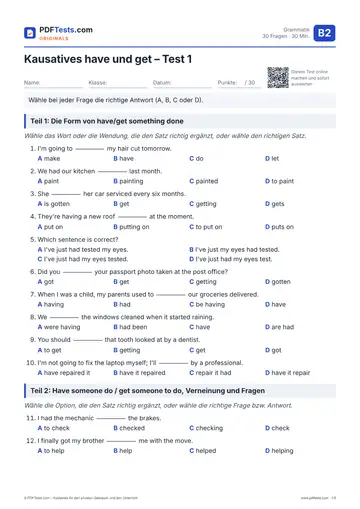
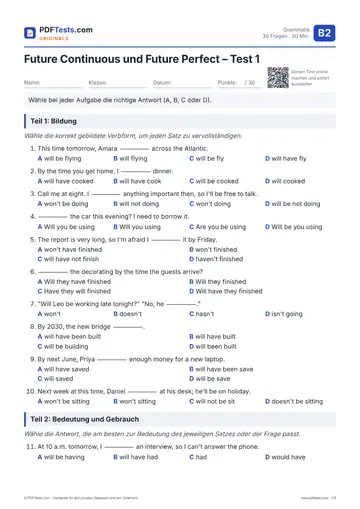
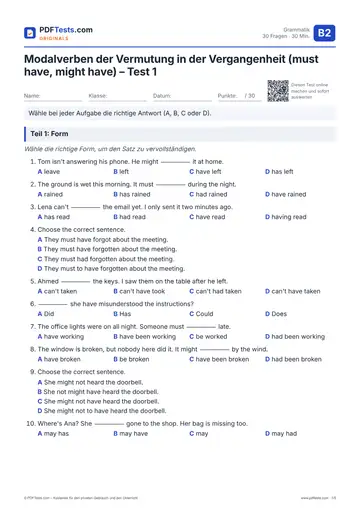
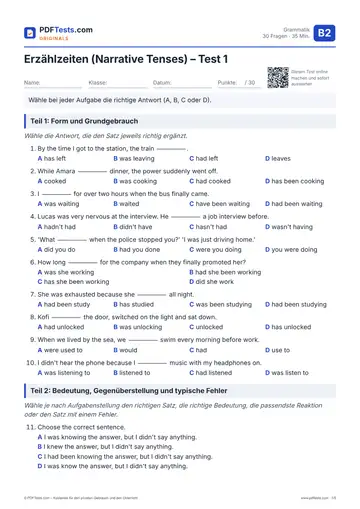
Zeitformen und ZukunftsformenKonditionalsätze und Wünsche (wish)ModalverbenPassiv und kausative StrukturenInversion und RelativsätzePhrasal Verbs und KollokationenWortbildungLeseverstehen

So nutzen Sie diesen Test

  1. Laden Sie das PDF herunter und drucken Sie es aus – oder machen Sie den Test unten online.
  2. Beantworten Sie alle Fragen ohne Wörterbuch und ohne Zeitdruck.
  3. Prüfen Sie Ihre Antworten und notieren Sie, was Sie wiederholen sollten.

Hinweise für Lehrkräfte

Planen Sie etwa 60 Minuten ohne Wörterbuch ein. Als grobe Orientierung: Ab 40 Punkten beherrscht die Person B2 sicher, 30–39 Punkte deuten darauf hin, dass sie auf dem Weg zu B2 ist, und unter 30 Punkten ist ein B1-Kurs wahrscheinlich besser geeignet. Der Test zielt auf typische Fehler ab, etwa 'since' vs. 'for', 'suggest' + to-Infinitiv, die falsche Zeitform nach 'wish' und 'it's high time' sowie leicht verwechselbare Paare wie 'rise/raise'. Nutzen Sie die Fehler in Teil 3 als Grundlage für Folgestunden zu Inversion, gemischten Konditionalsätzen (mixed conditionals) und nicht notwendigen Relativsätzen (non-defining relative clauses).