PDFTests Originals

Leseverstehen – Test 3

C1 Fortgeschritten LeseverstehenEnglisch

Dieser Test zum Leseverstehen auf Niveau C1 enthält drei Originaltexte unterschiedlicher Textsorten: einen populärwissenschaftlichen Artikel über das Gedächtnis, eine Kurzgeschichte über zwei Geschwister auf einer Bergwanderung und einen Leserbrief an eine Zeitung zum Thema Handschrift im Unterricht. Die 20 Fragen prüfen globales und detailliertes Verstehen, das Erschließen impliziter Aussagen, die Schreibabsicht sowie Wortschatz im Kontext. Der Test eignet sich für fortgeschrittene Lernende, die sich auf C1-Prüfungen vorbereiten, und für Lehrkräfte, die eine fertige Leistungsüberprüfung zum Leseverstehen suchen.

Fragen
20
Zeit
40 Min.
PDF
7 Seiten
Lösungen
Enthalten
  • 100 % kostenlos
  • Ohne Anmeldung
  • Druckfertiges A4-PDF
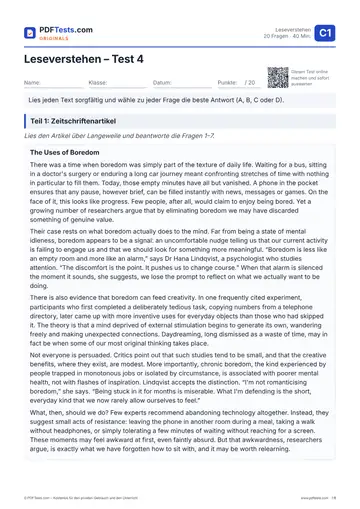
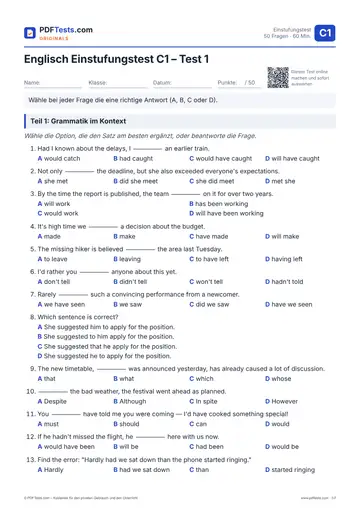
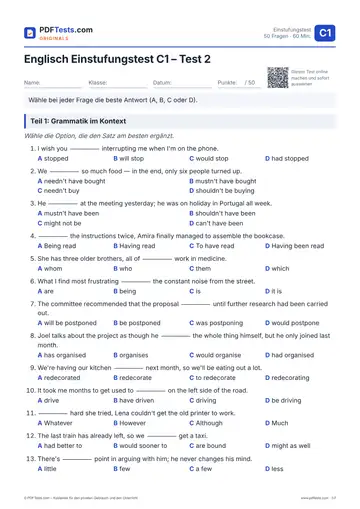
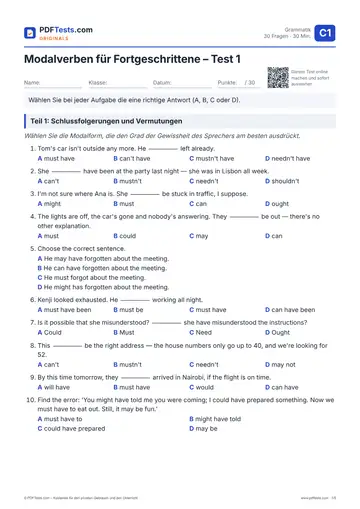
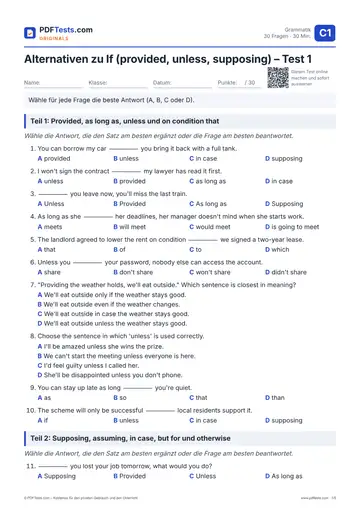
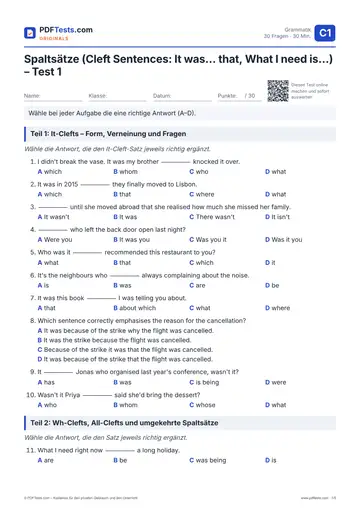
Vorschau von Seite 1: Leseverstehen – Test 3 PDF öffnen

Test online machen

Lies jeden Text aufmerksam und wähle für jede Frage die beste Antwort (A, B, C oder D). Wählen Sie Ihre Antworten und klicken Sie auf „Antworten prüfen“.

Teil 1: Populärwissenschaftlicher Artikel

Lies den Artikel über das Gedächtnis und beantworte die Fragen 1–7.

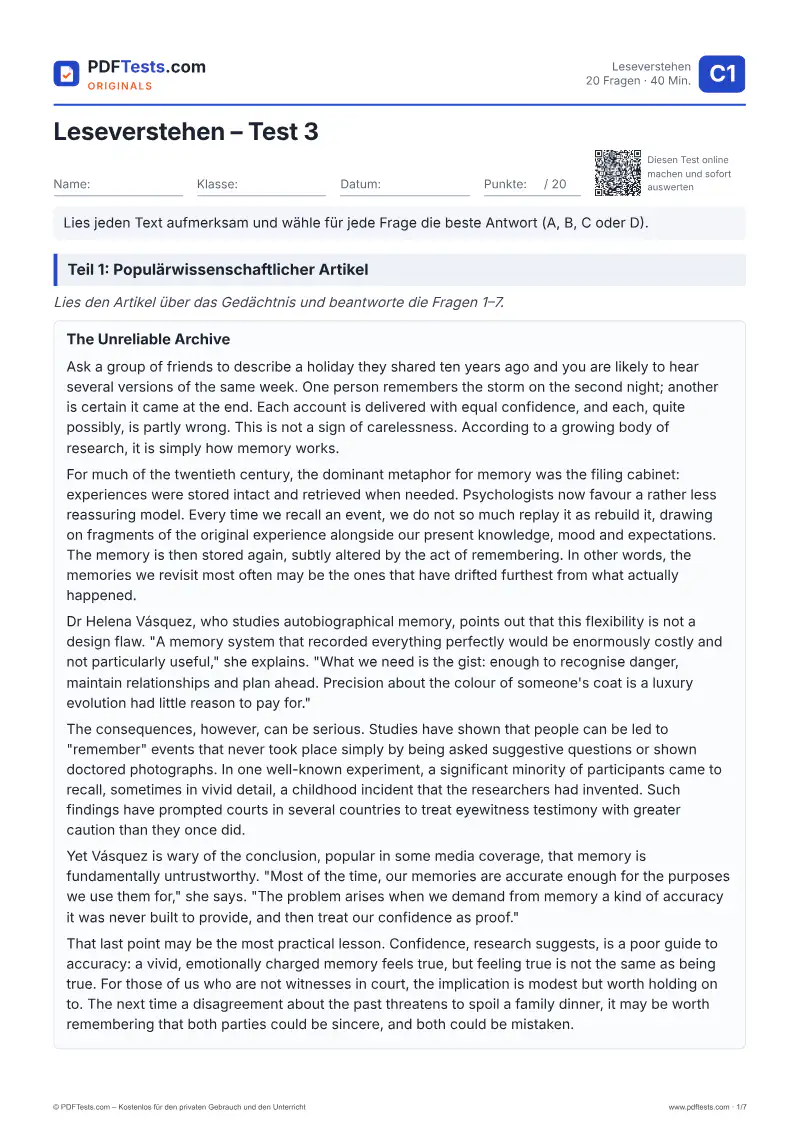
The Unreliable Archive

Ask a group of friends to describe a holiday they shared ten years ago and you are likely to hear several versions of the same week. One person remembers the storm on the second night; another is certain it came at the end. Each account is delivered with equal confidence, and each, quite possibly, is partly wrong. This is not a sign of carelessness. According to a growing body of research, it is simply how memory works.

For much of the twentieth century, the dominant metaphor for memory was the filing cabinet: experiences were stored intact and retrieved when needed. Psychologists now favour a rather less reassuring model. Every time we recall an event, we do not so much replay it as rebuild it, drawing on fragments of the original experience alongside our present knowledge, mood and expectations. The memory is then stored again, subtly altered by the act of remembering. In other words, the memories we revisit most often may be the ones that have drifted furthest from what actually happened.

Dr Helena Vásquez, who studies autobiographical memory, points out that this flexibility is not a design flaw. "A memory system that recorded everything perfectly would be enormously costly and not particularly useful," she explains. "What we need is the gist: enough to recognise danger, maintain relationships and plan ahead. Precision about the colour of someone's coat is a luxury evolution had little reason to pay for."

The consequences, however, can be serious. Studies have shown that people can be led to "remember" events that never took place simply by being asked suggestive questions or shown doctored photographs. In one well-known experiment, a significant minority of participants came to recall, sometimes in vivid detail, a childhood incident that the researchers had invented. Such findings have prompted courts in several countries to treat eyewitness testimony with greater caution than they once did.

Yet Vásquez is wary of the conclusion, popular in some media coverage, that memory is fundamentally untrustworthy. "Most of the time, our memories are accurate enough for the purposes we use them for," she says. "The problem arises when we demand from memory a kind of accuracy it was never built to provide, and then treat our confidence as proof."

That last point may be the most practical lesson. Confidence, research suggests, is a poor guide to accuracy: a vivid, emotionally charged memory feels true, but feeling true is not the same as being true. For those of us who are not witnesses in court, the implication is modest but worth holding on to. The next time a disagreement about the past threatens to spoil a family dinner, it may be worth remembering that both parties could be sincere, and both could be mistaken.

  1. Which of the following best expresses the central idea of the article?

  2. According to paragraph 2, why might the memories we recall most often be the least accurate?

  3. In paragraph 4, the word 'doctored' in 'doctored photographs' is closest in meaning to:

  4. What does Dr Vásquez imply with her remark about 'the colour of someone's coat'?

  5. Why does the writer mention courts in paragraph 4?

  6. How does Dr Vásquez respond to the claim that memory is fundamentally untrustworthy?

  7. What does the writer suggest in the final paragraph?

Teil 2: Kurzgeschichte

Lies die Geschichte und beantworte die Fragen 8–14.

The Ridge

Maren had agreed to the walk mainly because refusing would have required an explanation. Her brother Teodor had suggested it in a message so brief it felt almost rehearsed: Saturday, the old ridge path, early start. They had not spent a whole day together since their father's house was sold, and the sale (who had wanted it, who had handled it, who had been consulted too late) still sat between them like a third walker neither of them acknowledged.

The first hour passed in safe topics. The weather, which was holding. His new job, which he described in more detail than she needed. Her daughter's exams. Teodor walked ahead, as he always had, setting a pace that was just slightly too fast, and Maren found herself irritated by how familiar the view of his back was.

Near the cairn at the halfway point, the path narrowed and the wind picked up. Teodor stopped to retie a lace that did not need retying. "Dad used to make us stop here," he said, without looking up. "He'd give us each a square of chocolate and tell us the worst part was over."

"It never was," Maren said. "The scramble at the end was always worse."

"I know. I think that was the point." He straightened. "He wasn't lying, exactly. He just knew we'd keep going if we thought the hard bit was behind us."

She considered this. It was the kind of observation she would have expected from herself rather than from him, and it unsettled her slightly, as if he had borrowed something without asking.

They reached the scramble an hour later. It was shorter than she remembered, but steeper, and halfway up Maren's foot slipped on a loose stone. Before she could steady herself, Teodor's hand was there, gripping her wrist with a firmness that surprised them both. Neither spoke until they had reached the top.

At the summit, he produced a bar of chocolate from his pocket and broke off two squares with exaggerated ceremony. Maren laughed despite herself.

"I should have asked you," he said suddenly. "About the house. Before I signed anything. I told myself there wasn't time, but that wasn't really it."

It was not quite an apology, and a year ago she would have pointed that out. Instead she took the chocolate and looked down at the path they had come up, which from here seemed far gentler than it had felt.

"The worst part's over," she said.

He glanced at her, uncertain whether she meant the climb. She was not entirely sure herself.

  1. Why did Maren agree to go on the walk?

  2. The sale of the house sat between them 'like a third walker neither of them acknowledged'. This suggests that the sale was…

  3. What is suggested by the fact that Teodor 'stopped to retie a lace that did not need retying'?

  4. What has Teodor come to understand about his father's words at the cairn?

  5. At the summit, Teodor breaks off the chocolate 'with exaggerated ceremony'. This means he does it…

  6. 'It was not quite an apology, and a year ago she would have pointed that out.' What does this sentence imply about Maren?

  7. What is the effect of the story's final lines?

Teil 3: Leserbrief

Lies den Leserbrief an eine Zeitung und beantworte die Fragen 15–20.

Dear Editor,

I read Daniel Forsythe's article "Time to Let the Pen Go" (14 March) with interest, and with some sympathy for its central frustration. Anyone who has watched a class of ten-year-olds labour over joined-up letters while the clock ticks towards lunch will understand the appeal of his argument: that in an age of keyboards and voice recognition, schools should stop devoting precious hours to a skill most adults barely use. I would, however, urge readers to treat his conclusion with considerable caution.

Mr Forsythe presents handwriting as a purely mechanical skill, a means of putting words on paper that can be replaced by a faster, tidier alternative. This is where his case is weakest. A considerable body of research suggests that forming letters by hand engages the brain differently from pressing keys. Students who take notes by hand, for instance, tend to write less than those who type, yet they often recall and understand the material better, apparently because the slower pace forces them to summarise rather than transcribe. Handwriting, in other words, may be less about the page than about the thinking that happens on the way to it.

Nor is it obvious that the time saved would be well spent. Mr Forsythe suggests that the hours freed up could go to coding or digital literacy. Both are valuable, but they are not substitutes for the fine motor control, patience and attention to detail that handwriting practice develops, particularly in younger children. As an occupational therapist who works with primary schools, I see every week the difficulties faced by children whose hands have had too little practice at precise, controlled movement, and these difficulties extend well beyond writing.

None of this means that schools should cling to every traditional practice. The insistence on a single, uniform style of joined-up writing, for example, seems to me far less defensible than the teaching of legible handwriting in general, and I would happily see it relaxed. Equally, there is no reason why pupils should not become fluent typists as well; the two skills are complementary rather than competing.

What concerns me most is the article's underlying assumption that if a technology can perform a task, the human skill behind it has become obsolete. Calculators did not make mental arithmetic worthless, and spell-checkers have not made spelling irrelevant. We should be wary of discarding a skill before we fully understand what else it was quietly teaching us.

Yours faithfully,

Grace Mbeki

Occupational therapist

  1. Why has Grace Mbeki written to the newspaper?

  2. In paragraph 4, the writer says handwriting and typing are 'complementary rather than competing'. This means that the two skills…

  3. According to the letter, why do students who take notes by hand often understand the material better?

  4. Why does the writer mention that she is an occupational therapist who works with primary schools?

  5. Which traditional practice would the writer be happy to see changed?

  6. Why does the writer refer to calculators and spell-checkers in the final paragraph?

War diese Seite hilfreich?

Fehler melden

Falsche Lösung, Tippfehler oder unklare Erklärung? Schreiben Sie uns, wir korrigieren es.

Vorschau

Über diesen Test

Dieser Test zum Leseverstehen auf Niveau C1 enthält drei Originaltexte unterschiedlicher Textsorten: einen populärwissenschaftlichen Artikel über das Gedächtnis, eine Kurzgeschichte über zwei Geschwister auf einer Bergwanderung und einen Leserbrief an eine Zeitung zum Thema Handschrift im Unterricht. Die 20 Fragen prüfen globales und detailliertes Verstehen, das Erschließen impliziter Aussagen, die Schreibabsicht sowie Wortschatz im Kontext. Der Test eignet sich für fortgeschrittene Lernende, die sich auf C1-Prüfungen vorbereiten, und für Lehrkräfte, die eine fertige Leistungsüberprüfung zum Leseverstehen suchen.

Themen

LeseverstehenGlobalverstehen und HauptaussageSchlussfolgerndes Lesen (Inference)Wortschatz im KontextSchreibabsichtInterpretation erzählender TexteArgumentative Texte

So nutzen Sie diesen Test

  1. Laden Sie das PDF herunter und drucken Sie es aus – oder machen Sie den Test unten online.
  2. Beantworten Sie alle Fragen ohne Wörterbuch und ohne Zeitdruck.
  3. Prüfen Sie Ihre Antworten und notieren Sie, was Sie wiederholen sollten.

Hinweise für Lehrkräfte

Setzen Sie den Test als Prüfungsvorbereitung mit Zeitvorgabe ein oder bearbeiten Sie pro Unterrichtsstunde einen Text. Die Fragen zielen auf typische Schwachstellen auf C1-Niveau: eine Antwort zu wählen, nur weil sie Wörter aus dem Text wiederholt, bildhafte Sprache wörtlich zu verstehen und die Meinung der Verfasserin mit Ansichten zu verwechseln, die sie lediglich wiedergibt. Lassen Sie die Lernenden anschließend die genaue Textstelle unterstreichen, die jede Antwort belegt. Als Anschlussaufgabe können die Lernenden einen eigenen Antwortbrief an Grace Mbeki schreiben oder die Geschichte aus Teodors Sicht fortsetzen.