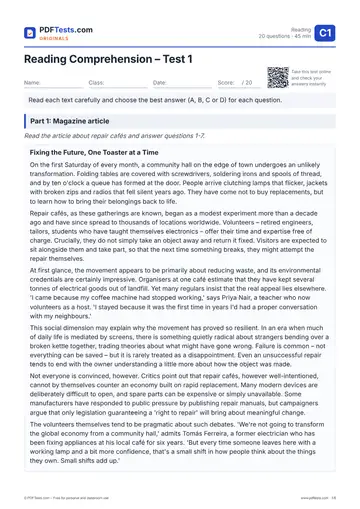
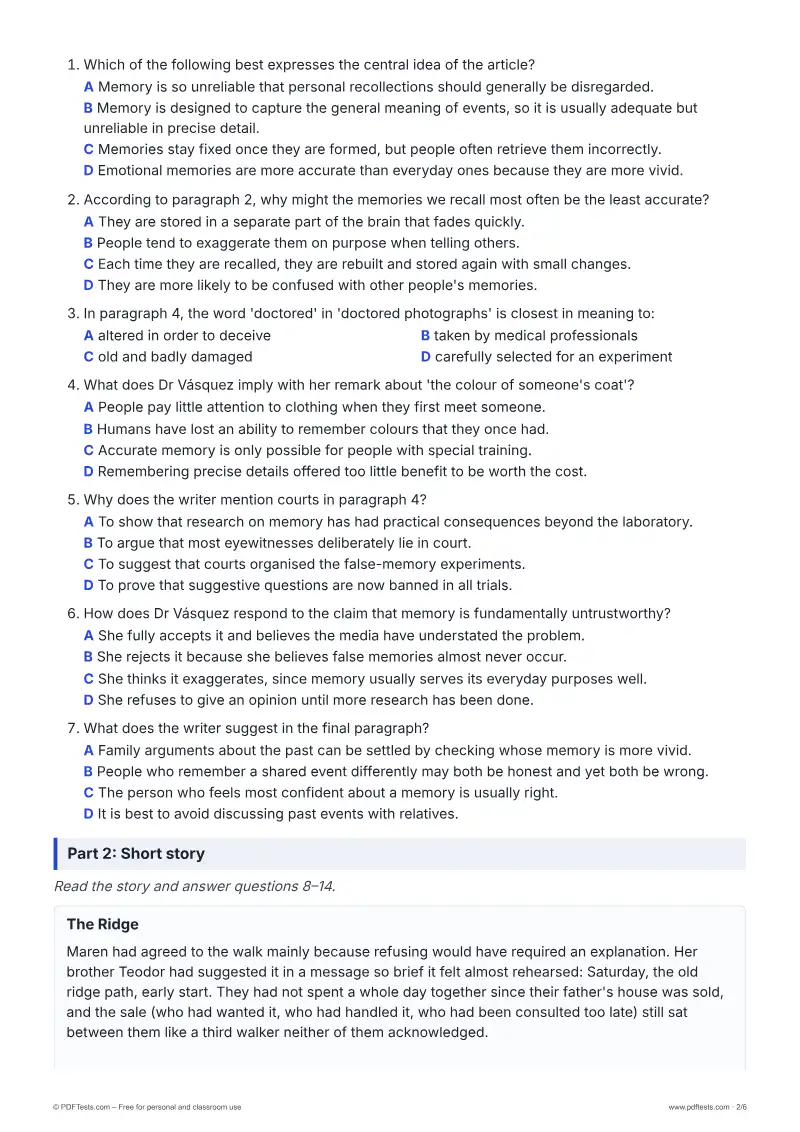
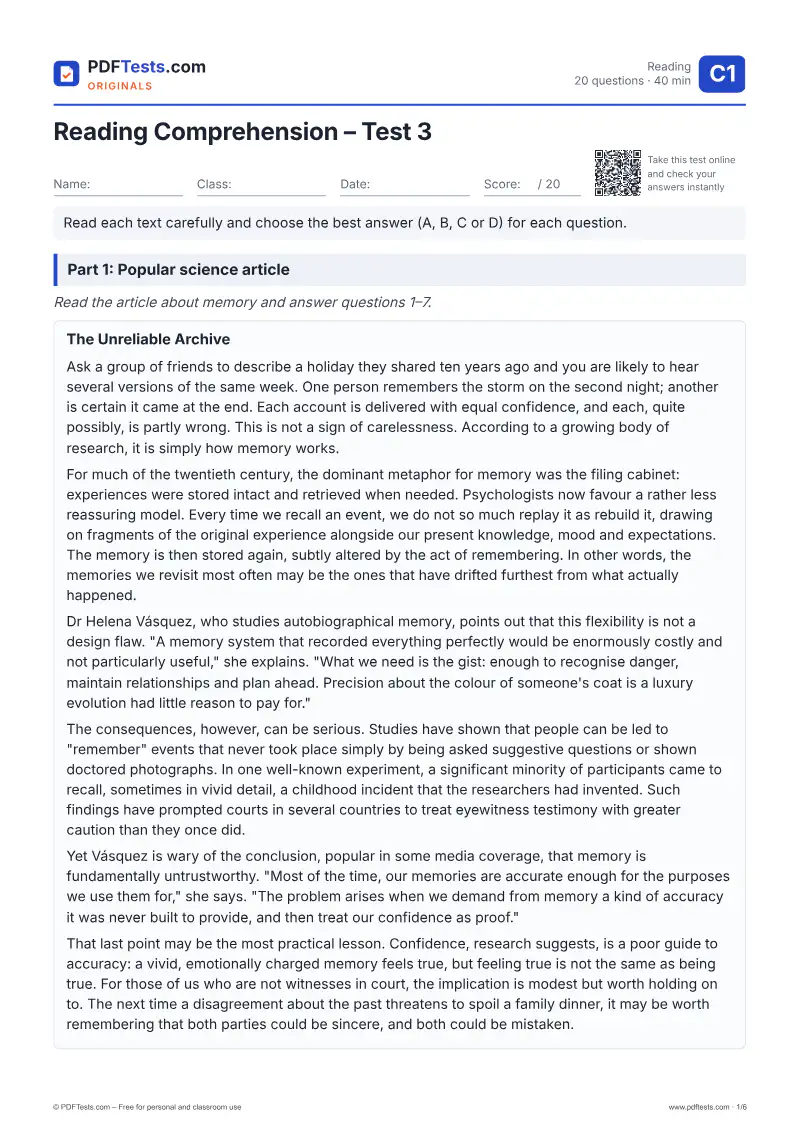
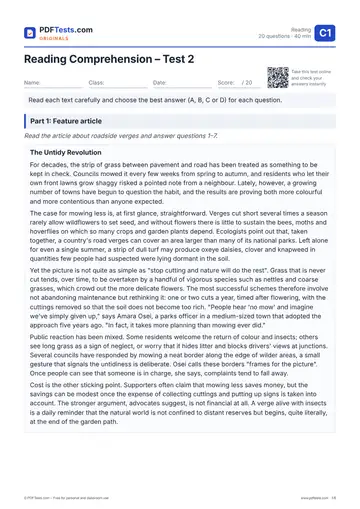
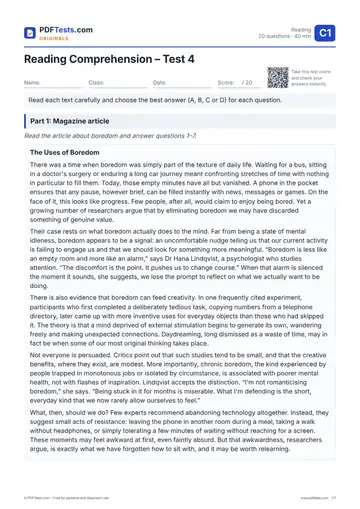
This C1 reading comprehension test has three original texts in different genres: a popular science article about memory, a short story about two siblings on a mountain walk, and a letter to a newspaper editor about teaching handwriting. The 20 questions test gist, detail, inference, writer's purpose and vocabulary in context. It suits advanced learners preparing for C1 exams and teachers who need a ready-made reading assessment.
Read each text carefully and choose the best answer (A, B, C or D) for each question. Choose your answers, then press “Check my answers”.
0%
Your result
[["Keep practising","This topic needs more practice. Start with the guide, then try a worksheet."],["Good start","You know the basics. Read the guide and practise the parts you missed."],["Very good!","Just a few slips. Review your mistakes, then try the next test."],["Excellent!","You have mastered this topic. Ready for the next challenge?"]]
Please describe the problem in a few words. Sorry, the report could not be sent. Please email us at [email protected].
Preview
About this test
This C1 reading comprehension test has three original texts in different genres: a popular science article about memory, a short story about two siblings on a mountain walk, and a letter to a newspaper editor about teaching handwriting. The 20 questions test gist, detail, inference, writer's purpose and vocabulary in context. It suits advanced learners preparing for C1 exams and teachers who need a ready-made reading assessment.
Topics covered
Reading comprehensionGist and main ideaInferenceVocabulary in contextWriter's purposeNarrative interpretationArgumentative texts
How to use this test
Download the PDF and print it, or take the test online below.
Answer every question without a dictionary or time pressure.
Check your answers and note the topics you need to review.
Notes for teachers
Use this test as a timed exam practice task or work through one text per lesson. The questions target typical C1 weaknesses: choosing an answer because it repeats words from the text, reading figurative language literally, and confusing the writer's opinion with views the writer reports. Afterwards, ask students to underline the exact evidence for each answer. As a follow-up, students could write their own letter replying to Grace Mbeki or continue the story from Teodor's point of view.
 C1
 Open PDF
 C1
 C1
 C1
 C1
 C1
 C1
 C1