PDFTests Originals

Leseverstehen – Test 1

C2 Kompetente Sprachverwendung LeseverstehenEnglisch

Dieser Test zum Leseverstehen auf Niveau C2 umfasst drei Originaltexte unterschiedlicher Textsorten: einen nachdenklichen Essay, einen Auszug aus einer literarischen Erzählung und eine Buchrezension. Die 20 Aufgaben prüfen Globalverstehen, Detailverstehen, das Erschließen impliziter Aussagen, Ton und Haltung sowie Wortschatz im Kontext. Der Test eignet sich für fortgeschrittene Lernende, die sich auf Prüfungen auf C2-Niveau vorbereiten, und für Lehrkräfte, die eine fertige Lernerfolgskontrolle zum Ausdrucken suchen.

Fragen
20
Zeit
40 Min.
PDF
6 Seiten
Lösungen
Enthalten
  • 100 % kostenlos
  • Ohne Anmeldung
  • Druckfertiges A4-PDF
Vorschau von Seite 1: Leseverstehen – Test 1 PDF öffnen

Test online machen

Lies jeden Text aufmerksam durch und wähle bei jeder Frage die beste Antwort (A, B, C oder D). Wählen Sie Ihre Antworten und klicken Sie auf „Antworten prüfen“.

Teil 1: Nachdenklicher Essay

Lies den Essay über das Reparieren von Alltagsgegenständen und beantworte die Fragen 1–7.

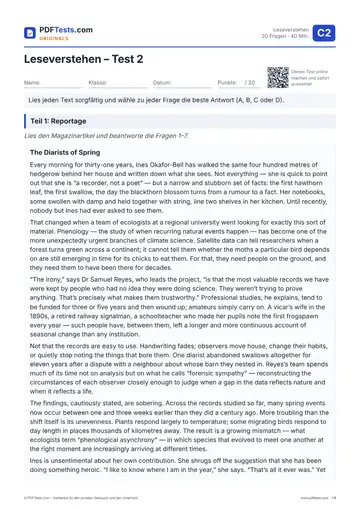
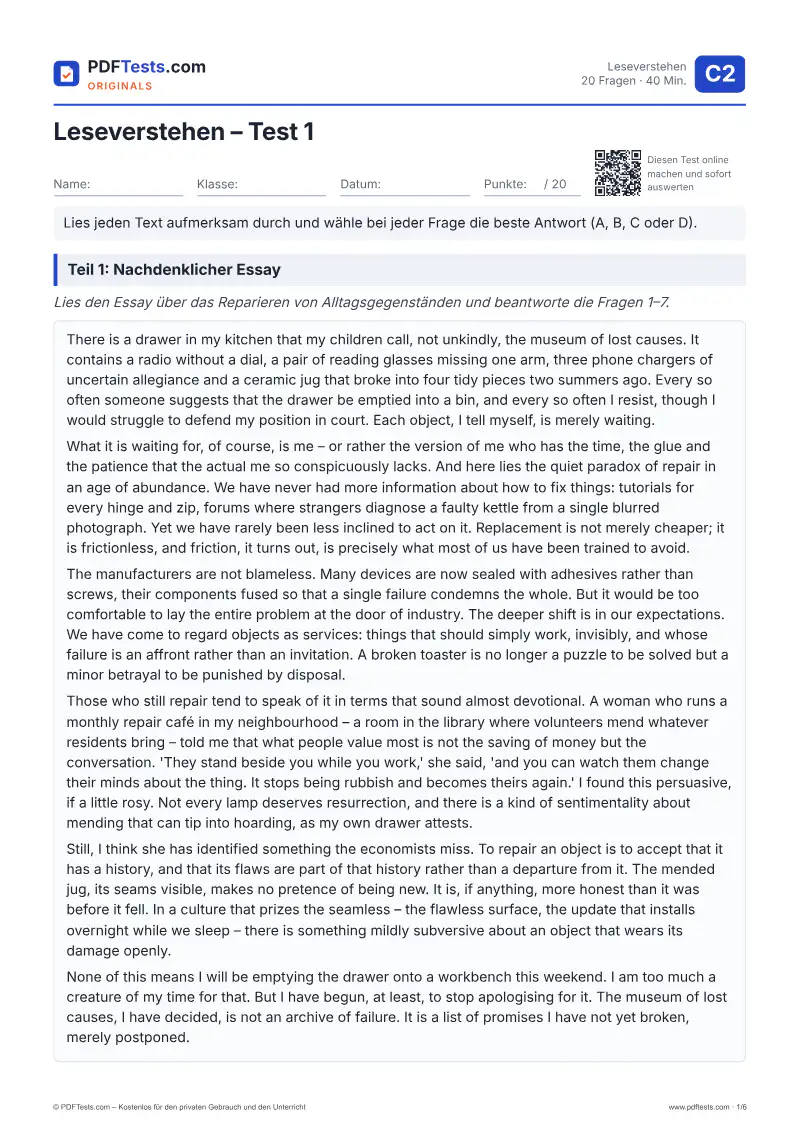
There is a drawer in my kitchen that my children call, not unkindly, the museum of lost causes. It contains a radio without a dial, a pair of reading glasses missing one arm, three phone chargers of uncertain allegiance and a ceramic jug that broke into four tidy pieces two summers ago. Every so often someone suggests that the drawer be emptied into a bin, and every so often I resist, though I would struggle to defend my position in court. Each object, I tell myself, is merely waiting.

What it is waiting for, of course, is me – or rather the version of me who has the time, the glue and the patience that the actual me so conspicuously lacks. And here lies the quiet paradox of repair in an age of abundance. We have never had more information about how to fix things: tutorials for every hinge and zip, forums where strangers diagnose a faulty kettle from a single blurred photograph. Yet we have rarely been less inclined to act on it. Replacement is not merely cheaper; it is frictionless, and friction, it turns out, is precisely what most of us have been trained to avoid.

The manufacturers are not blameless. Many devices are now sealed with adhesives rather than screws, their components fused so that a single failure condemns the whole. But it would be too comfortable to lay the entire problem at the door of industry. The deeper shift is in our expectations. We have come to regard objects as services: things that should simply work, invisibly, and whose failure is an affront rather than an invitation. A broken toaster is no longer a puzzle to be solved but a minor betrayal to be punished by disposal.

Those who still repair tend to speak of it in terms that sound almost devotional. A woman who runs a monthly repair café in my neighbourhood – a room in the library where volunteers mend whatever residents bring – told me that what people value most is not the saving of money but the conversation. 'They stand beside you while you work,' she said, 'and you can watch them change their minds about the thing. It stops being rubbish and becomes theirs again.' I found this persuasive, if a little rosy. Not every lamp deserves resurrection, and there is a kind of sentimentality about mending that can tip into hoarding, as my own drawer attests.

Still, I think she has identified something the economists miss. To repair an object is to accept that it has a history, and that its flaws are part of that history rather than a departure from it. The mended jug, its seams visible, makes no pretence of being new. It is, if anything, more honest than it was before it fell. In a culture that prizes the seamless – the flawless surface, the update that installs overnight while we sleep – there is something mildly subversive about an object that wears its damage openly.

None of this means I will be emptying the drawer onto a workbench this weekend. I am too much a creature of my time for that. But I have begun, at least, to stop apologising for it. The museum of lost causes, I have decided, is not an archive of failure. It is a list of promises I have not yet broken, merely postponed.

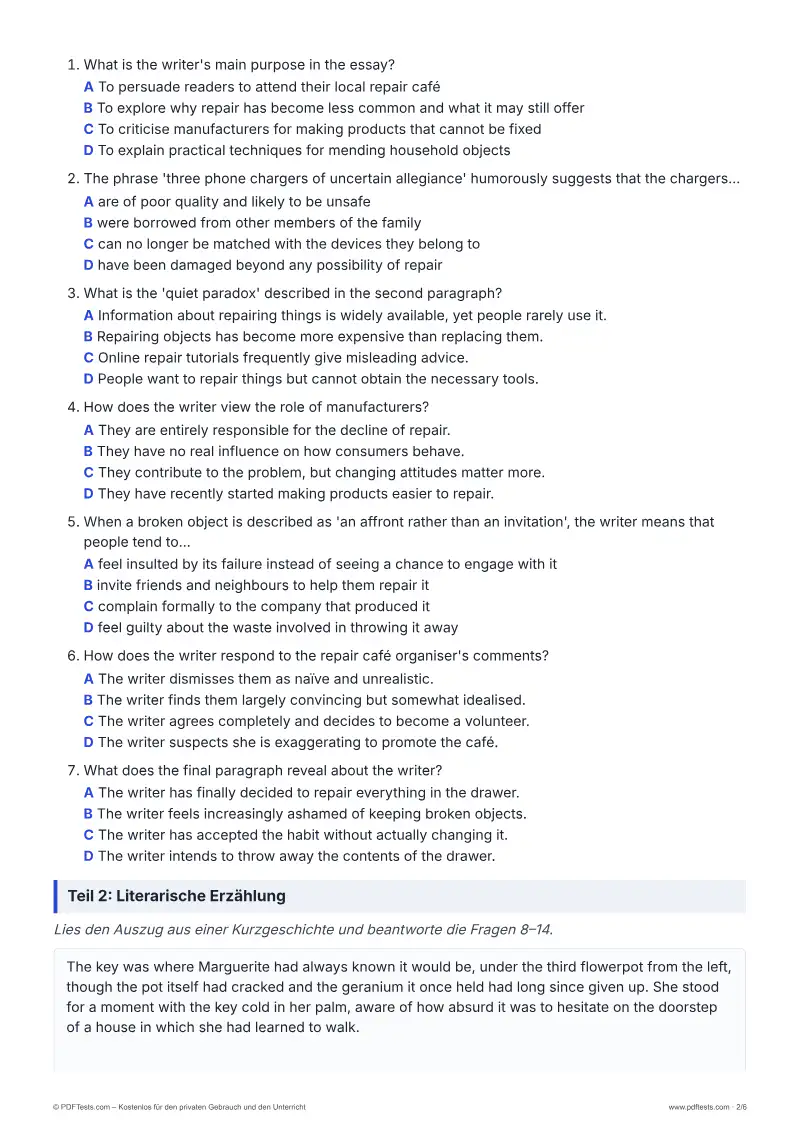
  1. What is the writer's main purpose in the essay?

  2. The phrase 'three phone chargers of uncertain allegiance' humorously suggests that the chargers…

  3. What is the 'quiet paradox' described in the second paragraph?

  4. How does the writer view the role of manufacturers?

  5. When a broken object is described as 'an affront rather than an invitation', the writer means that people tend to…

  6. How does the writer respond to the repair café organiser's comments?

  7. What does the final paragraph reveal about the writer?

Teil 2: Literarische Erzählung

Lies den Auszug aus einer Kurzgeschichte und beantworte die Fragen 8–14.

The key was where Marguerite had always known it would be, under the third flowerpot from the left, though the pot itself had cracked and the geranium it once held had long since given up. She stood for a moment with the key cold in her palm, aware of how absurd it was to hesitate on the doorstep of a house in which she had learned to walk.

Inside, the hallway smelt of dust and, faintly, of the pipe tobacco her father had sworn he gave up in the nineties. She smiled despite herself. He had been a man of small, stubborn deceptions, none of them cruel, all of them transparent to everyone but him. The coat stand still held his raincoat, its pockets, she discovered, still holding a bus ticket, a pencil stub and a list in his cramped hand: 'bread, batteries, ring Marguerite'. She read the last item three times before folding the paper and putting it in her own pocket, where it seemed to weigh far more than paper should.

Her brother had offered to come. More accurately, Tomasz had offered in the tone people use when they are confident of being refused, and she had refused, partly to spare him and partly, if she was honest, to spare herself his efficiency. Tomasz would have arrived with boxes already labelled. He would have had the kitchen cleared by noon and a valuation for the piano by teatime, and he would have been right to do so, and she would have hated him for it in a way neither of them would ever mention.

The workshop was at the back, beyond the kitchen, down two steps that had always been one step too many for visitors, who stumbled with dependable regularity. Her father had refused to fix them. 'It keeps people humble,' he would say, which was the sort of thing he said instead of admitting he had simply never got round to it. She took the steps carefully now, as if he might be watching, ready to be pleased.

The room was exactly as he had left it, and that was the difficulty. A clock lay open on the bench, its innards arranged on a cloth in an order that would have meant something to him and meant nothing to her. A magnifying lamp was still angled over the work, as though he had stepped out to put the kettle on and might return at any moment to resume. She understood, with a clarity that felt almost physical, that whatever she did next would be the first decision in this room that was not his.

She had come intending to be practical. She had a notebook and a list of her own, and a vague plan involving charity shops. Instead she sat down on his stool, which was too low for her, as it had always been, and looked at the clock for a long time. She did not know how to repair it. She did not know, either, how to put the pieces in a box and carry them out to the car, which would at least have had the merit of being an ending.

Outside, a neighbour's dog began to bark and then thought better of it. Marguerite switched off the lamp. Then, after a moment, she switched it on again.

  1. What does the detail of the cracked flowerpot and the dead geranium mainly suggest?

  2. Her father's deceptions were 'transparent to everyone but him'. This means that he…

  3. Why does the list seem to 'weigh far more than paper should'?

  4. What can be inferred about Marguerite's relationship with Tomasz?

  5. What does the father's comment about the steps reveal about his character?

  6. The room was exactly as he had left it, 'and that was the difficulty'. Why was this difficult for Marguerite?

  7. What does the final action of switching the lamp off and on again most likely suggest?

Teil 3: Buchrezension

Lies die Rezension eines Geschichtsbuchs und beantworte die Fragen 15–20.

There is a particular kind of book that seems to have been written in reverse: the author arrives at a dazzling conclusion and then works backwards, assembling whatever evidence will carry the reader there. Ravi Anand's Edges of the Known, an ambitious study of how mapmakers have handled the unknown, is not quite that book, but it occasionally keeps uncomfortable company with it.

Anand's central argument is elegant and, at first glance, counter-intuitive. The blank spaces on old maps, he contends, were not admissions of ignorance so much as acts of intellectual honesty – a refusal to invent what could not be verified. The decline of the blank, which he traces from the eighteenth century onwards, therefore represents not simply the triumph of exploration but a gradual loss of tolerance for uncertainty. By the time every coastline had been charted, we had also, he suggests, forgotten how to live comfortably with not knowing.

It is a seductive thesis, and Anand pursues it with considerable flair. His chapters on early survey expeditions are vivid without being breathless, and he has a gift for the telling detail: the surveyor who marked a mountain range 'conjectural' in such small letters that later copyists omitted the word entirely, thereby turning a guess into geography. Such episodes illustrate his point beautifully, and he is at his best when he lets them speak for themselves.

The trouble begins when he does not. In the book's second half, Anand extends his argument from cartography to culture at large, and the leaps become harder to follow. A chapter linking the disappearance of blank spaces to the modern appetite for instant answers is lively but thinly sourced, relying more on assertion than demonstration. One senses an author who has grown so fond of his metaphor that he is reluctant to let it rest. By the time he is applying it to online search engines and the design of shopping centres, the blank space has become less an idea than a skeleton key, expected to open every door.

It would be unfair, however, to dismiss the book on these grounds. Even its overreaching chapters are more stimulating than many more cautious studies, and Anand writes with a lucidity that historians of his field have not always managed. His prose is rarely ornamental; when it is, the ornament usually earns its place. Readers with no particular interest in maps will find themselves, perhaps to their surprise, lingering over reproductions of seventeenth-century coastlines – and the book's generous illustrations deserve credit here.

There is, too, a certain irony in the book's weaknesses. A work that celebrates the courage to leave things unsaid might itself have benefited from a little more restraint. Had Anand trusted his readers to draw the wider conclusions themselves, he would have written a shorter book and, I suspect, a more persuasive one. As it stands, Edges of the Known is an uneven but genuinely original contribution: a book to argue with, which is not the least of compliments.

  1. In the first paragraph, the reviewer suggests that Anand's book…

  2. What is Anand's central argument?

  3. What does the anecdote about the surveyor mainly illustrate?

  4. The reviewer says the blank space has become 'a skeleton key, expected to open every door'. This means that…

  5. What does the reviewer mean by 'the ornament usually earns its place'?

  6. What irony does the reviewer identify in the final paragraph?

Vorschau

Über diesen Test

Dieser Test zum Leseverstehen auf Niveau C2 umfasst drei Originaltexte unterschiedlicher Textsorten: einen nachdenklichen Essay, einen Auszug aus einer literarischen Erzählung und eine Buchrezension. Die 20 Aufgaben prüfen Globalverstehen, Detailverstehen, das Erschließen impliziter Aussagen, Ton und Haltung sowie Wortschatz im Kontext. Der Test eignet sich für fortgeschrittene Lernende, die sich auf Prüfungen auf C2-Niveau vorbereiten, und für Lehrkräfte, die eine fertige Lernerfolgskontrolle zum Ausdrucken suchen.

Themen

LeseverstehenErschließen impliziter Aussagen (Inference)Haltung und Ton des AutorsWortschatz im KontextLiterarische ErzählungNachdenklicher EssayBuchrezension

So nutzen Sie diesen Test

  1. Laden Sie das PDF herunter und drucken Sie es aus – oder machen Sie den Test unten online.
  2. Beantworten Sie alle Fragen ohne Wörterbuch und ohne Zeitdruck.
  3. Prüfen Sie Ihre Antworten und notieren Sie, was Sie wiederholen sollten.

Hinweise für Lehrkräfte

Planen Sie etwa 40 Minuten ein oder geben Sie jeden Teil als eigene Aufgabe von 12–15 Minuten. Viele Distraktoren zielen auf ein wörtliches oder nur teilweises Verständnis ab – etwa wenn „written in reverse“ wörtlich genommen wird oder wenn Vorbehalte des Autors mit völliger Ablehnung verwechselt werden. Die Lernenden sollten ihre Antworten begründen, indem sie auf die genaue Formulierung im Text verweisen. Als Anschlussaufgabe können die Lernenden eine Stellungnahme von etwa 150 Wörtern zu einem der Texte verfassen, z. B. eine Antwort auf den Essay oder eine Fortsetzung der Geschichte.