PDFTests Originals

Kollokationen und Bedeutungsnuancen (C2) – Test 1

C2 Kompetente Sprachverwendung WortschatzEnglisch

Dieser Wortschatztest auf Niveau C2 prüft, wie sicher du fortgeschrittene englische Kollokationen, feine Bedeutungsunterschiede und die passende Wortwahl im Kontext beherrschst. Er behandelt Verb-Nomen- und Adverb-Adjektiv-Kollokationen, leicht verwechselbare Wortfamilien sowie einen Lückentext. Der Test eignet sich für fortgeschrittene Lernende, die sich auf Prüfungen auf Proficiency-Niveau vorbereiten, und für Lehrkräfte, die eine fertige Lernstandskontrolle suchen.
Fragen
30
Zeit
35 Min.
PDF
5 Seiten
Lösungen
Enthalten
  • 100 % kostenlos
  • Ohne Anmeldung
  • Druckfertiges A4-PDF
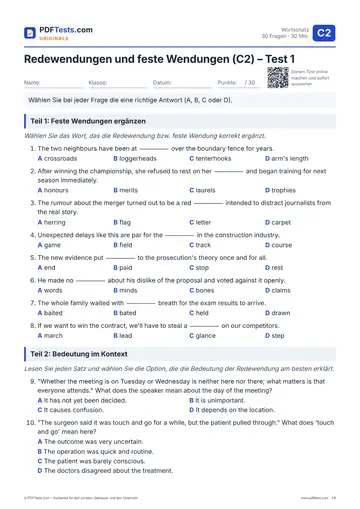
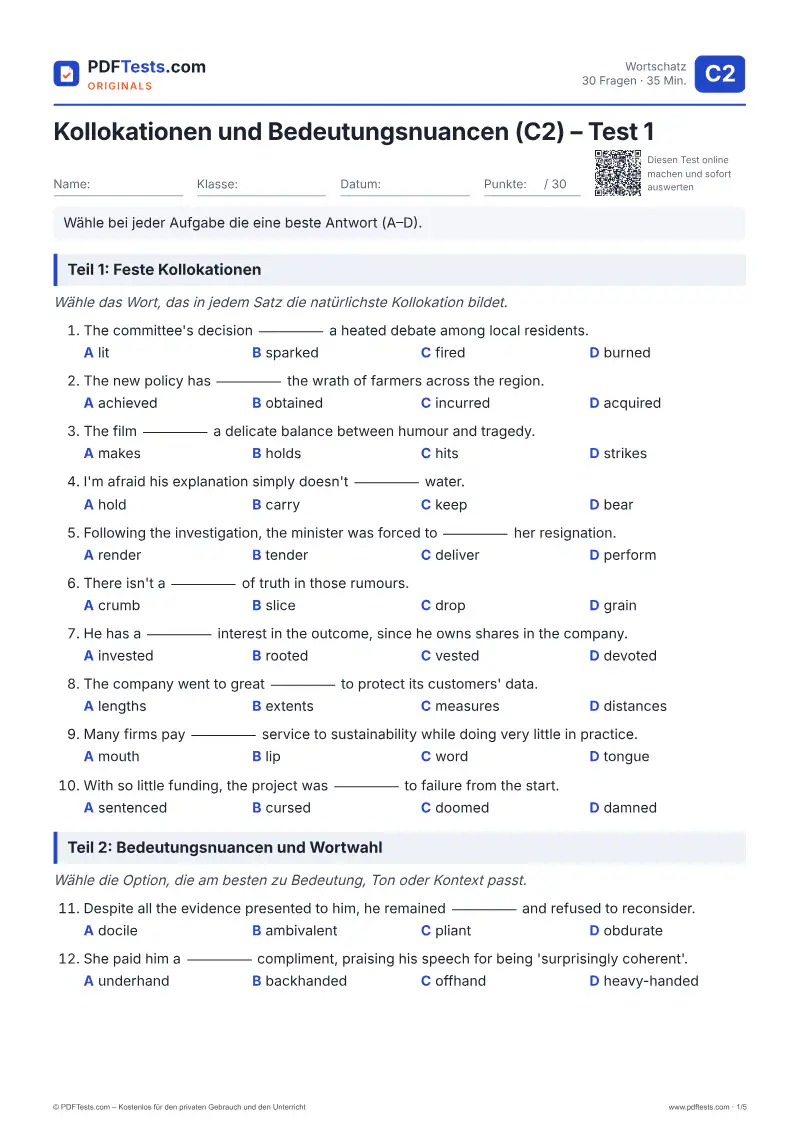
Vorschau von Seite 1: Kollokationen und Bedeutungsnuancen (C2) – Test 1 PDF öffnen

Test online machen

Wähle bei jeder Aufgabe die eine beste Antwort (A–D). Wählen Sie Ihre Antworten und klicken Sie auf „Antworten prüfen“.

Teil 1: Feste Kollokationen

Wähle das Wort, das in jedem Satz die natürlichste Kollokation bildet.

  1. The committee's decision _____ a heated debate among local residents.

  2. The new policy has _____ the wrath of farmers across the region.

  3. The film _____ a delicate balance between humour and tragedy.

  4. I'm afraid his explanation simply doesn't _____ water.

  5. Following the investigation, the minister was forced to _____ her resignation.

  6. There isn't a _____ of truth in those rumours.

  7. He has a _____ interest in the outcome, since he owns shares in the company.

  8. The company went to great _____ to protect its customers' data.

  9. Many firms pay _____ service to sustainability while doing very little in practice.

  10. With so little funding, the project was _____ to failure from the start.

Teil 2: Bedeutungsnuancen und Wortwahl

Wähle die Option, die am besten zu Bedeutung, Ton oder Kontext passt.

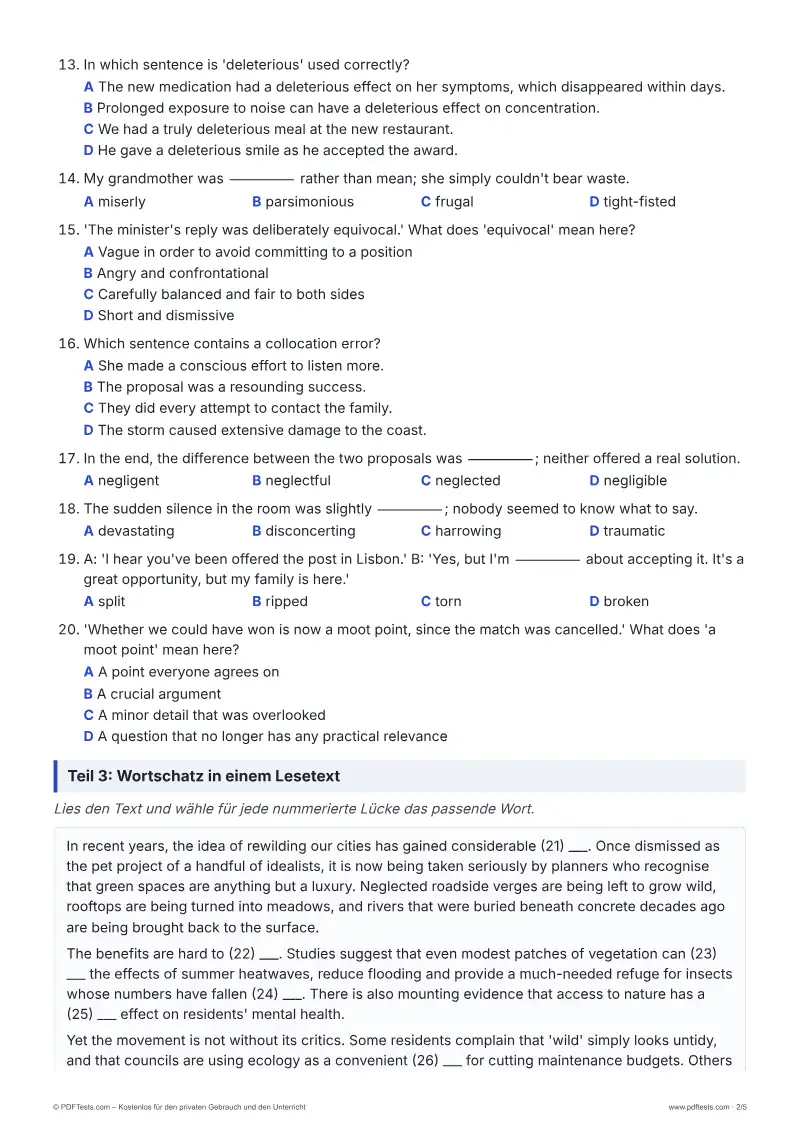
  1. Despite all the evidence presented to him, he remained _____ and refused to reconsider.

  2. She paid him a _____ compliment, praising his speech for being 'surprisingly coherent'.

  3. In which sentence is 'deleterious' used correctly?

  4. My grandmother was _____ rather than mean; she simply couldn't bear waste.

  5. 'The minister's reply was deliberately equivocal.' What does 'equivocal' mean here?

  6. Which sentence contains a collocation error?

  7. In the end, the difference between the two proposals was _____; neither offered a real solution.

  8. The sudden silence in the room was slightly _____; nobody seemed to know what to say.

  9. A: 'I hear you've been offered the post in Lisbon.' B: 'Yes, but I'm _____ about accepting it. It's a great opportunity, but my family is here.'

  10. 'Whether we could have won is now a moot point, since the match was cancelled.' What does 'a moot point' mean here?

Teil 3: Wortschatz in einem Lesetext

Lies den Text und wähle für jede nummerierte Lücke das passende Wort.

In recent years, the idea of rewilding our cities has gained considerable (21) ___. Once dismissed as the pet project of a handful of idealists, it is now being taken seriously by planners who recognise that green spaces are anything but a luxury. Neglected roadside verges are being left to grow wild, rooftops are being turned into meadows, and rivers that were buried beneath concrete decades ago are being brought back to the surface.

The benefits are hard to (22) ___. Studies suggest that even modest patches of vegetation can (23) ___ the effects of summer heatwaves, reduce flooding and provide a much-needed refuge for insects whose numbers have fallen (24) ___. There is also mounting evidence that access to nature has a (25) ___ effect on residents' mental health.

Yet the movement is not without its critics. Some residents complain that 'wild' simply looks untidy, and that councils are using ecology as a convenient (26) ___ for cutting maintenance budgets. Others worry that new parks will drive up property prices, pushing out the very communities they were meant to serve, a process sometimes called 'green gentrification'.

Advocates concede that these concerns are not (27) ___. The challenge, they argue, is to involve local people from the outset rather than presenting them with a (28) ___ accompli. Where residents have been given a genuine say, projects have tended to (29) ___ root far more successfully. Rewilding, it seems, is as much about people as it is about plants, and its long-term success will (30) ___ on whether cities can get that balance right.

  1. (21) the idea of rewilding our cities has gained considerable _____

  2. (22) The benefits are hard to _____.

  3. (23) even modest patches of vegetation can _____ the effects of summer heatwaves

  4. (24) insects whose numbers have fallen _____

  5. (25) access to nature has a _____ effect on residents' mental health

  6. (26) councils are using ecology as a convenient _____ for cutting maintenance budgets

  7. (27) Advocates concede that these concerns are not _____.

  8. (28) rather than presenting them with a _____ accompli

  9. (29) projects have tended to _____ root far more successfully

  10. (30) its long-term success will _____ on whether cities can get that balance right

War diese Seite hilfreich?

Fehler melden

Falsche Lösung, Tippfehler oder unklare Erklärung? Schreiben Sie uns, wir korrigieren es.

Mit einem Arbeitsblatt üben: Kollokationen und Nuancen (C2) – Arbeitsblatt 1

Vorschau

Über diesen Test

Dieser Wortschatztest auf Niveau C2 prüft, wie sicher du fortgeschrittene englische Kollokationen, feine Bedeutungsunterschiede und die passende Wortwahl im Kontext beherrschst. Er behandelt Verb-Nomen- und Adverb-Adjektiv-Kollokationen, leicht verwechselbare Wortfamilien sowie einen Lückentext. Der Test eignet sich für fortgeschrittene Lernende, die sich auf Prüfungen auf Proficiency-Niveau vorbereiten, und für Lehrkräfte, die eine fertige Lernstandskontrolle suchen.

Themen

Verb-Nomen-KollokationenAdverb-Adjektiv-KollokationenKonnotation und BedeutungsnuancenLeicht verwechselbare WörterWortfamilienIdiomatische WendungenWortschatz im Kontext

So nutzen Sie diesen Test

  1. Laden Sie das PDF herunter und drucken Sie es aus – oder machen Sie den Test unten online.
  2. Beantworten Sie alle Fragen ohne Wörterbuch und ohne Zeitdruck.
  3. Prüfen Sie Ihre Antworten und notieren Sie, was Sie wiederholen sollten.

Hinweise für Lehrkräfte

Setzen Sie den Test als Einstufungstest oder als Abschlusskontrolle einer Einheit in C2-Gruppen oder starken C1-Gruppen ein. Die Distraktoren zielen auf typische Fehler fortgeschrittener Lernender: Fast-Synonyme, die nicht miteinander kollokieren (do/make, efforts/lengths), leicht verwechselbare Formen (mitigate/militate, negligible/negligent) und Wörter mit unpassender Konnotation (frugal/miserly). Zur Vertiefung können die Lernenden eigene Sätze mit den richtigen Kollokationen schreiben oder begründen, warum die einzelnen Distraktoren unidiomatisch klingen.