PDFTests Originals

Grammatik für Fortgeschrittene – Test 1

C2 Kompetente Sprachverwendung GrammatikEnglisch

Dieser C2-Grammatiktest prüft genau die Strukturen, an denen man sehr kompetente Sprachverwender erkennt: Inversion, Konjunktiv (Subjunctive), gemischte Bedingungssätze (Mixed Conditionals), Spaltsätze (Cleft Sentences), Partizipialkonstruktionen und Ellipse. Er eignet sich für fortgeschrittene Lernende, die sich auf Prüfungen auf Proficiency-Niveau vorbereiten, und für Lehrkräfte, die Form, Bedeutung und Gebrauch schnell und gründlich überprüfen möchten.
Fragen
30
Zeit
35 Min.
PDF
5 Seiten
Lösungen
Enthalten
  • 100 % kostenlos
  • Ohne Anmeldung
  • Druckfertiges A4-PDF
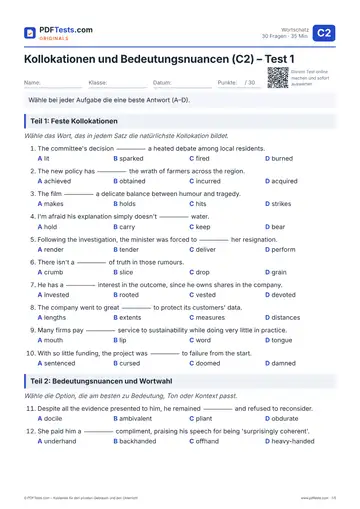
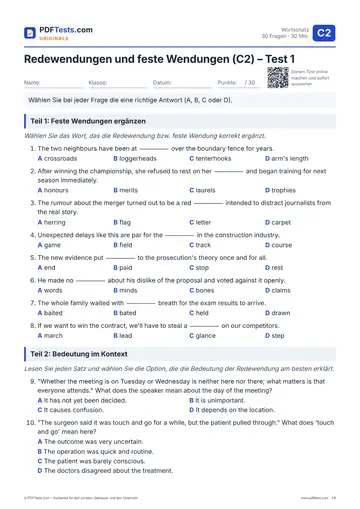
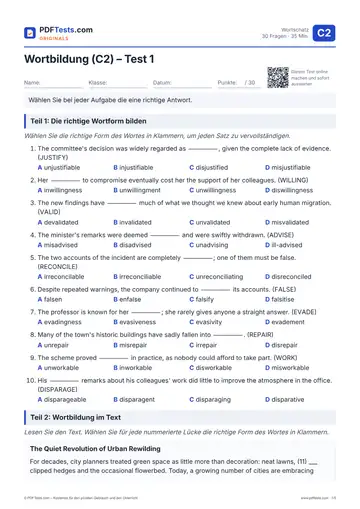
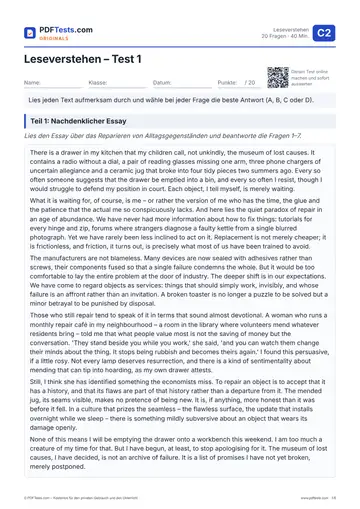
Vorschau von Seite 1: Grammatik für Fortgeschrittene – Test 1 PDF öffnen

Test online machen

Wähle bei jeder Aufgabe die eine richtige Antwort. Wählen Sie Ihre Antworten und klicken Sie auf „Antworten prüfen“.

Teil 1: Anspruchsvolle Strukturen im Kontext

Wähle die Option, die den Satz jeweils am besten ergänzt.

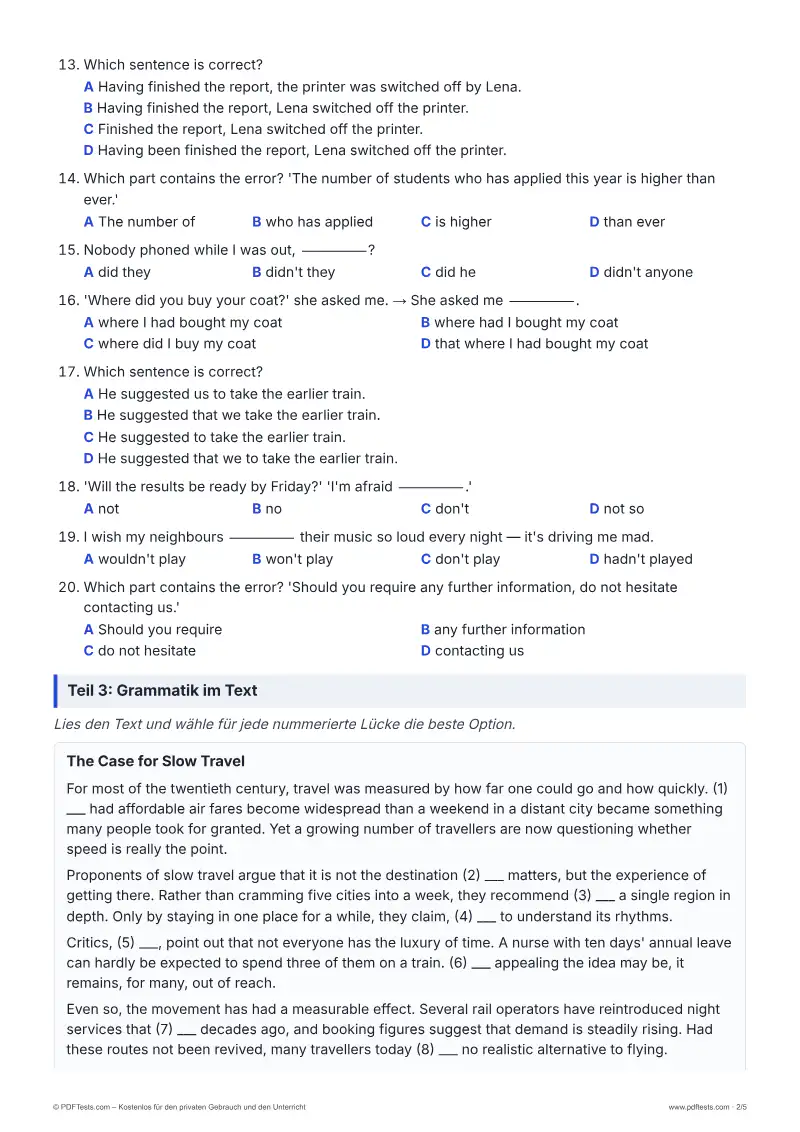
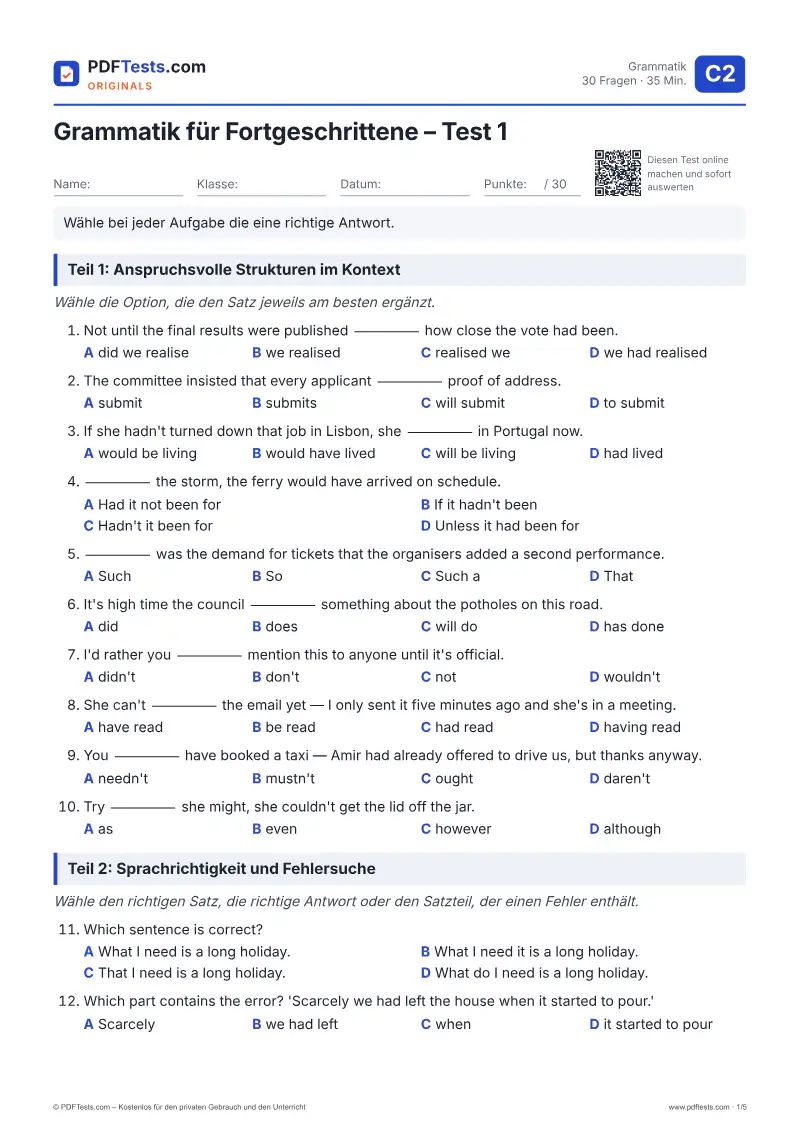
  1. Not until the final results were published _____ how close the vote had been.

  2. The committee insisted that every applicant _____ proof of address.

  3. If she hadn't turned down that job in Lisbon, she _____ in Portugal now.

  4. _____ the storm, the ferry would have arrived on schedule.

  5. _____ was the demand for tickets that the organisers added a second performance.

  6. It's high time the council _____ something about the potholes on this road.

  7. I'd rather you _____ mention this to anyone until it's official.

  8. She can't _____ the email yet — I only sent it five minutes ago and she's in a meeting.

  9. You _____ have booked a taxi — Amir had already offered to drive us, but thanks anyway.

  10. Try _____ she might, she couldn't get the lid off the jar.

Teil 2: Sprachrichtigkeit und Fehlersuche

Wähle den richtigen Satz, die richtige Antwort oder den Satzteil, der einen Fehler enthält.

  1. Which sentence is correct?

  2. Which part contains the error? 'Scarcely we had left the house when it started to pour.'

  3. Which sentence is correct?

  4. Which part contains the error? 'The number of students who has applied this year is higher than ever.'

  5. Nobody phoned while I was out, _____?

  6. 'Where did you buy your coat?' she asked me. → She asked me _____.

  7. Which sentence is correct?

  8. 'Will the results be ready by Friday?' 'I'm afraid _____.'

  9. I wish my neighbours _____ their music so loud every night — it's driving me mad.

  10. Which part contains the error? 'Should you require any further information, do not hesitate contacting us.'

Teil 3: Grammatik im Text

Lies den Text und wähle für jede nummerierte Lücke die beste Option.

The Case for Slow Travel

For most of the twentieth century, travel was measured by how far one could go and how quickly. (1) ___ had affordable air fares become widespread than a weekend in a distant city became something many people took for granted. Yet a growing number of travellers are now questioning whether speed is really the point.

Proponents of slow travel argue that it is not the destination (2) ___ matters, but the experience of getting there. Rather than cramming five cities into a week, they recommend (3) ___ a single region in depth. Only by staying in one place for a while, they claim, (4) ___ to understand its rhythms.

Critics, (5) ___, point out that not everyone has the luxury of time. A nurse with ten days' annual leave can hardly be expected to spend three of them on a train. (6) ___ appealing the idea may be, it remains, for many, out of reach.

Even so, the movement has had a measurable effect. Several rail operators have reintroduced night services that (7) ___ decades ago, and booking figures suggest that demand is steadily rising. Had these routes not been revived, many travellers today (8) ___ no realistic alternative to flying.

Perhaps the most valuable lesson of slow travel is not about transport at all. It is a reminder that (9) ___ we hurry, the less we notice. Whether or not we ever board a sleeper train, it is worth asking ourselves how much we (10) ___ by always rushing to the next thing.

  1. Gap (1)

  2. Gap (2)

  3. Gap (3)

  4. Gap (4)

  5. Gap (5)

  6. Gap (6)

  7. Gap (7)

  8. Gap (8)

  9. Gap (9)

  10. Gap (10)

Vorschau

Über diesen Test

Dieser C2-Grammatiktest prüft genau die Strukturen, an denen man sehr kompetente Sprachverwender erkennt: Inversion, Konjunktiv (Subjunctive), gemischte Bedingungssätze (Mixed Conditionals), Spaltsätze (Cleft Sentences), Partizipialkonstruktionen und Ellipse. Er eignet sich für fortgeschrittene Lernende, die sich auf Prüfungen auf Proficiency-Niveau vorbereiten, und für Lehrkräfte, die Form, Bedeutung und Gebrauch schnell und gründlich überprüfen möchten.

Themen

Inversion und Voranstellung (Fronting)Konjunktiv (Subjunctive) und irreale VergangenheitGemischte Bedingungssätze (Mixed Conditionals)Modalverben mit Perfekt (Modal Perfects)Spaltsätze (Cleft Sentences)Partizipialkonstruktionen (Participle Clauses)Ellipse und Ersetzung (Substitution)Konzessive Strukturen

So nutzen Sie diesen Test

  1. Laden Sie das PDF herunter und drucken Sie es aus – oder machen Sie den Test unten online.
  2. Beantworten Sie alle Fragen ohne Wörterbuch und ohne Zeitdruck.
  3. Prüfen Sie Ihre Antworten und notieren Sie, was Sie wiederholen sollten.

Hinweise für Lehrkräfte

Setzen Sie den Test als Diagnoseinstrument oder zur Wiederholung vor einer C2-Prüfung ein. Er zielt auf hartnäckige Fehler auf fortgeschrittenem Niveau: fehlende Inversion mit Hilfsverb nach verneinenden Adverbialen, Indikativformen nach Verben des Forderns (mandative verbs), unverbundene Partizipien (dangling participles), „suggest + Objekt + Infinitiv“ sowie die Subjekt-Verb-Kongruenz bei „the number of“. Zur Vertiefung können die Lernenden die falschen Antwortoptionen so umschreiben, dass sie korrekt werden, oder den Lesetext in ein formelleres bzw. informelleres Register übertragen.