PDFTests Originals

Leseverstehen – Test 2

C2 Kompetente Sprachverwendung LeseverstehenEnglisch

Dieser Test zum Leseverstehen auf Niveau C2 umfasst drei Originaltexte aus unterschiedlichen Textsorten: eine Magazinreportage, eine literarische Kurzgeschichte und einen formellen offenen Brief. Die 20 Multiple-Choice-Fragen prüfen das Erfassen der Kernaussage, Detailverständnis, das Erschließen impliziter Bedeutungen, den Ton sowie die Bedeutung von Wörtern und Wendungen im Kontext. Der Test eignet sich für fortgeschrittene Lernende, die sich auf Prüfungen auf höchstem Niveau vorbereiten, und für Lehrkräfte, die eine anspruchsvolle Leseaufgabe zum Ausdrucken suchen.

Fragen
20
Zeit
40 Min.
PDF
8 Seiten
Lösungen
Enthalten
  • 100 % kostenlos
  • Ohne Anmeldung
  • Druckfertiges A4-PDF
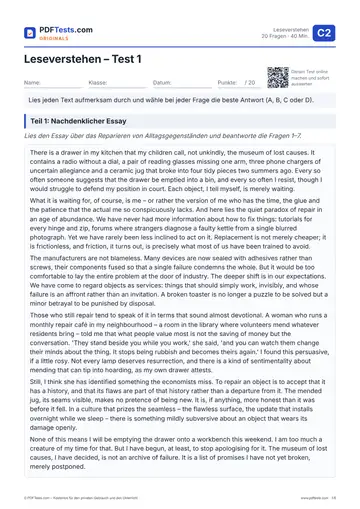
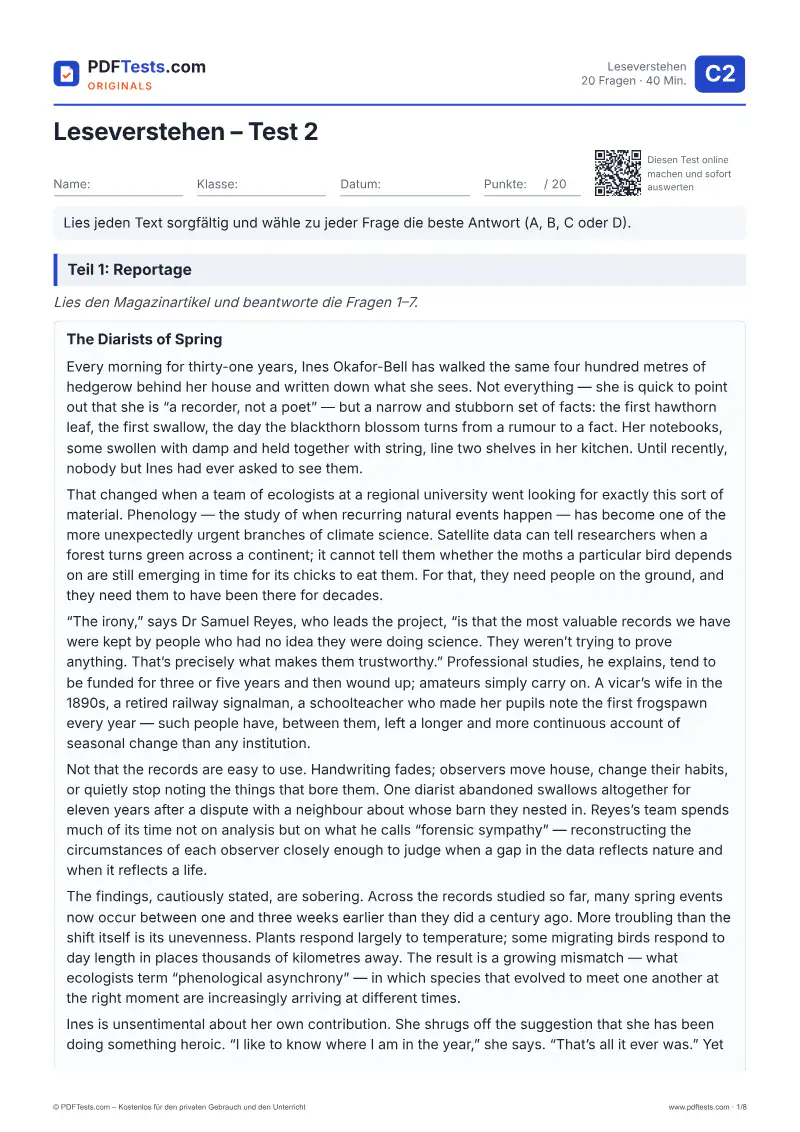
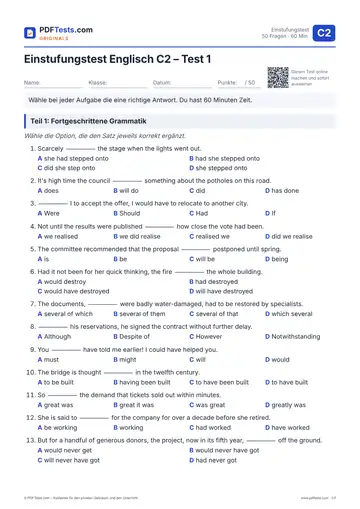
Vorschau von Seite 1: Leseverstehen – Test 2 PDF öffnen

Test online machen

Lies jeden Text sorgfältig und wähle zu jeder Frage die beste Antwort (A, B, C oder D). Wählen Sie Ihre Antworten und klicken Sie auf „Antworten prüfen“.

Teil 1: Reportage

Lies den Magazinartikel und beantworte die Fragen 1–7.

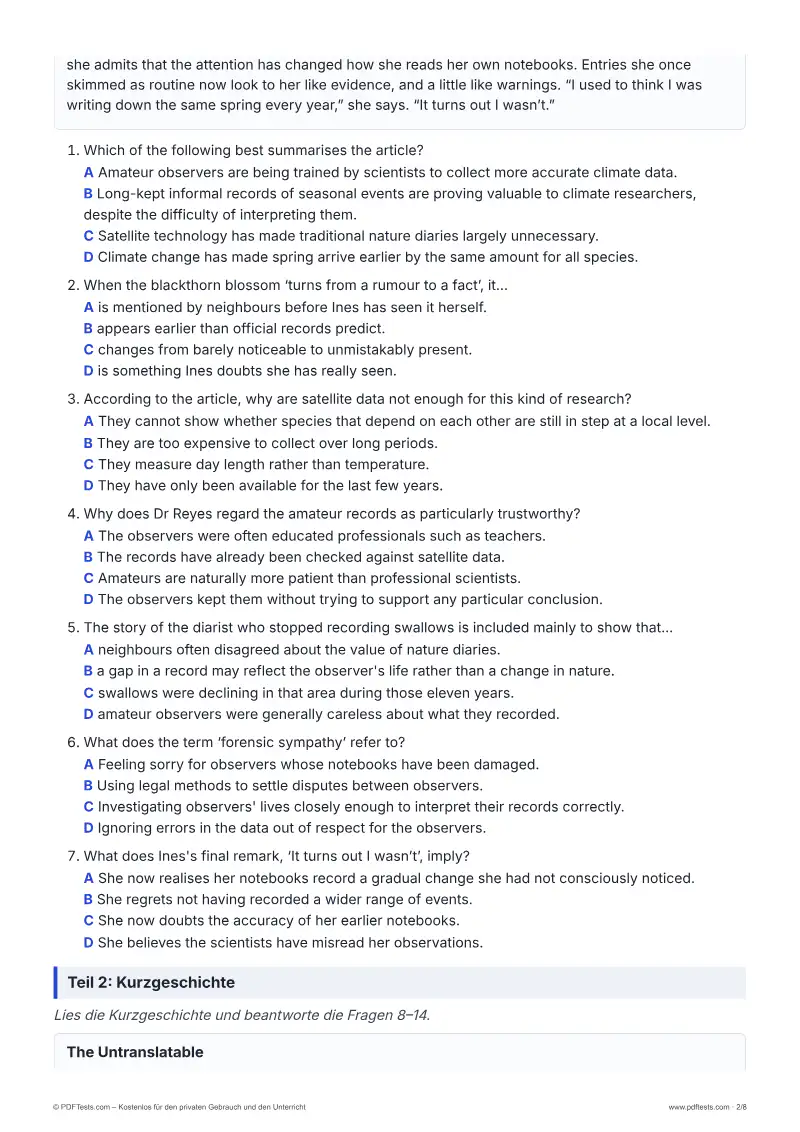
The Diarists of Spring

Every morning for thirty-one years, Ines Okafor-Bell has walked the same four hundred metres of hedgerow behind her house and written down what she sees. Not everything — she is quick to point out that she is “a recorder, not a poet” — but a narrow and stubborn set of facts: the first hawthorn leaf, the first swallow, the day the blackthorn blossom turns from a rumour to a fact. Her notebooks, some swollen with damp and held together with string, line two shelves in her kitchen. Until recently, nobody but Ines had ever asked to see them.

That changed when a team of ecologists at a regional university went looking for exactly this sort of material. Phenology — the study of when recurring natural events happen — has become one of the more unexpectedly urgent branches of climate science. Satellite data can tell researchers when a forest turns green across a continent; it cannot tell them whether the moths a particular bird depends on are still emerging in time for its chicks to eat them. For that, they need people on the ground, and they need them to have been there for decades.

“The irony,” says Dr Samuel Reyes, who leads the project, “is that the most valuable records we have were kept by people who had no idea they were doing science. They weren’t trying to prove anything. That’s precisely what makes them trustworthy.” Professional studies, he explains, tend to be funded for three or five years and then wound up; amateurs simply carry on. A vicar’s wife in the 1890s, a retired railway signalman, a schoolteacher who made her pupils note the first frogspawn every year — such people have, between them, left a longer and more continuous account of seasonal change than any institution.

Not that the records are easy to use. Handwriting fades; observers move house, change their habits, or quietly stop noting the things that bore them. One diarist abandoned swallows altogether for eleven years after a dispute with a neighbour about whose barn they nested in. Reyes’s team spends much of its time not on analysis but on what he calls “forensic sympathy” — reconstructing the circumstances of each observer closely enough to judge when a gap in the data reflects nature and when it reflects a life.

The findings, cautiously stated, are sobering. Across the records studied so far, many spring events now occur between one and three weeks earlier than they did a century ago. More troubling than the shift itself is its unevenness. Plants respond largely to temperature; some migrating birds respond to day length in places thousands of kilometres away. The result is a growing mismatch — what ecologists term “phenological asynchrony” — in which species that evolved to meet one another at the right moment are increasingly arriving at different times.

Ines is unsentimental about her own contribution. She shrugs off the suggestion that she has been doing something heroic. “I like to know where I am in the year,” she says. “That’s all it ever was.” Yet she admits that the attention has changed how she reads her own notebooks. Entries she once skimmed as routine now look to her like evidence, and a little like warnings. “I used to think I was writing down the same spring every year,” she says. “It turns out I wasn’t.”

  1. Which of the following best summarises the article?

  2. When the blackthorn blossom ‘turns from a rumour to a fact’, it…

  3. According to the article, why are satellite data not enough for this kind of research?

  4. Why does Dr Reyes regard the amateur records as particularly trustworthy?

  5. The story of the diarist who stopped recording swallows is included mainly to show that…

  6. What does the term ‘forensic sympathy’ refer to?

  7. What does Ines's final remark, ‘It turns out I wasn’t’, imply?

Teil 2: Kurzgeschichte

Lies die Kurzgeschichte und beantworte die Fragen 8–14.

The Untranslatable

Teodor Vance had agreed to meet her in the café of the hotel where he was not, he made clear within a minute, staying. “I never stay where I meet people,” he said, as if this were a principle rather than a habit, and Haruka Lindqvist filed it away in her head with the other things she was collecting: the scarf worn indoors, the way he read the menu as though it had been badly edited.

She had spent fourteen months inside his novel. She knew its rhythms better than she knew some of her friends’ voices; she had dreamt, twice, in its long sentences crowded with subordinate clauses. What she had not done, until this afternoon, was meet the man who had written them, and she was discovering that the two were less closely related than she had assumed.

“Chapter nine,” he said, before the coffee came. “The scene with the grandmother and the eel.”

She had expected this. In the original, the grandmother’s final remark turned on a pun — a word meaning both “slippery” and “evasive” — that had no equivalent in Haruka’s language. She had replaced it with a different joke, one about the weather, which was not his joke but which did, she believed, what his joke did: it made the reader laugh at the precise moment they realised the old woman was lying.

“You’ve changed it,” he said.

“I’ve kept it,” she said. “I’ve changed the words.”

He looked at her for a long moment, and she understood that this was a distinction he had heard before and had never found persuasive. “The eel,” he said, “is the point. The eel is in chapter two. The eel is on the cover.”

She had known that too, and had spent three evenings on it. Every literal version she tried left the grandmother sounding not cunning but merely confused, and the scene — which in his language was the funniest in the book — collapsed into something a reader would pass over without noticing it had ever been meant to stand up. She tried to explain this. She heard herself becoming more fluent and less convincing as she went on, the way people do when they are defending something they love to someone who has the power to take it away.

Vance listened without interrupting, which she had not expected. When she had finished, he stirred his coffee for longer than coffee requires.

“When I wrote that line,” he said at last, “my mother had just died. She used to say it. The word, I mean. About my father, mostly.” He set the spoon down with great care, as though it were the thing that might break. “I’m not asking you to make it funny. I know it won’t be funny. I’m asking you to leave her in.”

Haruka found she had nothing ready to say, which in her profession was a rare and somewhat alarming condition. She thought of the weather joke, of which she had been, until about thirty seconds earlier, quietly proud.

“There might be a way,” she said slowly, “to keep the eel and lose the joke. Put the laugh somewhere else in the scene. Earlier, perhaps.”

“Would it work?”

“I don’t know,” she said, and it was the first entirely honest thing either of them had said all afternoon.

He nodded, and for the first time he took off the scarf.

  1. The detail that Vance ‘read the menu as though it had been badly edited’ suggests that he…

  2. What does Haruka discover in the second paragraph?

  3. Why had Haruka replaced the grandmother's pun with a joke about the weather?

  4. When Haruka says ‘I’ve kept it. I’ve changed the words’, she means that…

  5. Haruka becomes ‘more fluent and less convincing’ as she speaks. This suggests that…

  6. Why does Vance want the eel kept in the scene?

  7. Why is ‘I don’t know’ described as ‘the first entirely honest thing either of them had said all afternoon’?

Teil 3: Offener Brief

Lies den Brief und beantworte die Fragen 15–20.

A Letter to Our Members from the Director

Dear Members,

Few decisions in my eleven years at the Harbourside Library have generated as much correspondence as our proposal to convert the Reading Room on the second floor into what our plans, somewhat unhappily, describe as a “flexible learning space”. I have read every one of your letters — more than four hundred of them — and I owe you, at the very least, an explanation that does not hide behind that phrase.

Let me begin with what is not in dispute. The Reading Room is beautiful. Its long oak tables, its green-shaded lamps and, above all, its silence have made it, for many of you, something closer to a refuge than a facility. Several of you wrote that it is the only place in the city where you can think. I do not take that lightly, and I would be suspicious of any librarian who did.

What is also not in dispute, however uncomfortable, is who currently uses it. Our counts show that on an average weekday the room seats around thirty people, most of them regular visitors of long standing. Meanwhile, on the ground floor, students without a quiet space at home sit on the carpet between the shelves, and the small groups who come to us for language classes, job-seeking workshops and homework clubs are routinely turned away for lack of room. A library that keeps its finest space for those who already know how to find it is, I would suggest, failing at something fundamental.

Some of you have argued that silence is precisely what a library is for, and that every other public space in the city has already surrendered to noise. I have some sympathy with this view; I hold a version of it myself. But I would gently point out that the Reading Room has not always been silent. When it opened, it was a newspaper room, loud with conversation and the rattle of pages, and the rule of silence was introduced only sixty years later. Tradition, in other words, is rather younger than it looks.

None of this means that silence should be abolished, and nor will it be. Having listened to your concerns, we have revised the proposal in three respects. First, the eastern third of the room, including the original tables, will remain a strictly silent area. Second, the new group spaces will be separated from it by glass partitions designed with expert acoustic advice. Third, the arrangement will be reviewed after twelve months, and the review will be published in full, whatever it concludes.

I am aware that compromises tend to disappoint everyone in roughly equal measure, and I do not expect this one to be an exception. Some of you will feel that we have conceded too much; others, that we have conceded nothing at all. I can only say that the alternative — choosing between a library that serves a few people perfectly and one that serves many people adequately — seemed to us a false choice, and one we were not willing to make.

The door of my office remains open, though I would ask, given the subject, that you knock quietly.

With thanks and respect,

Amara Delacroix-Nwosu

Director

  1. Which best describes the Director's approach throughout the letter?

  2. By promising ‘an explanation that does not hide behind that phrase’, the Director…

  3. Why does the Director mention the students sitting on the carpet on the ground floor?

  4. What is the main purpose of mentioning that the room was originally a newspaper room?

  5. What does the Director mean when she says compromises ‘tend to disappoint everyone in roughly equal measure’?

  6. Her request that people ‘knock quietly’ is best understood as…

Vorschau

Über diesen Test

Dieser Test zum Leseverstehen auf Niveau C2 umfasst drei Originaltexte aus unterschiedlichen Textsorten: eine Magazinreportage, eine literarische Kurzgeschichte und einen formellen offenen Brief. Die 20 Multiple-Choice-Fragen prüfen das Erfassen der Kernaussage, Detailverständnis, das Erschließen impliziter Bedeutungen, den Ton sowie die Bedeutung von Wörtern und Wendungen im Kontext. Der Test eignet sich für fortgeschrittene Lernende, die sich auf Prüfungen auf höchstem Niveau vorbereiten, und für Lehrkräfte, die eine anspruchsvolle Leseaufgabe zum Ausdrucken suchen.

Themen

Globalverstehen (Reading for gist)Schlussfolgern und implizite Aussagen (Inference)Wortschatz im KontextHaltung und Ton des VerfassersLiterarische InterpretationArgumentative und formelle Texte

So nutzen Sie diesen Test

  1. Laden Sie das PDF herunter und drucken Sie es aus – oder machen Sie den Test unten online.
  2. Beantworten Sie alle Fragen ohne Wörterbuch und ohne Zeitdruck.
  3. Prüfen Sie Ihre Antworten und notieren Sie, was Sie wiederholen sollten.

Hinweise für Lehrkräfte

Setzen Sie den Test als zeitlich begrenzte Prüfungsaufgabe oder als Grundlage für eine genaue Textanalyse im Unterricht ein. Die Distraktoren zielen auf typische Fehler auf fortgeschrittenem Niveau: bildliche Sprache wörtlich nehmen, von einem einzelnen Detail vorschnell verallgemeinern, eine Aussage wählen, die zwar im Text steht, die Frage aber nicht beantwortet, sowie Ironie oder Untertreibung (Understatement) übersehen. Als Anschlussaufgabe können die Lernenden die genauen Textstellen heraussuchen, die jede Antwort belegen, oder einen Absatz des offenen Briefs aus der Sicht eines Mitglieds umschreiben, das die Änderung ablehnt.