PDFTests Originals

Prepositions of Time (in, on, at) – Test 1

A1 Beginner GrammarEnglish

This A1 grammar test checks how well learners use the prepositions of time in, on and at with clock times, days, dates, months, years, seasons and parts of the day. It also covers negatives, questions and common phrases with no preposition, such as every Sunday and tomorrow. It suits beginner learners and teachers who want a quick classroom or homework check.
Questions
30
Time
25 min
PDF
4 pages
Answer key
Included
  • 100% free
  • No sign-up or email
  • Print-ready A4 PDF
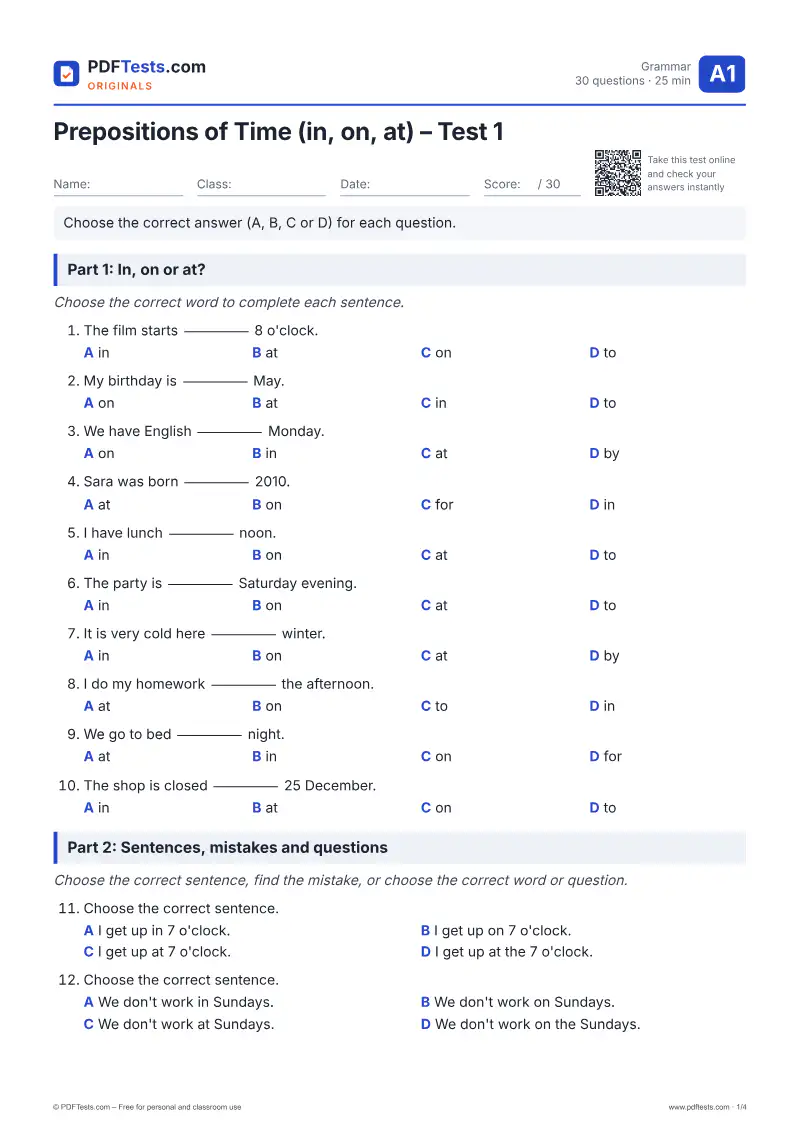
Preview of page 1 of Prepositions of Time (in, on, at) – Test 1 Open PDF

Take the test online

Choose the correct answer (A, B, C or D) for each question. Choose your answers, then press “Check my answers”.

Part 1: In, on or at?

Choose the correct word to complete each sentence.

  1. The film starts _____ 8 o'clock.

  2. My birthday is _____ May.

  3. We have English _____ Monday.

  4. Sara was born _____ 2010.

  5. I have lunch _____ noon.

  6. The party is _____ Saturday evening.

  7. It is very cold here _____ winter.

  8. I do my homework _____ the afternoon.

  9. We go to bed _____ night.

  10. The shop is closed _____ 25 December.

Part 2: Sentences, mistakes and questions

Choose the correct sentence, find the mistake, or choose the correct word or question.

  1. Choose the correct sentence.

  2. Choose the correct sentence.

  3. Is your exam _____ June or July?

  4. Find the mistake: My sister's birthday is in 3 April.

  5. Find the mistake: We have a test at Friday morning.

  6. Find the mistake: In Tuesday, I always go to the gym.

  7. The museum doesn't open _____ Mondays.

  8. I see my grandmother _____ every Sunday.

  9. Are you free _____ tomorrow?

  10. Choose the right question for this answer: "At half past six."

Part 3: Reading – Amira's week

Read Amira's email. Then choose the correct word for each gap (1–10).

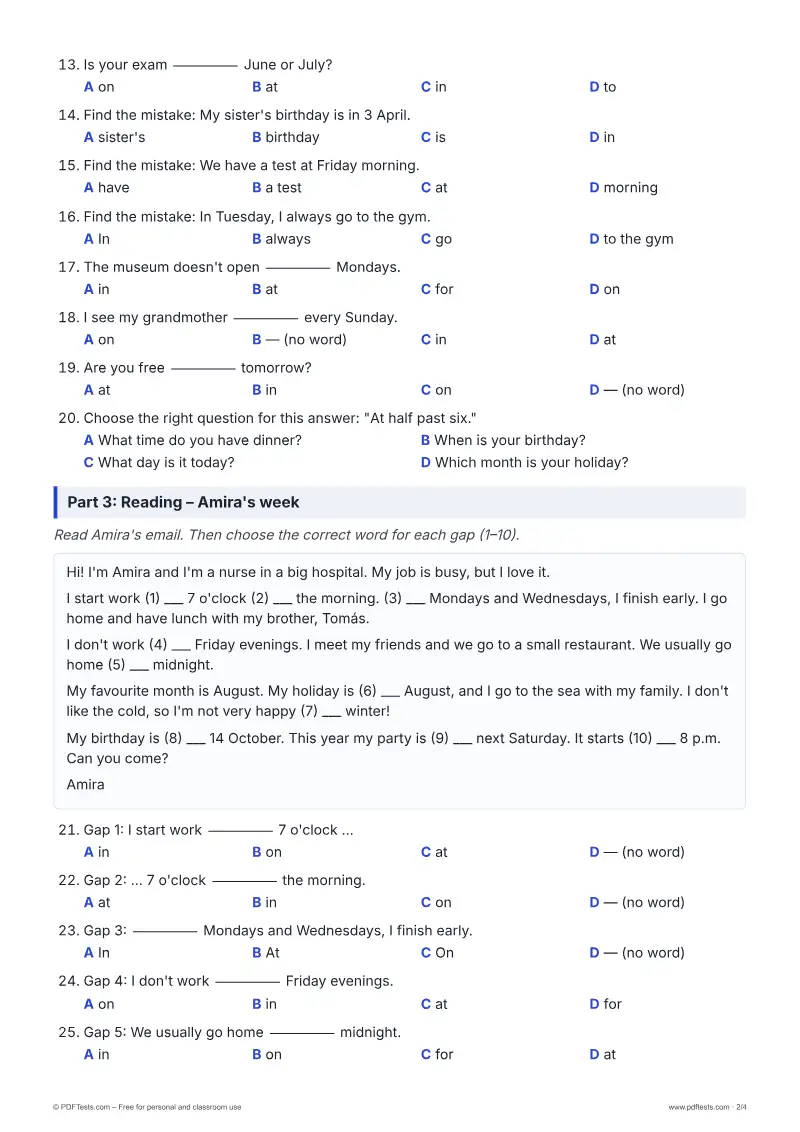
Hi! I'm Amira and I'm a nurse in a big hospital. My job is busy, but I love it.

I start work (1) ___ 7 o'clock (2) ___ the morning. (3) ___ Mondays and Wednesdays, I finish early. I go home and have lunch with my brother, Tomás.

I don't work (4) ___ Friday evenings. I meet my friends and we go to a small restaurant. We usually go home (5) ___ midnight.

My favourite month is August. My holiday is (6) ___ August, and I go to the sea with my family. I don't like the cold, so I'm not very happy (7) ___ winter!

My birthday is (8) ___ 14 October. This year my party is (9) ___ next Saturday. It starts (10) ___ 8 p.m. Can you come?

Amira

  1. Gap 1: I start work _____ 7 o'clock …

  2. Gap 2: … 7 o'clock _____ the morning.

  3. Gap 3: _____ Mondays and Wednesdays, I finish early.

  4. Gap 4: I don't work _____ Friday evenings.

  5. Gap 5: We usually go home _____ midnight.

  6. Gap 6: My holiday is _____ August.

  7. Gap 7: I'm not very happy _____ winter!

  8. Gap 8: My birthday is _____ 14 October.

  9. Gap 9: This year my party is _____ next Saturday.

  10. Gap 10: It starts _____ 8 p.m.

Preview

About this test

This A1 grammar test checks how well learners use the prepositions of time in, on and at with clock times, days, dates, months, years, seasons and parts of the day. It also covers negatives, questions and common phrases with no preposition, such as every Sunday and tomorrow. It suits beginner learners and teachers who want a quick classroom or homework check.

Topics covered

at + clock timeson + days and datesin + months, years and seasonsParts of the dayNo preposition (every, next, tomorrow)Negatives and questionsFinding common mistakes

How to use this test

  1. Download the PDF and print it, or take the test online below.
  2. Answer every question without a dictionary or time pressure.
  3. Check your answers and note the topics you need to review.

Notes for teachers

Use this test after introducing the basic rule: at for clock times, on for days and dates, and in for months, years, seasons and longer periods. It targets typical A1 errors such as 'in Monday', 'at Friday morning', 'in 3 April' and adding a preposition before every, next or tomorrow. Part 2 includes error-spotting items that work well for pair discussion. As a follow-up, ask learners to write five sentences about their own week using in, on and at.