PDFTests Originals

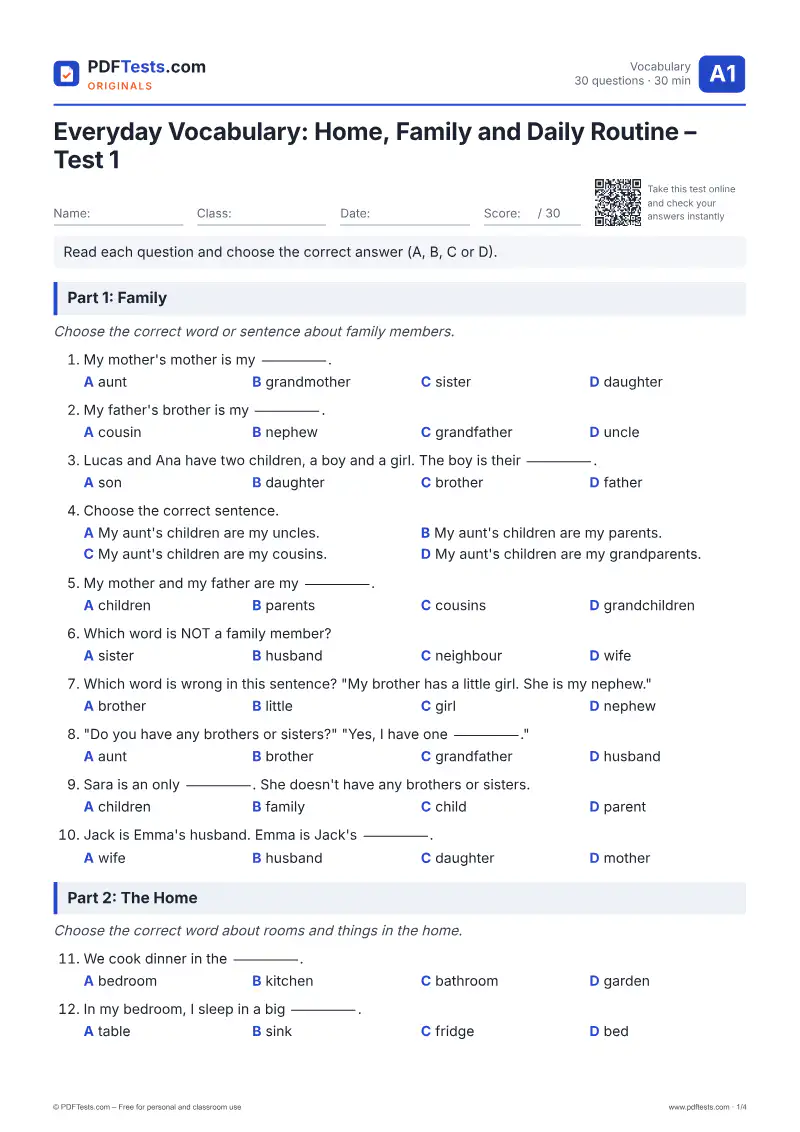
Everyday Vocabulary: Home, Family and Daily Routine – Test 1

A1 Beginner VocabularyEnglish

This A1 vocabulary test checks everyday words about family members, rooms and things in the home, and daily routines. It is for beginner learners and their teachers. The 30 multiple-choice questions include gap fills, word choice, collocations, finding the error and a short reading text.
Questions
30
Time
30 min
PDF
4 pages
Answer key
Included
  • 100% free
  • No sign-up or email
  • Print-ready A4 PDF
Preview of page 1 of Everyday Vocabulary: Home, Family and Daily Routine – Test 1 Open PDF

Take the test online

Read each question and choose the correct answer (A, B, C or D). Choose your answers, then press “Check my answers”.

Part 1: Family

Choose the correct word or sentence about family members.

  1. My mother's mother is my _____.

  2. My father's brother is my _____.

  3. Lucas and Ana have two children, a boy and a girl. The boy is their _____.

  4. Choose the correct sentence.

  5. My mother and my father are my _____.

  6. Which word is NOT a family member?

  7. Which word is wrong in this sentence? "My brother has a little girl. She is my nephew."

  8. "Do you have any brothers or sisters?" "Yes, I have one _____."

  9. Sara is an only _____. She doesn't have any brothers or sisters.

  10. Jack is Emma's husband. Emma is Jack's _____.

Part 2: The Home

Choose the correct word about rooms and things in the home.

  1. We cook dinner in the _____.

  2. In my bedroom, I sleep in a big _____.

  3. The milk is cold because it is in the _____.

  4. I have a shower in the _____ every morning.

  5. Can you _____ the door, please? It's cold in here.

  6. It's dark. Please turn _____ the light.

  7. Which word is NOT a room?

  8. We live on the third _____ of a big building.

  9. In the evening, we sit on the _____ and watch TV.

  10. "Our flat is small. It has two bedrooms, a kitchen and a bathroom." What is a flat?

Part 3: Daily Routine

Read the text. Then choose the correct answer.

Hi, I'm Daniel. I live with my wife, Leila, and our son, Omar, in a small flat in the city. On weekdays, I get up at half past six. I have a shower and get dressed. Then I make breakfast for my family. We usually have bread, eggs and tea.

Omar goes to school at eight o'clock. Leila takes him by bus, and then she goes to work. I work at home, so I start work at nine o'clock in my small office next to the living room.

In the evening, we have dinner together at seven. After dinner, I wash the dishes and Omar does his homework. Leila reads a book on the sofa. We go to bed at about ten o'clock. At the weekend, we get up late!

  1. In the text, "get up" means:

  2. Every morning, Daniel _____ a shower.

  3. In the text, "get dressed" means:

  4. "On weekdays" means:

  5. Daniel gets up at "half past six". This is:

  6. After dinner, Omar does his _____.

  7. After dinner, Daniel washes the _____.

  8. At the weekend, the family gets up late. On weekdays, they get up _____.

  9. Choose the correct sentence.

  10. "What time do you have lunch?" "_____"

Preview

About this test

This A1 vocabulary test checks everyday words about family members, rooms and things in the home, and daily routines. It is for beginner learners and their teachers. The 30 multiple-choice questions include gap fills, word choice, collocations, finding the error and a short reading text.

Topics covered

Family membersRooms in the houseThings in the homeDaily routine verbsCollocations with have, do and goTelling the time

How to use this test

  1. Download the PDF and print it, or take the test online below.
  2. Answer every question without a dictionary or time pressure.
  3. Check your answers and note the topics you need to review.

Notes for teachers

Use this test after a unit on family, home and daily routines, or as a quick placement check for beginners. It targets common A1 errors: mixing up family words (nephew/niece, aunt/uncle), wrong verb collocations (do a shower, make homework) and unnecessary articles (go to the bed). As follow-up, students can draw their family tree, label a plan of their home, or write five sentences about their own day.