PDFTests Originals

Prepositions of Place (in, on, under, next to) – Test 1

A1 Beginner GrammarEnglish

This A1 grammar test checks how well learners use the prepositions of place in, on, under and next to. It covers their meaning, correct form, and use in questions and negative sentences, and ends with a short reading text. It suits beginners in class or for self-study.
Questions
30
Time
25 min
PDF
4 pages
Answer key
Included
  • 100% free
  • No sign-up or email
  • Print-ready A4 PDF
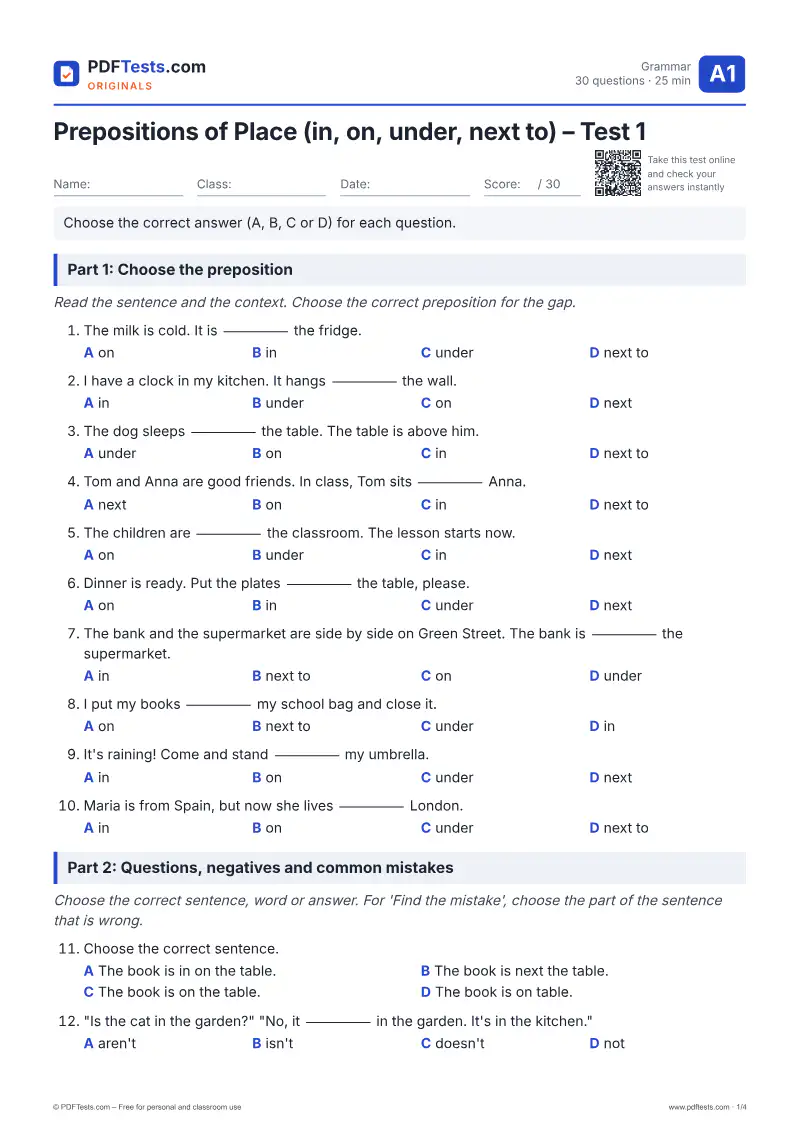
Preview of page 1 of Prepositions of Place (in, on, under, next to) – Test 1 Open PDF

Take the test online

Choose the correct answer (A, B, C or D) for each question. Choose your answers, then press “Check my answers”.

Part 1: Choose the preposition

Read the sentence and the context. Choose the correct preposition for the gap.

  1. The milk is cold. It is _____ the fridge.

  2. I have a clock in my kitchen. It hangs _____ the wall.

  3. The dog sleeps _____ the table. The table is above him.

  4. Tom and Anna are good friends. In class, Tom sits _____ Anna.

  5. The children are _____ the classroom. The lesson starts now.

  6. Dinner is ready. Put the plates _____ the table, please.

  7. The bank and the supermarket are side by side on Green Street. The bank is _____ the supermarket.

  8. I put my books _____ my school bag and close it.

  9. It's raining! Come and stand _____ my umbrella.

  10. Maria is from Spain, but now she lives _____ London.

Part 2: Questions, negatives and common mistakes

Choose the correct sentence, word or answer. For 'Find the mistake', choose the part of the sentence that is wrong.

  1. Choose the correct sentence.

  2. "Is the cat in the garden?" "No, it _____ in the garden. It's in the kitchen."

  3. "_____ the keys on the table?" "Yes, they are."

  4. "Where _____ the bathroom?" "It's next to the bedroom."

  5. Choose the correct question.

  6. "Where is the bus stop?" Choose the best answer.

  7. Find the mistake: My dog sleeps under to the table.

  8. Find the mistake: Lucas sits next Emma in class.

  9. Choose the correct sentence.

  10. "Where are my glasses?" "They _____ on the table. Look, they're in your bag!"

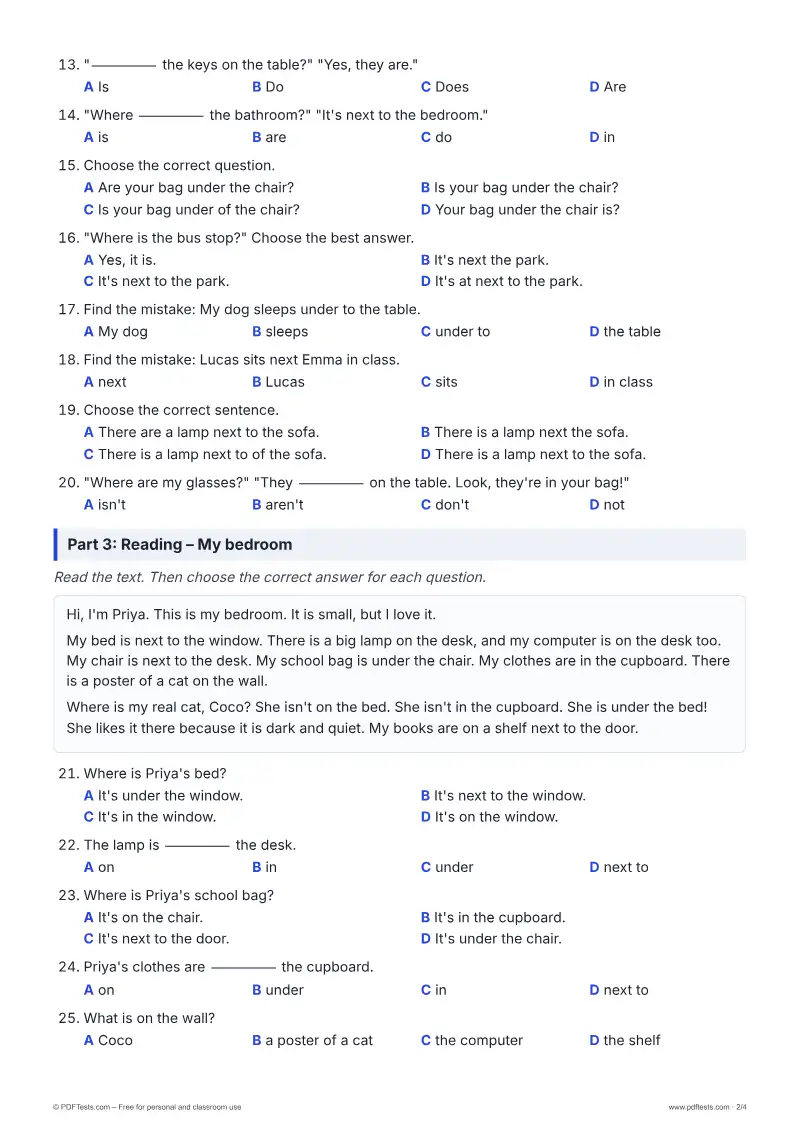
Part 3: Reading – My bedroom

Read the text. Then choose the correct answer for each question.

Hi, I'm Priya. This is my bedroom. It is small, but I love it.

My bed is next to the window. There is a big lamp on the desk, and my computer is on the desk too. My chair is next to the desk. My school bag is under the chair. My clothes are in the cupboard. There is a poster of a cat on the wall.

Where is my real cat, Coco? She isn't on the bed. She isn't in the cupboard. She is under the bed! She likes it there because it is dark and quiet. My books are on a shelf next to the door.

  1. Where is Priya's bed?

  2. The lamp is _____ the desk.

  3. Where is Priya's school bag?

  4. Priya's clothes are _____ the cupboard.

  5. What is on the wall?

  6. "Is Coco on the bed?"

  7. Where is Coco?

  8. Priya's chair is _____ the desk.

  9. Where is the shelf with the books?

  10. Which sentence is true?

Preview

About this test

This A1 grammar test checks how well learners use the prepositions of place in, on, under and next to. It covers their meaning, correct form, and use in questions and negative sentences, and ends with a short reading text. It suits beginners in class or for self-study.

Topics covered

Prepositions of placein / on / under / next toWhere questionsNegative sentences with beCommon errors (next / next to)Reading: describing a room

How to use this test

  1. Download the PDF and print it, or take the test online below.
  2. Answer every question without a dictionary or time pressure.
  3. Check your answers and note the topics you need to review.

Notes for teachers

Use this test after introducing in, on, under and next to with real objects in the classroom. It targets typical A1 errors, such as 'next' without 'to', 'in the wall' instead of 'on the wall', extra words like 'under to', and is/are agreement in questions and negatives. As a follow-up, ask students to describe their own bedroom or hide an object in the classroom for a 'Where is it?' game.