PDFTests Originals

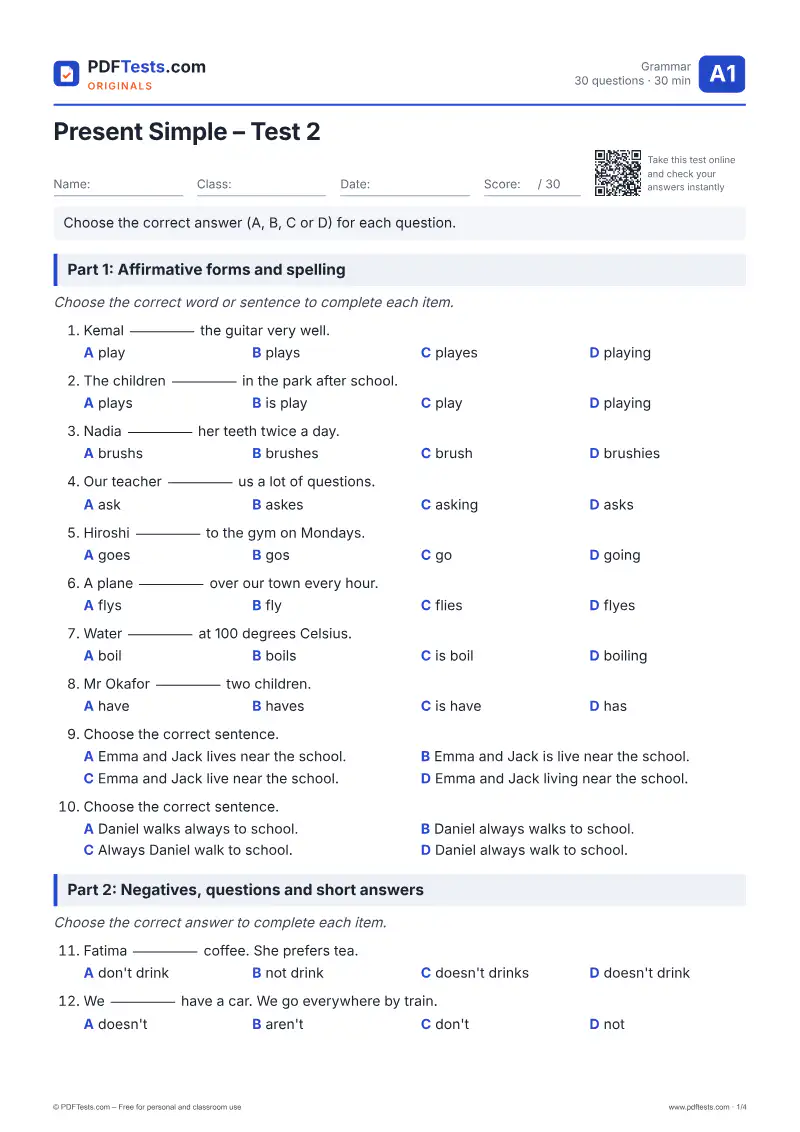
Present Simple – Test 2

A1 Beginner GrammarEnglish

This printable A1 grammar test checks the Present Simple: third-person -s/-es/-ies spelling, adverbs of frequency, negatives with don't/doesn't, questions with do/does and short answers. It ends with error correction and a short reading text about daily routines. It suits beginner learners and teachers who need a quick, reliable check.
Questions
30
Time
30 min
PDF
4 pages
Answer key
Included
  • 100% free
  • No sign-up or email
  • Print-ready A4 PDF
Preview of page 1 of Present Simple – Test 2 Open PDF

Take the test online

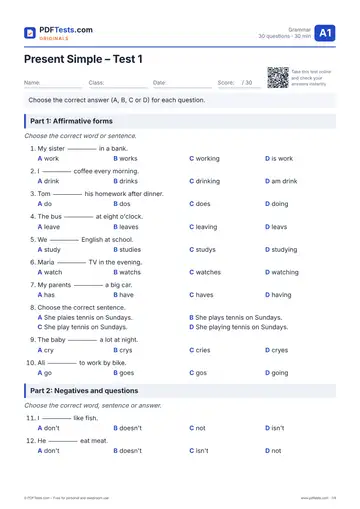
Choose the correct answer (A, B, C or D) for each question. Choose your answers, then press “Check my answers”.

Part 1: Affirmative forms and spelling

Choose the correct word or sentence to complete each item.

  1. Kemal _____ the guitar very well.

  2. The children _____ in the park after school.

  3. Nadia _____ her teeth twice a day.

  4. Our teacher _____ us a lot of questions.

  5. Hiroshi _____ to the gym on Mondays.

  6. A plane _____ over our town every hour.

  7. Water _____ at 100 degrees Celsius.

  8. Mr Okafor _____ two children.

  9. Choose the correct sentence.

  10. Choose the correct sentence.

Part 2: Negatives, questions and short answers

Choose the correct answer to complete each item.

  1. Fatima _____ coffee. She prefers tea.

  2. We _____ have a car. We go everywhere by train.

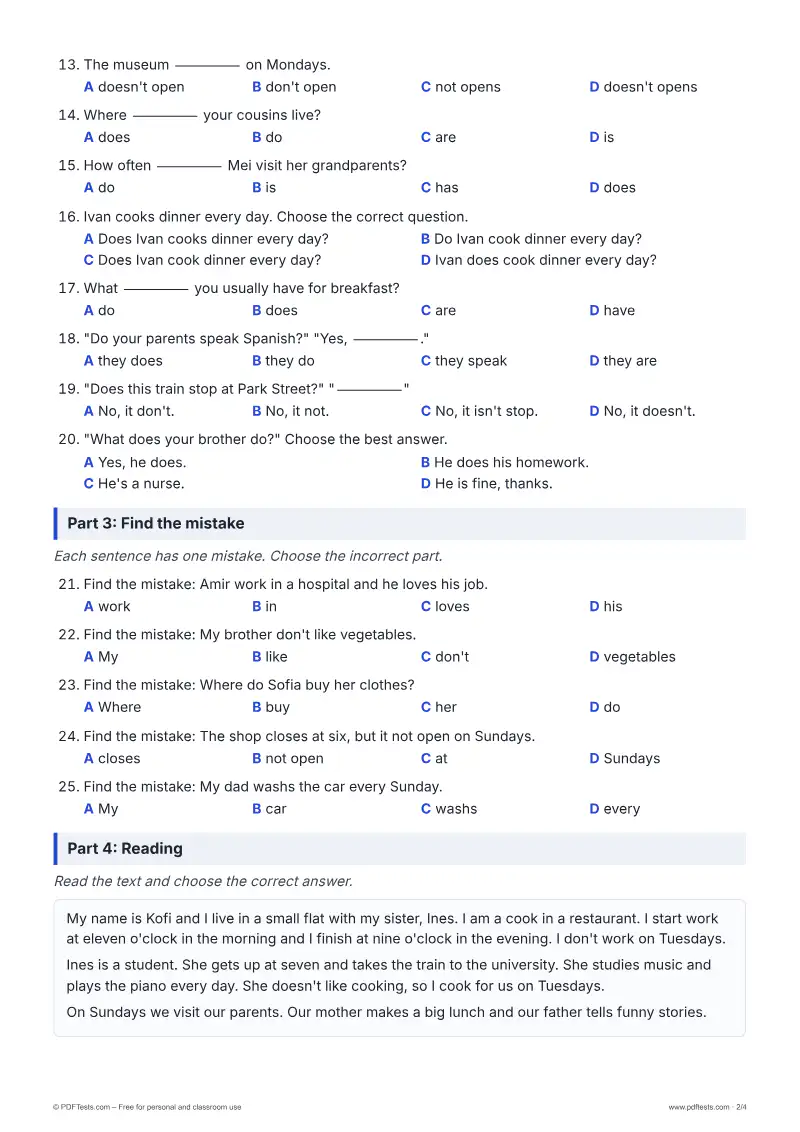
  3. The museum _____ on Mondays.

  4. Where _____ your cousins live?

  5. How often _____ Mei visit her grandparents?

  6. Ivan cooks dinner every day. Choose the correct question.

  7. What _____ you usually have for breakfast?

  8. "Do your parents speak Spanish?" "Yes, _____."

  9. "Does this train stop at Park Street?" "_____"

  10. "What does your brother do?" Choose the best answer.

Part 3: Find the mistake

Each sentence has one mistake. Choose the incorrect part.

  1. Find the mistake: Amir work in a hospital and he loves his job.

  2. Find the mistake: My brother don't like vegetables.

  3. Find the mistake: Where do Sofia buy her clothes?

  4. Find the mistake: The shop closes at six, but it not open on Sundays.

  5. Find the mistake: My dad washs the car every Sunday.

Part 4: Reading

Read the text and choose the correct answer.

My name is Kofi and I live in a small flat with my sister, Ines. I am a cook in a restaurant. I start work at eleven o'clock in the morning and I finish at nine o'clock in the evening. I don't work on Tuesdays.

Ines is a student. She gets up at seven and takes the train to the university. She studies music and plays the piano every day. She doesn't like cooking, so I cook for us on Tuesdays.

On Sundays we visit our parents. Our mother makes a big lunch and our father tells funny stories.

  1. What does Kofi do?

  2. When does Kofi finish work?

  3. What does Ines study?

  4. Ines _____ cooking.

  5. "Does Kofi work on Tuesdays?"

Preview

About this test

This printable A1 grammar test checks the Present Simple: third-person -s/-es/-ies spelling, adverbs of frequency, negatives with don't/doesn't, questions with do/does and short answers. It ends with error correction and a short reading text about daily routines. It suits beginner learners and teachers who need a quick, reliable check.

Topics covered

Present SimpleThird person -s / -es / -iesNegatives: don't / doesn'tQuestions with do / doesShort answersAdverbs of frequencyDaily routines

How to use this test

  1. Download the PDF and print it, or take the test online below.
  2. Answer every question without a dictionary or time pressure.
  3. Check your answers and note the topics you need to review.

Notes for teachers

Use this test after teaching Present Simple affirmatives, negatives and questions, or as a review. It targets typical A1 errors: a missing third-person -s, wrong spelling (washs, flys), don't/doesn't confusion, double marking (doesn't drinks), the wrong auxiliary with plural subjects, and adverb word order. As a follow-up, ask students to write five sentences about a family member's routine, then turn them into questions and negative sentences.