PDFTests Originals

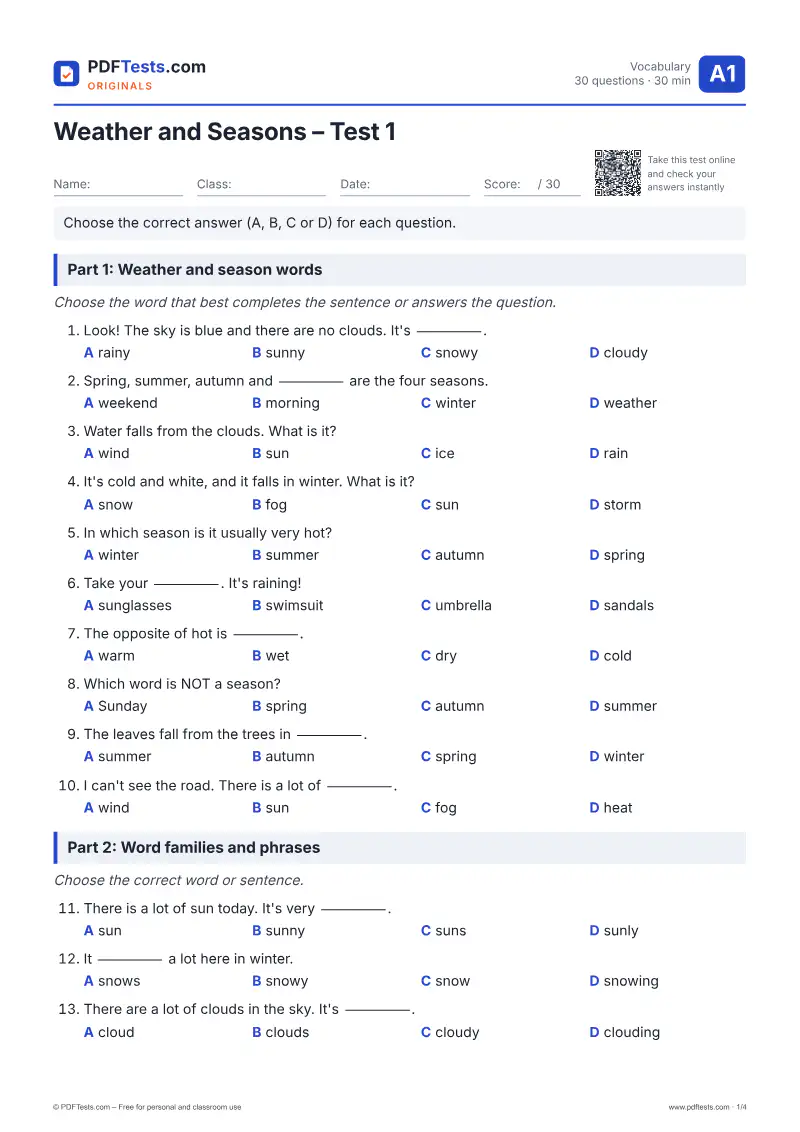
Weather and Seasons – Test 1

A1 Beginner VocabularyEnglish

This A1 vocabulary test checks basic words for weather, seasons and clothes for different weather. It includes word choice, word families like sun/sunny, common phrases and a short reading text. It suits beginner learners of all ages and teachers who need a quick, printable check.
Questions
30
Time
30 min
PDF
4 pages
Answer key
Included
  • 100% free
  • No sign-up or email
  • Print-ready A4 PDF
Preview of page 1 of Weather and Seasons – Test 1 Open PDF

Take the test online

Choose the correct answer (A, B, C or D) for each question. Choose your answers, then press “Check my answers”.

Part 1: Weather and season words

Choose the word that best completes the sentence or answers the question.

  1. Look! The sky is blue and there are no clouds. It's _____.

  2. Spring, summer, autumn and _____ are the four seasons.

  3. Water falls from the clouds. What is it?

  4. It's cold and white, and it falls in winter. What is it?

  5. In which season is it usually very hot?

  6. Take your _____. It's raining!

  7. The opposite of hot is _____.

  8. Which word is NOT a season?

  9. The leaves fall from the trees in _____.

  10. I can't see the road. There is a lot of _____.

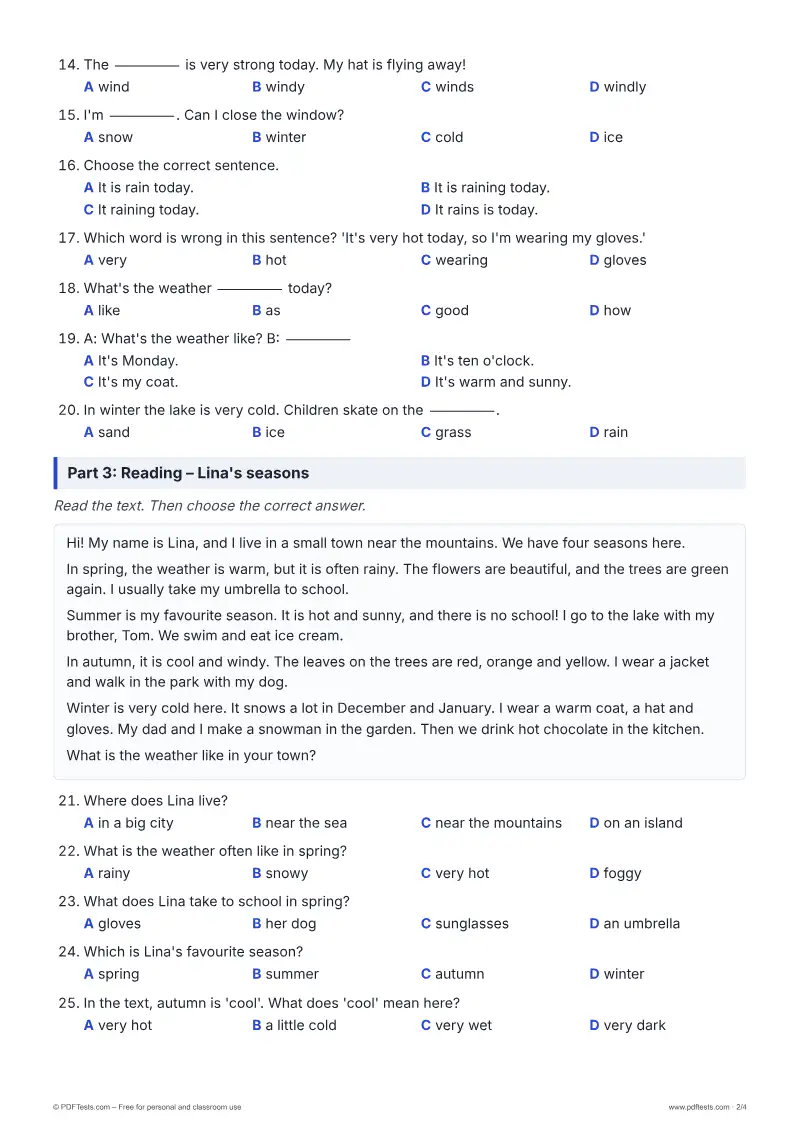
Part 2: Word families and phrases

Choose the correct word or sentence.

  1. There is a lot of sun today. It's very _____.

  2. It _____ a lot here in winter.

  3. There are a lot of clouds in the sky. It's _____.

  4. The _____ is very strong today. My hat is flying away!

  5. I'm _____. Can I close the window?

  6. Choose the correct sentence.

  7. Which word is wrong in this sentence? 'It's very hot today, so I'm wearing my gloves.'

  8. What's the weather _____ today?

  9. A: What's the weather like? B: _____

  10. In winter the lake is very cold. Children skate on the _____.

Part 3: Reading – Lina's seasons

Read the text. Then choose the correct answer.

Hi! My name is Lina, and I live in a small town near the mountains. We have four seasons here.

In spring, the weather is warm, but it is often rainy. The flowers are beautiful, and the trees are green again. I usually take my umbrella to school.

Summer is my favourite season. It is hot and sunny, and there is no school! I go to the lake with my brother, Tom. We swim and eat ice cream.

In autumn, it is cool and windy. The leaves on the trees are red, orange and yellow. I wear a jacket and walk in the park with my dog.

Winter is very cold here. It snows a lot in December and January. I wear a warm coat, a hat and gloves. My dad and I make a snowman in the garden. Then we drink hot chocolate in the kitchen.

What is the weather like in your town?

  1. Where does Lina live?

  2. What is the weather often like in spring?

  3. What does Lina take to school in spring?

  4. Which is Lina's favourite season?

  5. In the text, autumn is 'cool'. What does 'cool' mean here?

  6. What colour are the leaves in autumn?

  7. When does it snow a lot?

  8. What does Lina wear in winter?

  9. What do Lina and her dad make in the garden?

  10. Where do they drink hot chocolate?

Was this page helpful?

Report a mistake

Spotted a wrong answer, a typo or an unclear explanation? Tell us and we will fix it.

Practise with a worksheet: Weather and Seasons – Worksheet 1

Preview

About this test

This A1 vocabulary test checks basic words for weather, seasons and clothes for different weather. It includes word choice, word families like sun/sunny, common phrases and a short reading text. It suits beginner learners of all ages and teachers who need a quick, printable check.

Topics covered

Weather wordsThe four seasonsWord families (sun – sunny)Clothes for the weatherTalking about the weatherReading for meaning

How to use this test

  1. Download the PDF and print it, or take the test online below.
  2. Answer every question without a dictionary or time pressure.
  3. Check your answers and note the topics you need to review.

Notes for teachers

Use this test after a unit on weather and seasons, or as a quick diagnostic. Part 2 targets common beginner errors such as using the noun instead of the adjective ('It's sun' instead of 'It's sunny') and mixing up 'It's raining' with 'It is rain'. For follow-up, ask learners to describe today's weather or write a short text like Lina's about their own town.