PDFTests Originals

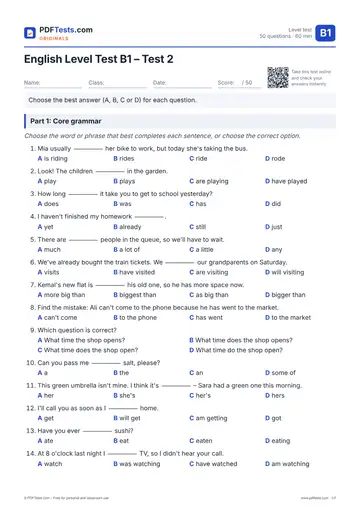
English Level Test B1 – Test 3

B1 Intermediate Level testEnglish

This B1 placement test checks whether a learner is secure at intermediate level. It samples key B1 grammar, everyday vocabulary and functional language, and ends with a short reading text. It suits teenage and adult learners and their teachers.
Questions
50
Time
60 min
PDF
6 pages
Answer key
Included
  • 100% free
  • No sign-up or email
  • Print-ready A4 PDF
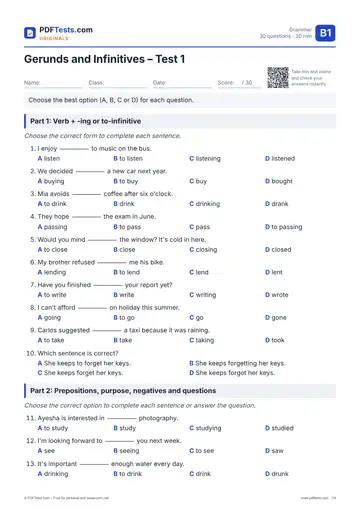
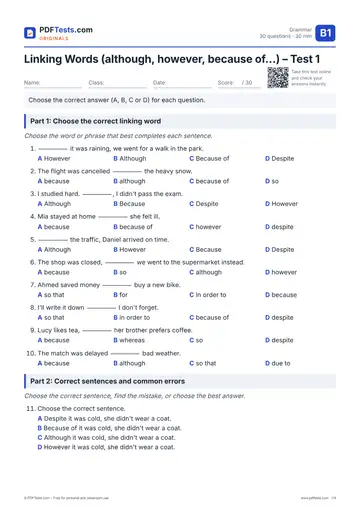
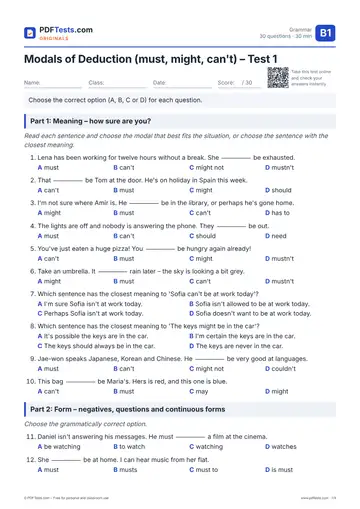
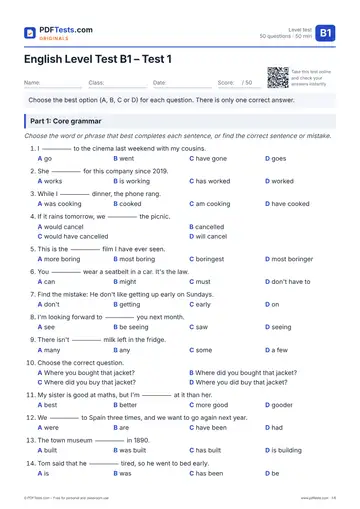
Preview of page 1 of English Level Test B1 – Test 3 Open PDF

Take the test online

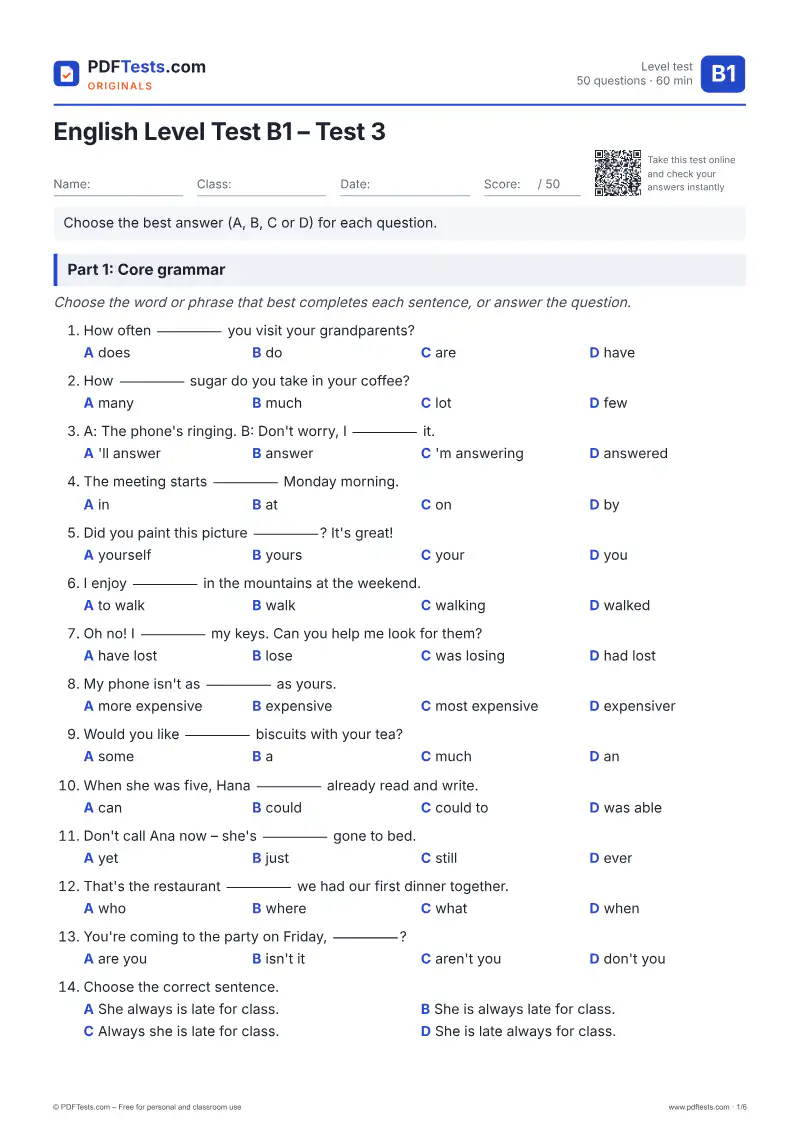
Choose the best answer (A, B, C or D) for each question. Choose your answers, then press “Check my answers”.

Part 1: Core grammar

Choose the word or phrase that best completes each sentence, or answer the question.

  1. How often _____ you visit your grandparents?

  2. How _____ sugar do you take in your coffee?

  3. A: The phone's ringing. B: Don't worry, I _____ it.

  4. The meeting starts _____ Monday morning.

  5. Did you paint this picture _____? It's great!

  6. I enjoy _____ in the mountains at the weekend.

  7. Oh no! I _____ my keys. Can you help me look for them?

  8. My phone isn't as _____ as yours.

  9. Would you like _____ biscuits with your tea?

  10. When she was five, Hana _____ already read and write.

  11. Don't call Ana now – she's _____ gone to bed.

  12. That's the restaurant _____ we had our first dinner together.

  13. You're coming to the party on Friday, _____?

  14. Choose the correct sentence.

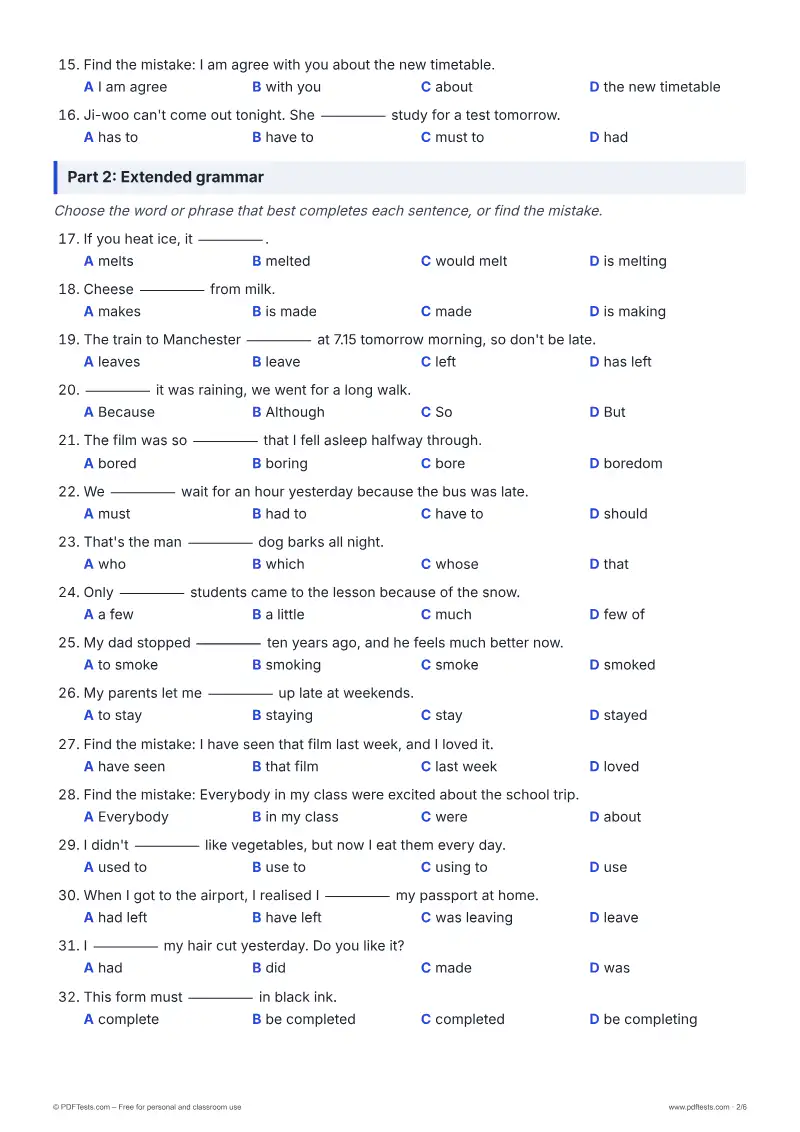
  15. Find the mistake: I am agree with you about the new timetable.

  16. Ji-woo can't come out tonight. She _____ study for a test tomorrow.

Part 2: Extended grammar

Choose the word or phrase that best completes each sentence, or find the mistake.

  1. If you heat ice, it _____.

  2. Cheese _____ from milk.

  3. The train to Manchester _____ at 7.15 tomorrow morning, so don't be late.

  4. _____ it was raining, we went for a long walk.

  5. The film was so _____ that I fell asleep halfway through.

  6. We _____ wait for an hour yesterday because the bus was late.

  7. That's the man _____ dog barks all night.

  8. Only _____ students came to the lesson because of the snow.

  9. My dad stopped _____ ten years ago, and he feels much better now.

  10. My parents let me _____ up late at weekends.

  11. Find the mistake: I have seen that film last week, and I loved it.

  12. Find the mistake: Everybody in my class were excited about the school trip.

  13. I didn't _____ like vegetables, but now I eat them every day.

  14. When I got to the airport, I realised I _____ my passport at home.

  15. I _____ my hair cut yesterday. Do you like it?

  16. This form must _____ in black ink.

Part 3: Vocabulary and everyday English

Choose the best word, meaning or response for each question.

  1. Let's _____ a break – we've been working for two hours.

  2. Could you _____ the music, please? I'm trying to sleep.

  3. "We ran out of coffee this morning, so I had tea instead." What does 'ran out of' mean here?

  4. The children were full of _____ before the school trip. (EXCITE)

  5. I'm sorry, but the manager is _____ at the moment. Can I take a message? (AVAILABLE)

  6. We had a lot of _____ at the party – we danced all night.

  7. How was your _____ from the airport? Was there much traffic?

  8. Leo is very _____. He gets nervous when he has to talk to people he doesn't know.

  9. I've got a dentist _____ at 3 pm, so I'll leave work early.

  10. A: I'm so sorry I'm late. B: _____

  11. A: How about going to the zoo on Sunday? B: _____

  12. A: Should we eat at home or go out tonight? B: It's up to you. What does B mean?

Part 4: Reading

Read the text and choose the best answer for each question.

Our Year Without a Car

Last spring, my family made a decision that surprised all our friends: we sold our car. We live in a medium-sized town, and for years we had used the car for almost everything – going to work, taking the children to school, even driving to the shop at the end of our street. But the car was getting old, and repairing it was becoming very expensive. Instead of buying a new one, my wife Amara suggested that we try living without one for a year.

The first few weeks were hard. It rained a lot, and our two children, Kofi and Esi, complained every morning about cycling to school. I had to get up thirty minutes earlier to catch the bus to the office. Shopping was also difficult at first, because we could only buy what we could carry. We soon learned to plan our meals for the whole week and to shop more carefully.

Slowly, things started to change. The children got stronger and began to race each other to school. I started reading books on the bus instead of sitting in traffic, and I finished more books that year than in the previous five. We also saved a lot of money on fuel, parking and insurance, so in the summer we could afford a holiday by train.

There were still some problems. When my mother became ill and we needed to visit her in another city, we had to rent a car for a weekend. But that only happened twice. Now the year is over, and nobody in the family wants to buy a car again. We have discovered that our town is much smaller – and friendlier – than it looked through a car window.

  1. Why did the family sell their car?

  2. What was difficult at the beginning?

  3. How did the family solve the shopping problem?

  4. In paragraph 3, 'race each other' means the children _____.

  5. When did the family use a car during the year?

  6. What is the main idea of the text?

Was this page helpful?

Report a mistake

Spotted a wrong answer, a typo or an unclear explanation? Tell us and we will fix it.

Preview

About this test

This B1 placement test checks whether a learner is secure at intermediate level. It samples key B1 grammar, everyday vocabulary and functional language, and ends with a short reading text. It suits teenage and adult learners and their teachers.

Topics covered

Present and past tensesModal verbsConditionals and passivesRelative clauses and linkersVerb patternsWord formationEveryday vocabulary and phrasal verbsReading comprehension

How to use this test

  1. Download the PDF and print it, or take the test online below.
  2. Answer every question without a dictionary or time pressure.
  3. Check your answers and note the topics you need to review.

Notes for teachers

Use the test at the start of a course or to confirm progress. A score of 38 or more suggests the learner is secure at B1, 28–37 suggests they need consolidation, and below 28 suggests A2 work first. The test targets common errors such as 'I am agree', 'have seen' with finished past time, 'didn't used to' and -ed/-ing adjective confusion. For follow-up, ask learners to correct the error sentences and write a short paragraph about a change in their own routine, based on the reading text.