PDFTests Originals

Test de niveau d'anglais B1 – Test 3

B1 Intermédiaire Test de niveauAnglais

Ce test de positionnement B1 permet de vérifier si un apprenant maîtrise solidement le niveau intermédiaire. Il passe en revue les points clés de grammaire du B1, le vocabulaire courant et les expressions fonctionnelles, puis se termine par un court texte de compréhension écrite. Il s'adresse aux adolescents et aux adultes, ainsi qu'à leurs enseignants.
Questions
50
Durée
60 min
PDF
6 pages
Corrigé
Inclus
  • 100 % gratuit
  • Sans inscription
  • PDF A4 prêt à imprimer
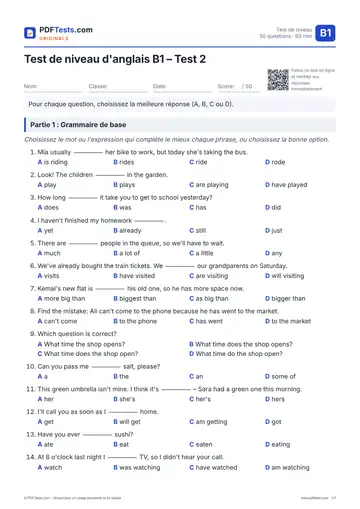
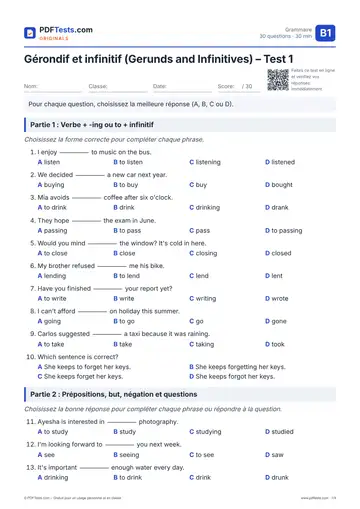
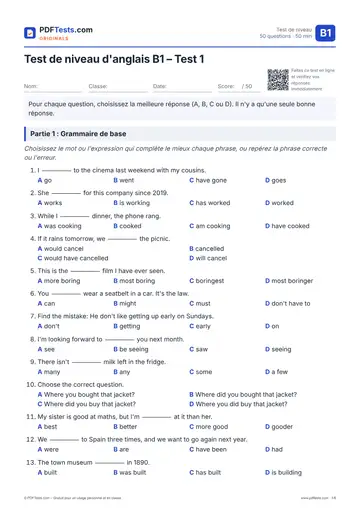
Aperçu de la page 1 : Test de niveau d'anglais B1 – Test 3 Ouvrir le PDF

Faire le test en ligne

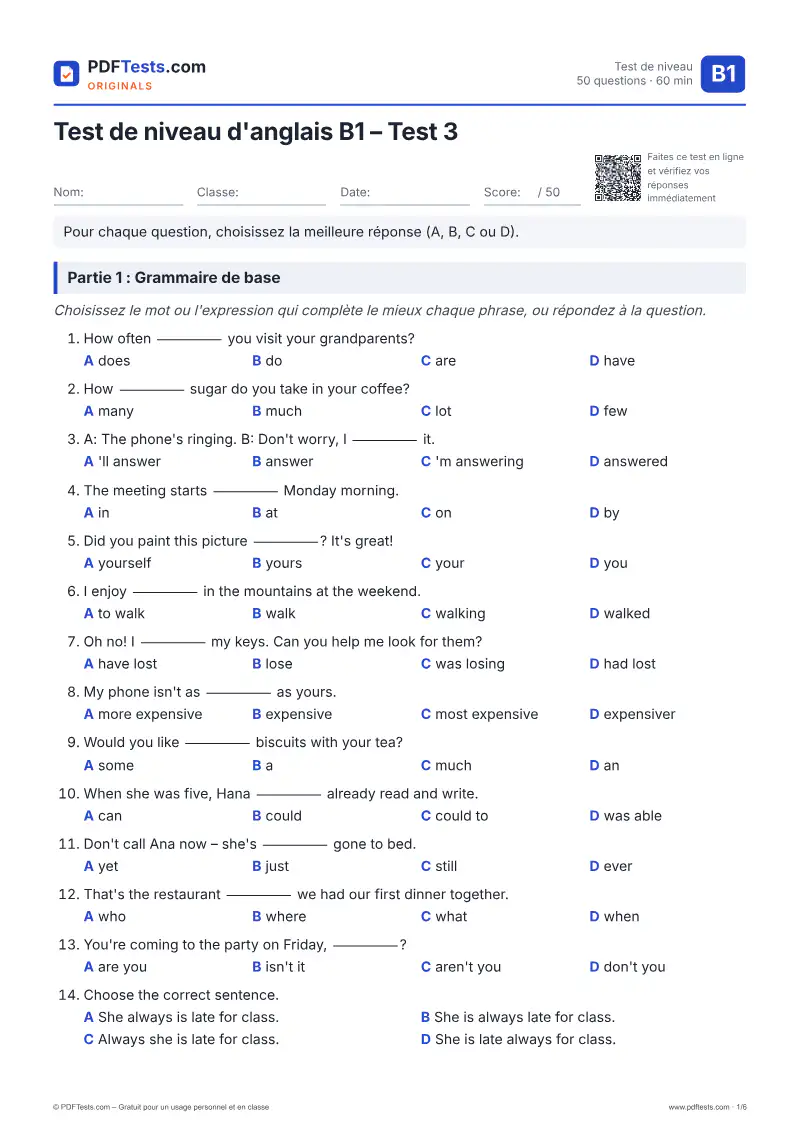
Pour chaque question, choisissez la meilleure réponse (A, B, C ou D). Choisissez vos réponses, puis cliquez sur « Vérifier mes réponses ».

Partie 1 : Grammaire de base

Choisissez le mot ou l'expression qui complète le mieux chaque phrase, ou répondez à la question.

  1. How often _____ you visit your grandparents?

  2. How _____ sugar do you take in your coffee?

  3. A: The phone's ringing. B: Don't worry, I _____ it.

  4. The meeting starts _____ Monday morning.

  5. Did you paint this picture _____? It's great!

  6. I enjoy _____ in the mountains at the weekend.

  7. Oh no! I _____ my keys. Can you help me look for them?

  8. My phone isn't as _____ as yours.

  9. Would you like _____ biscuits with your tea?

  10. When she was five, Hana _____ already read and write.

  11. Don't call Ana now – she's _____ gone to bed.

  12. That's the restaurant _____ we had our first dinner together.

  13. You're coming to the party on Friday, _____?

  14. Choose the correct sentence.

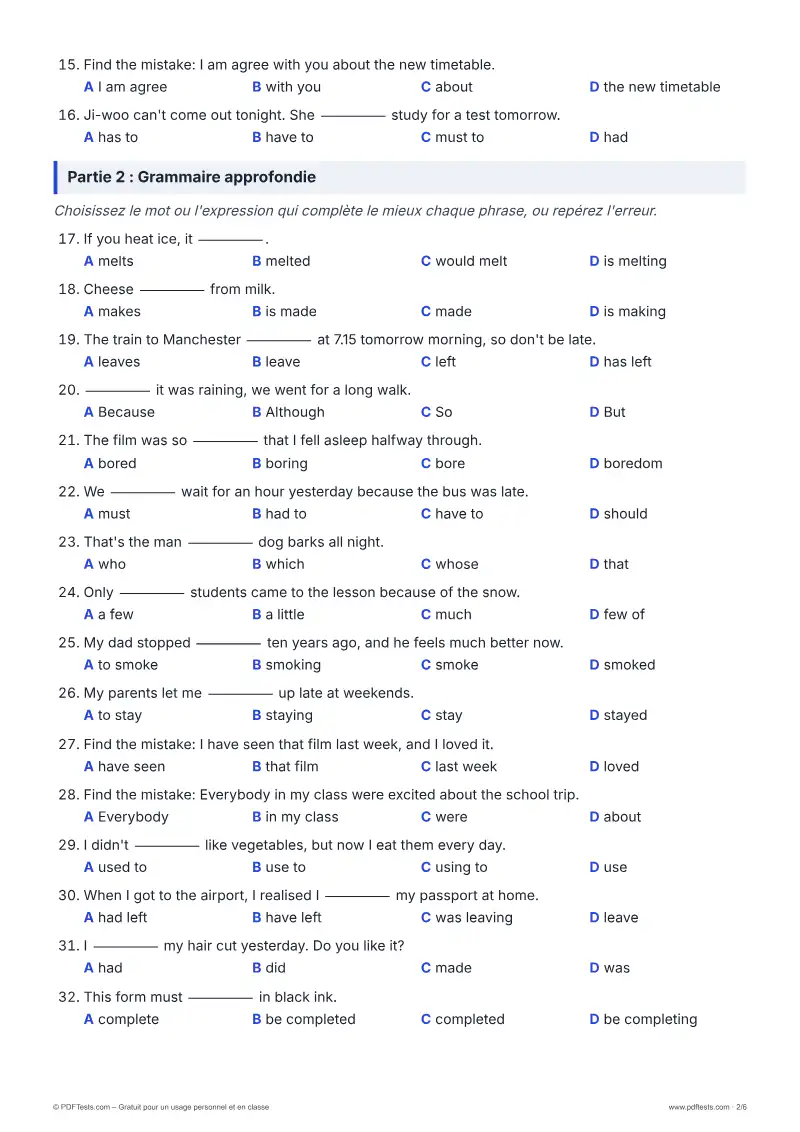
  15. Find the mistake: I am agree with you about the new timetable.

  16. Ji-woo can't come out tonight. She _____ study for a test tomorrow.

Partie 2 : Grammaire approfondie

Choisissez le mot ou l'expression qui complète le mieux chaque phrase, ou repérez l'erreur.

  1. If you heat ice, it _____.

  2. Cheese _____ from milk.

  3. The train to Manchester _____ at 7.15 tomorrow morning, so don't be late.

  4. _____ it was raining, we went for a long walk.

  5. The film was so _____ that I fell asleep halfway through.

  6. We _____ wait for an hour yesterday because the bus was late.

  7. That's the man _____ dog barks all night.

  8. Only _____ students came to the lesson because of the snow.

  9. My dad stopped _____ ten years ago, and he feels much better now.

  10. My parents let me _____ up late at weekends.

  11. Find the mistake: I have seen that film last week, and I loved it.

  12. Find the mistake: Everybody in my class were excited about the school trip.

  13. I didn't _____ like vegetables, but now I eat them every day.

  14. When I got to the airport, I realised I _____ my passport at home.

  15. I _____ my hair cut yesterday. Do you like it?

  16. This form must _____ in black ink.

Partie 3 : Vocabulaire et anglais du quotidien

Pour chaque question, choisissez le mot, le sens ou la réponse qui convient le mieux.

  1. Let's _____ a break – we've been working for two hours.

  2. Could you _____ the music, please? I'm trying to sleep.

  3. "We ran out of coffee this morning, so I had tea instead." What does 'ran out of' mean here?

  4. The children were full of _____ before the school trip. (EXCITE)

  5. I'm sorry, but the manager is _____ at the moment. Can I take a message? (AVAILABLE)

  6. We had a lot of _____ at the party – we danced all night.

  7. How was your _____ from the airport? Was there much traffic?

  8. Leo is very _____. He gets nervous when he has to talk to people he doesn't know.

  9. I've got a dentist _____ at 3 pm, so I'll leave work early.

  10. A: I'm so sorry I'm late. B: _____

  11. A: How about going to the zoo on Sunday? B: _____

  12. A: Should we eat at home or go out tonight? B: It's up to you. What does B mean?

Partie 4 : Compréhension écrite

Lisez le texte et choisissez la meilleure réponse pour chaque question.

Our Year Without a Car

Last spring, my family made a decision that surprised all our friends: we sold our car. We live in a medium-sized town, and for years we had used the car for almost everything – going to work, taking the children to school, even driving to the shop at the end of our street. But the car was getting old, and repairing it was becoming very expensive. Instead of buying a new one, my wife Amara suggested that we try living without one for a year.

The first few weeks were hard. It rained a lot, and our two children, Kofi and Esi, complained every morning about cycling to school. I had to get up thirty minutes earlier to catch the bus to the office. Shopping was also difficult at first, because we could only buy what we could carry. We soon learned to plan our meals for the whole week and to shop more carefully.

Slowly, things started to change. The children got stronger and began to race each other to school. I started reading books on the bus instead of sitting in traffic, and I finished more books that year than in the previous five. We also saved a lot of money on fuel, parking and insurance, so in the summer we could afford a holiday by train.

There were still some problems. When my mother became ill and we needed to visit her in another city, we had to rent a car for a weekend. But that only happened twice. Now the year is over, and nobody in the family wants to buy a car again. We have discovered that our town is much smaller – and friendlier – than it looked through a car window.

  1. Why did the family sell their car?

  2. What was difficult at the beginning?

  3. How did the family solve the shopping problem?

  4. In paragraph 3, 'race each other' means the children _____.

  5. When did the family use a car during the year?

  6. What is the main idea of the text?

Cette page vous a-t-elle été utile ?

Signaler une erreur

Une mauvaise réponse, une faute de frappe ou une explication peu claire ? Dites-le-nous, nous corrigerons.

Aperçu

À propos de ce test

Ce test de positionnement B1 permet de vérifier si un apprenant maîtrise solidement le niveau intermédiaire. Il passe en revue les points clés de grammaire du B1, le vocabulaire courant et les expressions fonctionnelles, puis se termine par un court texte de compréhension écrite. Il s'adresse aux adolescents et aux adultes, ainsi qu'à leurs enseignants.

Thèmes abordés

Temps du présent et du passéVerbes modauxPhrases conditionnelles et voix passivePropositions relatives et connecteurs logiquesConstructions verbalesFormation des motsVocabulaire courant et verbes à particule (phrasal verbs)Compréhension écrite

Comment utiliser ce test

  1. Téléchargez le PDF et imprimez-le, ou faites le test en ligne ci-dessous.
  2. Répondez à toutes les questions sans dictionnaire et sans vous presser.
  3. Vérifiez vos réponses et notez les points à revoir.

Notes pour l’enseignant

Utilisez ce test en début de formation ou pour confirmer les progrès. Un score de 38 ou plus indique que l'apprenant maîtrise le niveau B1 ; entre 28 et 37, des révisions sont nécessaires ; en dessous de 28, mieux vaut d'abord retravailler le niveau A2. Le test cible des erreurs fréquentes chez les francophones comme « I am agree », « have seen » avec un moment passé révolu, « didn't used to » et la confusion entre adjectifs en -ed et en -ing. En prolongement, demandez aux apprenants de corriger les phrases fautives et de rédiger un court paragraphe sur un changement dans leur propre quotidien, en s'inspirant du texte de lecture.