PDFTests Originals

Englisch Einstufungstest B1 – Test 3

B1 Mittelstufe EinstufungstestEnglisch

Dieser Einstufungstest B1 prüft, ob Lernende das Mittelstufenniveau sicher beherrschen. Er deckt zentrale B1-Grammatik, Alltagswortschatz und typische Redemittel ab und endet mit einem kurzen Lesetext. Geeignet für Jugendliche und Erwachsene sowie ihre Lehrkräfte.
Fragen
50
Zeit
60 Min.
PDF
6 Seiten
Lösungen
Enthalten
  • 100 % kostenlos
  • Ohne Anmeldung
  • Druckfertiges A4-PDF
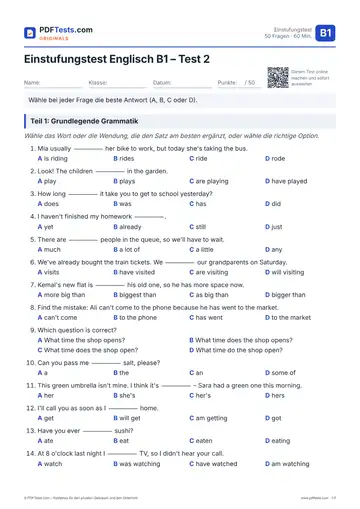
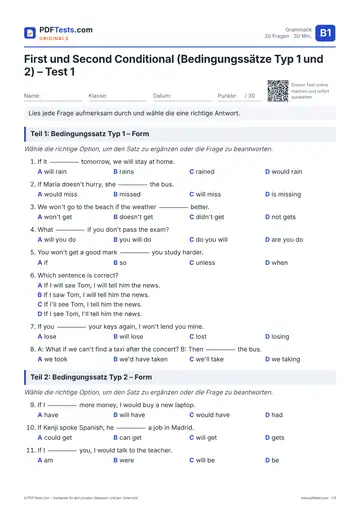
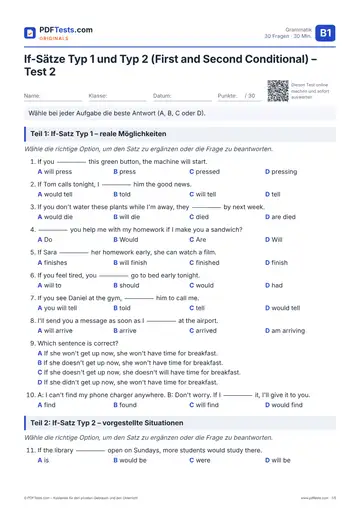
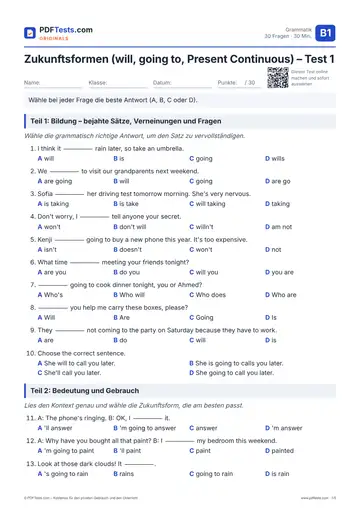
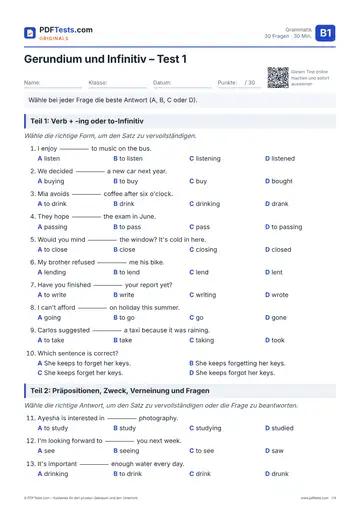
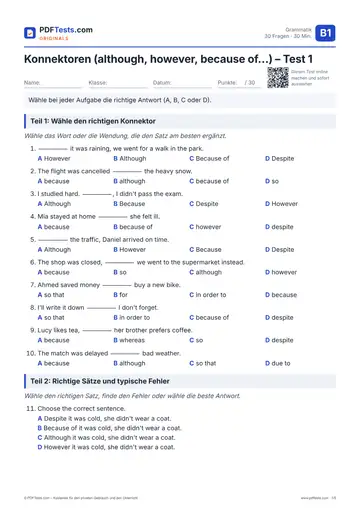
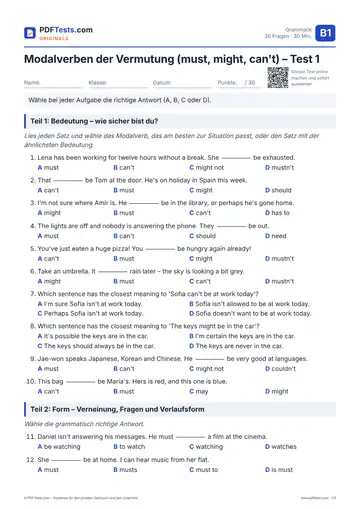
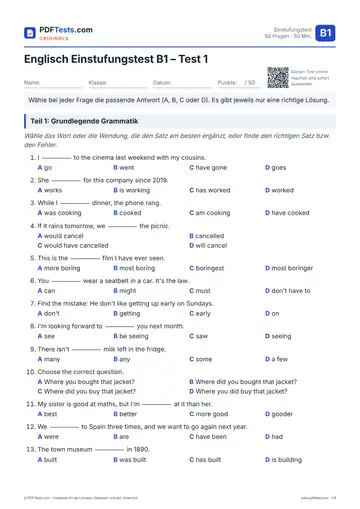
Vorschau von Seite 1: Englisch Einstufungstest B1 – Test 3 PDF öffnen

Test online machen

Wähle bei jeder Frage die beste Antwort (A, B, C oder D). Wählen Sie Ihre Antworten und klicken Sie auf „Antworten prüfen“.

Teil 1: Grundlegende Grammatik

Wähle das Wort oder die Wendung, die den Satz am besten ergänzt, oder beantworte die Frage.

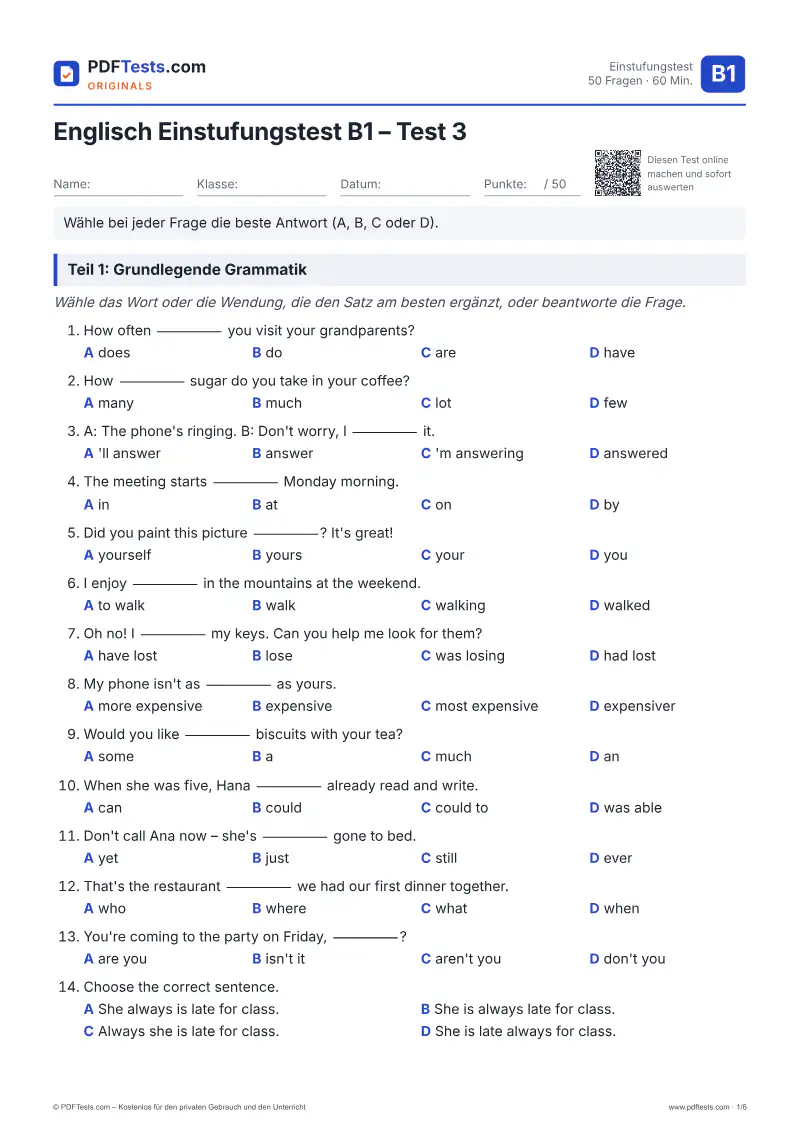
  1. How often _____ you visit your grandparents?

  2. How _____ sugar do you take in your coffee?

  3. A: The phone's ringing. B: Don't worry, I _____ it.

  4. The meeting starts _____ Monday morning.

  5. Did you paint this picture _____? It's great!

  6. I enjoy _____ in the mountains at the weekend.

  7. Oh no! I _____ my keys. Can you help me look for them?

  8. My phone isn't as _____ as yours.

  9. Would you like _____ biscuits with your tea?

  10. When she was five, Hana _____ already read and write.

  11. Don't call Ana now – she's _____ gone to bed.

  12. That's the restaurant _____ we had our first dinner together.

  13. You're coming to the party on Friday, _____?

  14. Choose the correct sentence.

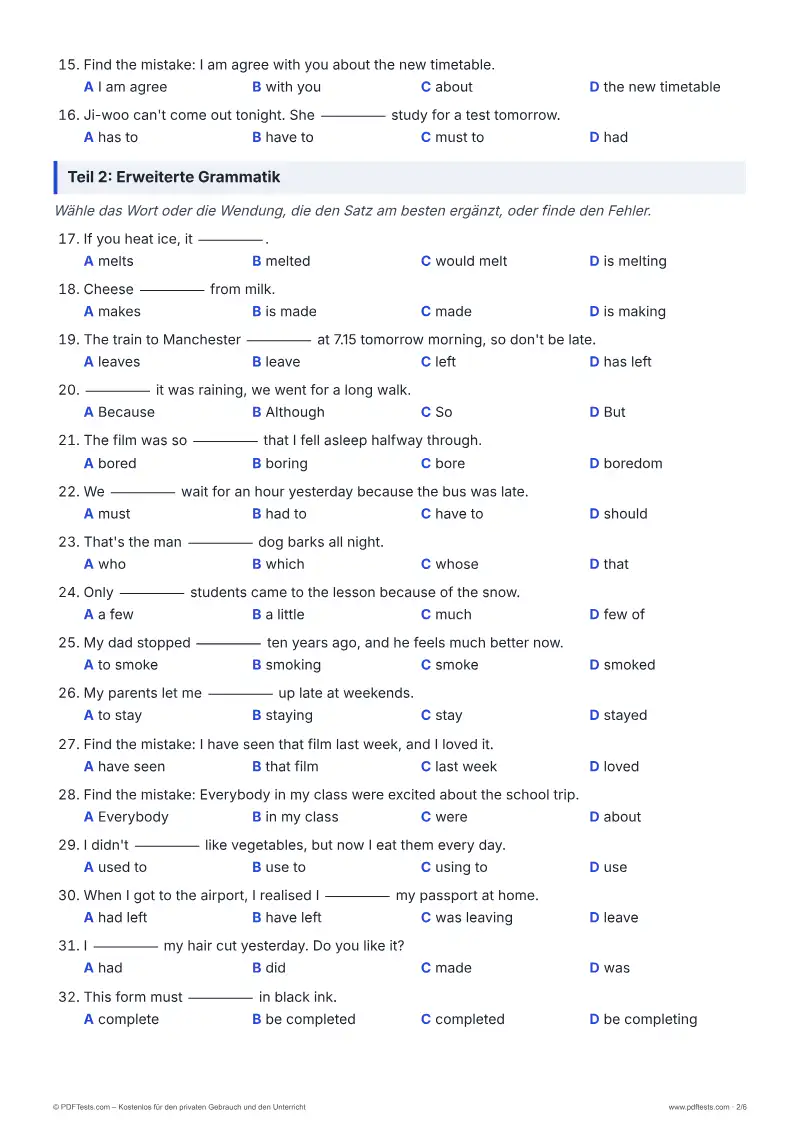
  15. Find the mistake: I am agree with you about the new timetable.

  16. Ji-woo can't come out tonight. She _____ study for a test tomorrow.

Teil 2: Erweiterte Grammatik

Wähle das Wort oder die Wendung, die den Satz am besten ergänzt, oder finde den Fehler.

  1. If you heat ice, it _____.

  2. Cheese _____ from milk.

  3. The train to Manchester _____ at 7.15 tomorrow morning, so don't be late.

  4. _____ it was raining, we went for a long walk.

  5. The film was so _____ that I fell asleep halfway through.

  6. We _____ wait for an hour yesterday because the bus was late.

  7. That's the man _____ dog barks all night.

  8. Only _____ students came to the lesson because of the snow.

  9. My dad stopped _____ ten years ago, and he feels much better now.

  10. My parents let me _____ up late at weekends.

  11. Find the mistake: I have seen that film last week, and I loved it.

  12. Find the mistake: Everybody in my class were excited about the school trip.

  13. I didn't _____ like vegetables, but now I eat them every day.

  14. When I got to the airport, I realised I _____ my passport at home.

  15. I _____ my hair cut yesterday. Do you like it?

  16. This form must _____ in black ink.

Teil 3: Wortschatz und Alltagsenglisch

Wähle bei jeder Frage das passende Wort, die richtige Bedeutung oder die beste Reaktion.

  1. Let's _____ a break – we've been working for two hours.

  2. Could you _____ the music, please? I'm trying to sleep.

  3. "We ran out of coffee this morning, so I had tea instead." What does 'ran out of' mean here?

  4. The children were full of _____ before the school trip. (EXCITE)

  5. I'm sorry, but the manager is _____ at the moment. Can I take a message? (AVAILABLE)

  6. We had a lot of _____ at the party – we danced all night.

  7. How was your _____ from the airport? Was there much traffic?

  8. Leo is very _____. He gets nervous when he has to talk to people he doesn't know.

  9. I've got a dentist _____ at 3 pm, so I'll leave work early.

  10. A: I'm so sorry I'm late. B: _____

  11. A: How about going to the zoo on Sunday? B: _____

  12. A: Should we eat at home or go out tonight? B: It's up to you. What does B mean?

Teil 4: Leseverstehen

Lies den Text und wähle bei jeder Frage die beste Antwort.

Our Year Without a Car

Last spring, my family made a decision that surprised all our friends: we sold our car. We live in a medium-sized town, and for years we had used the car for almost everything – going to work, taking the children to school, even driving to the shop at the end of our street. But the car was getting old, and repairing it was becoming very expensive. Instead of buying a new one, my wife Amara suggested that we try living without one for a year.

The first few weeks were hard. It rained a lot, and our two children, Kofi and Esi, complained every morning about cycling to school. I had to get up thirty minutes earlier to catch the bus to the office. Shopping was also difficult at first, because we could only buy what we could carry. We soon learned to plan our meals for the whole week and to shop more carefully.

Slowly, things started to change. The children got stronger and began to race each other to school. I started reading books on the bus instead of sitting in traffic, and I finished more books that year than in the previous five. We also saved a lot of money on fuel, parking and insurance, so in the summer we could afford a holiday by train.

There were still some problems. When my mother became ill and we needed to visit her in another city, we had to rent a car for a weekend. But that only happened twice. Now the year is over, and nobody in the family wants to buy a car again. We have discovered that our town is much smaller – and friendlier – than it looked through a car window.

  1. Why did the family sell their car?

  2. What was difficult at the beginning?

  3. How did the family solve the shopping problem?

  4. In paragraph 3, 'race each other' means the children _____.

  5. When did the family use a car during the year?

  6. What is the main idea of the text?

War diese Seite hilfreich?

Fehler melden

Falsche Lösung, Tippfehler oder unklare Erklärung? Schreiben Sie uns, wir korrigieren es.

Vorschau

Über diesen Test

Dieser Einstufungstest B1 prüft, ob Lernende das Mittelstufenniveau sicher beherrschen. Er deckt zentrale B1-Grammatik, Alltagswortschatz und typische Redemittel ab und endet mit einem kurzen Lesetext. Geeignet für Jugendliche und Erwachsene sowie ihre Lehrkräfte.

Themen

Gegenwarts- und VergangenheitszeitenModalverbenBedingungssätze (Conditionals) und PassivRelativsätze und BindewörterVerbmuster (Verb patterns)WortbildungAlltagswortschatz und Phrasal VerbsLeseverstehen

So nutzen Sie diesen Test

  1. Laden Sie das PDF herunter und drucken Sie es aus – oder machen Sie den Test unten online.
  2. Beantworten Sie alle Fragen ohne Wörterbuch und ohne Zeitdruck.
  3. Prüfen Sie Ihre Antworten und notieren Sie, was Sie wiederholen sollten.

Hinweise für Lehrkräfte

Setzen Sie den Test zu Kursbeginn oder zur Lernstandskontrolle ein. Ab 38 Punkten beherrscht die Person B1 sicher, bei 28–37 Punkten besteht Festigungsbedarf, unter 28 Punkten empfiehlt sich zunächst Arbeit auf A2-Niveau. Der Test zielt auf typische Fehler wie 'I am agree', 'have seen' mit abgeschlossenen Zeitangaben, 'didn't used to' und die Verwechslung von Adjektiven auf -ed/-ing. Zur Vertiefung können die Lernenden die Fehlersätze korrigieren und – angelehnt an den Lesetext – einen kurzen Absatz über eine Veränderung in ihrem eigenen Alltag schreiben.