PDFTests Originals

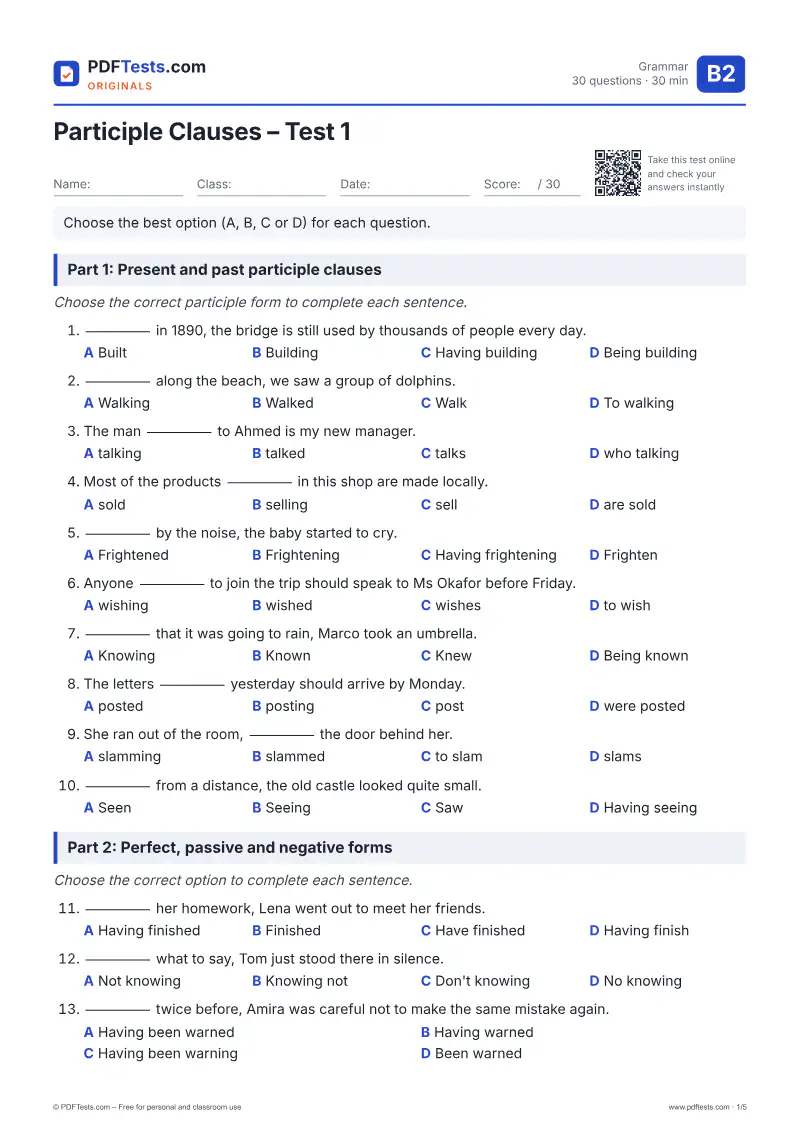
Participle Clauses – Test 1

B2 Upper-intermediate GrammarEnglish

This 30-question B2 test checks how well you form and use participle clauses in English. It covers present, past and perfect participles, negative and passive forms, clauses after conjunctions, and reduced relative clauses. It also targets typical errors such as dangling participles. It suits upper-intermediate learners and teachers who need a ready-made practice or assessment sheet.
Questions
30
Time
30 min
PDF
5 pages
Answer key
Included
  • 100% free
  • No sign-up or email
  • Print-ready A4 PDF
Preview of page 1 of Participle Clauses – Test 1 Open PDF

Take the test online

Choose the best option (A, B, C or D) for each question. Choose your answers, then press “Check my answers”.

Part 1: Present and past participle clauses

Choose the correct participle form to complete each sentence.

  1. _____ in 1890, the bridge is still used by thousands of people every day.

  2. _____ along the beach, we saw a group of dolphins.

  3. The man _____ to Ahmed is my new manager.

  4. Most of the products _____ in this shop are made locally.

  5. _____ by the noise, the baby started to cry.

  6. Anyone _____ to join the trip should speak to Ms Okafor before Friday.

  7. _____ that it was going to rain, Marco took an umbrella.

  8. The letters _____ yesterday should arrive by Monday.

  9. She ran out of the room, _____ the door behind her.

  10. _____ from a distance, the old castle looked quite small.

Part 2: Perfect, passive and negative forms

Choose the correct option to complete each sentence.

  1. _____ her homework, Lena went out to meet her friends.

  2. _____ what to say, Tom just stood there in silence.

  3. _____ twice before, Amira was careful not to make the same mistake again.

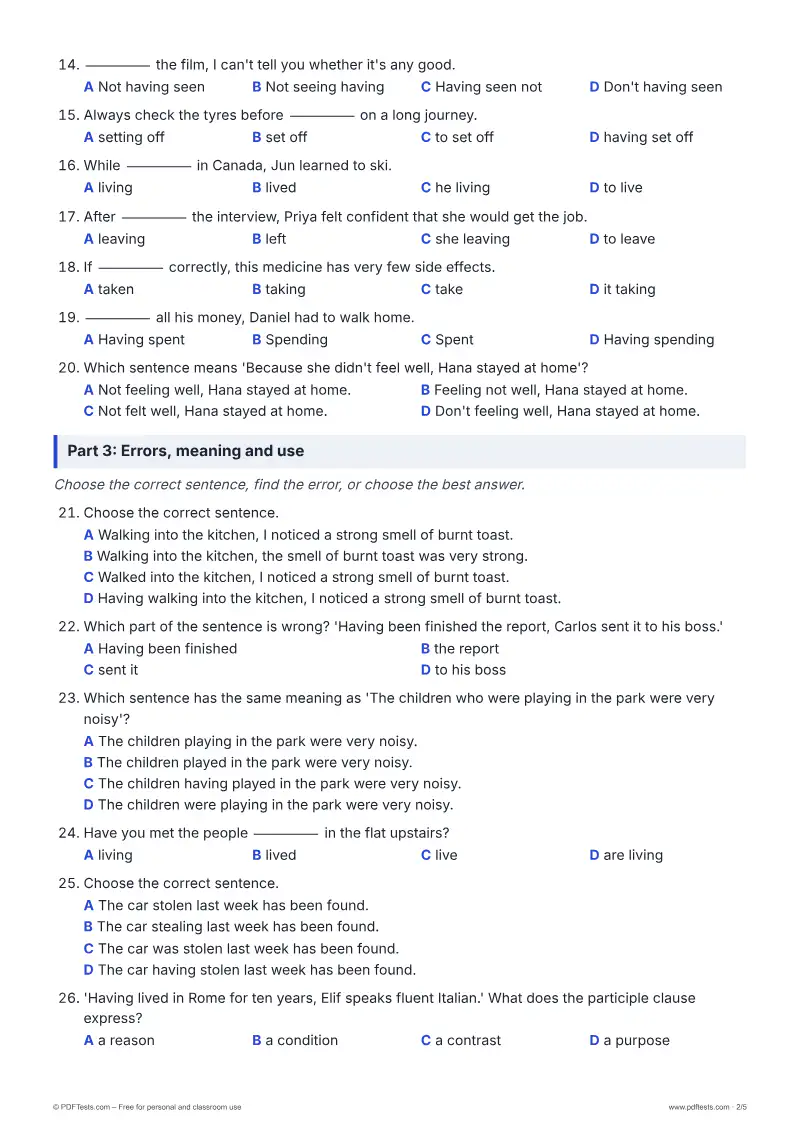
  4. _____ the film, I can't tell you whether it's any good.

  5. Always check the tyres before _____ on a long journey.

  6. While _____ in Canada, Jun learned to ski.

  7. After _____ the interview, Priya felt confident that she would get the job.

  8. If _____ correctly, this medicine has very few side effects.

  9. _____ all his money, Daniel had to walk home.

  10. Which sentence means 'Because she didn't feel well, Hana stayed at home'?

Part 3: Errors, meaning and use

Choose the correct sentence, find the error, or choose the best answer.

  1. Choose the correct sentence.

  2. Which part of the sentence is wrong? 'Having been finished the report, Carlos sent it to his boss.'

  3. Which sentence has the same meaning as 'The children who were playing in the park were very noisy'?

  4. Have you met the people _____ in the flat upstairs?

  5. Choose the correct sentence.

  6. 'Having lived in Rome for ten years, Elif speaks fluent Italian.' What does the participle clause express?

  7. _____ a Sunday, most of the shops were closed.

  8. A: Why didn't you call me back yesterday? B: _____

  9. 'Opening the drawer, she took out a pen.' What does this sentence mean?

  10. Which part of the sentence is wrong? 'Building in the 1960s, the library was designed to hold one million books.'

Preview

About this test

This 30-question B2 test checks how well you form and use participle clauses in English. It covers present, past and perfect participles, negative and passive forms, clauses after conjunctions, and reduced relative clauses. It also targets typical errors such as dangling participles. It suits upper-intermediate learners and teachers who need a ready-made practice or assessment sheet.

Topics covered

Present participle clausesPast participle clausesPerfect participlesNegative participle clausesReduced relative clausesConjunction + participleDangling participles

How to use this test

  1. Download the PDF and print it, or take the test online below.
  2. Answer every question without a dictionary or time pressure.
  3. Check your answers and note the topics you need to review.

Notes for teachers

Use Part 1 to check basic form, Part 2 for perfect, passive and negative forms, and Part 3 for error spotting and meaning. The most common error targeted is the dangling participle, where the participle clause does not share the subject of the main clause. Other targeted errors are the wrong position of 'not' and confusion between active and passive participles. As a follow-up, ask students to rewrite sentences with full adverbial or relative clauses as participle clauses, and the other way round.