 B2
B2 OriginalLevel test
PDFTests Originals
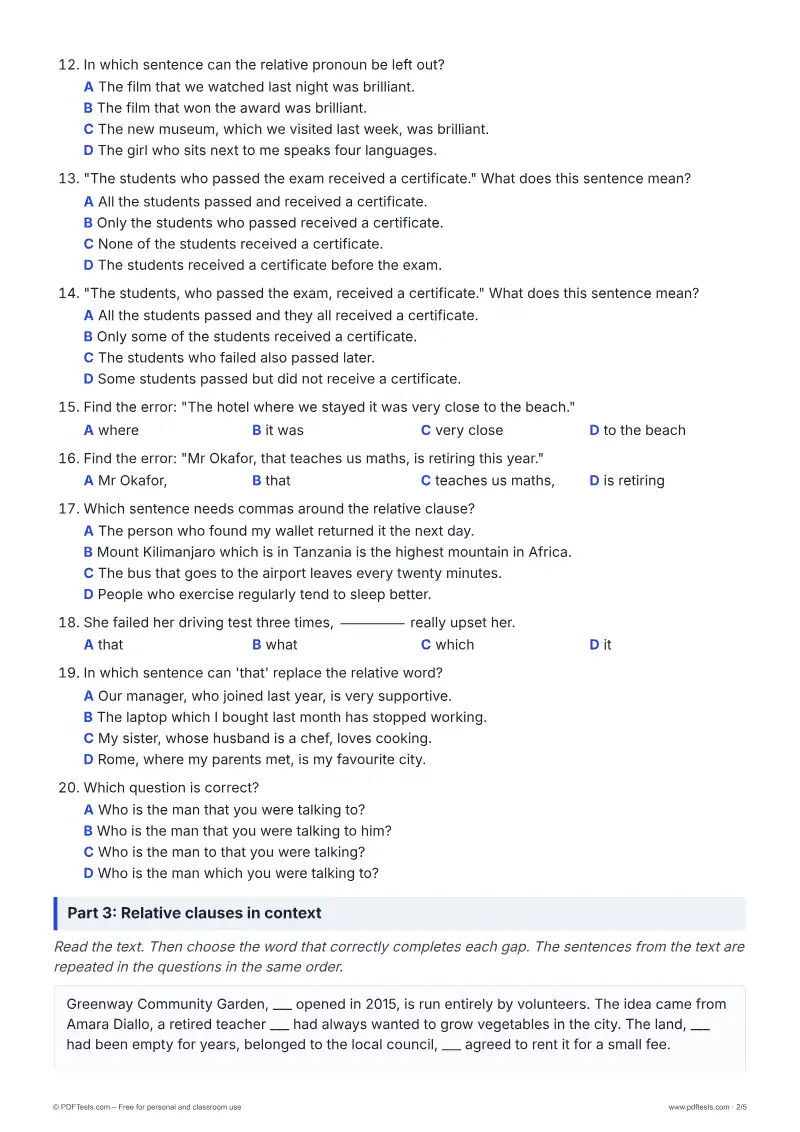
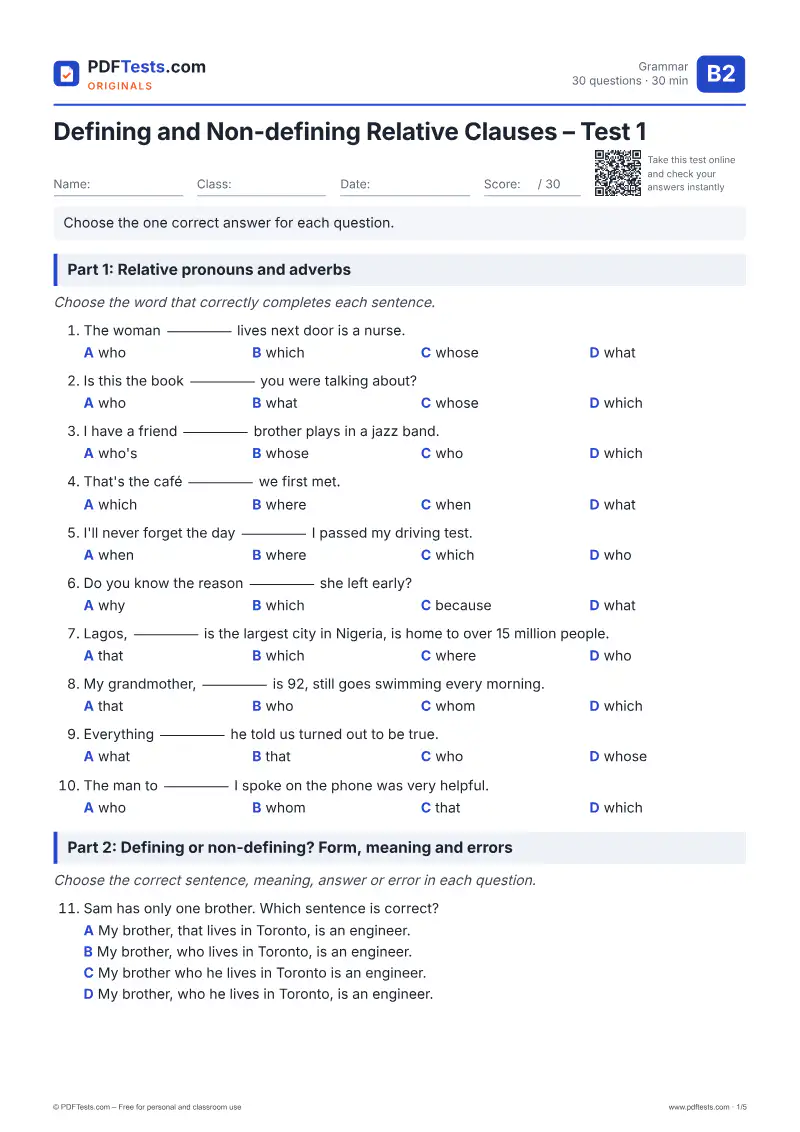
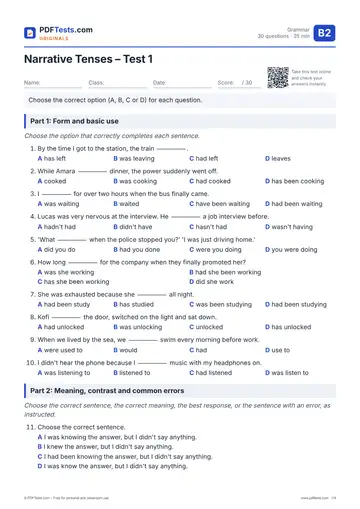
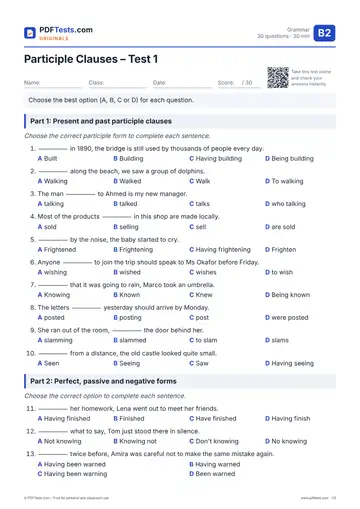
This 30-question B2 grammar test checks how well you use defining and non-defining relative clauses in English. It covers relative pronouns and adverbs, commas, when 'that' is possible or the pronoun can be left out, 'which' referring to a whole clause, prepositions with 'whom' and 'which', and typical learner errors. It is suitable for upper-intermediate learners, exam candidates and teachers who need a ready-made classroom check.
 Open PDF
 Choose the one correct answer for each question. Choose your answers, then press “Check my answers”.
This 30-question B2 grammar test checks how well you use defining and non-defining relative clauses in English. It covers relative pronouns and adverbs, commas, when 'that' is possible or the pronoun can be left out, 'which' referring to a whole clause, prepositions with 'whom' and 'which', and typical learner errors. It is suitable for upper-intermediate learners, exam candidates and teachers who need a ready-made classroom check.
Use Part 1 as a warm-up on pronoun choice, Part 2 to check punctuation, meaning and when 'that' or omission is possible, and Part 3 to test relative clauses in a connected text. The test targets frequent B2 errors: using 'that' in non-defining clauses, adding an extra pronoun ('where we stayed it was'), confusing 'whose' and 'who's', and using 'that' or 'what' to refer to a whole clause. As a follow-up, ask students to rewrite pairs of short sentences as one sentence with a relative clause and to explain whether commas are needed.
B2 OriginalLevel test
 B2
B2 OriginalLevel test
 B2
B2 OriginalGrammar
 B2
B2 OriginalGrammar
 B2
B2 OriginalGrammar
 B2
B2 OriginalGrammar
 B2
B2 OriginalGrammar
 B2
B2 OriginalGrammar