PDFTests Originals

Word Formation (prefixes and suffixes) – Test 1

B2 Upper-intermediate VocabularyEnglish

This B2 vocabulary test checks how well learners use prefixes and suffixes to build and change words. It covers negative and other prefixes, common noun, adjective, verb and adverb suffixes, and word families in a reading text. It suits upper-intermediate students preparing for exams such as B2-level certificates, and teachers who need a quick, printable check.
Questions
30
Time
30 min
PDF
4 pages
Answer key
Included
  • 100% free
  • No sign-up or email
  • Print-ready A4 PDF
Preview of page 1 of Word Formation (prefixes and suffixes) – Test 1 Open PDF

Take the test online

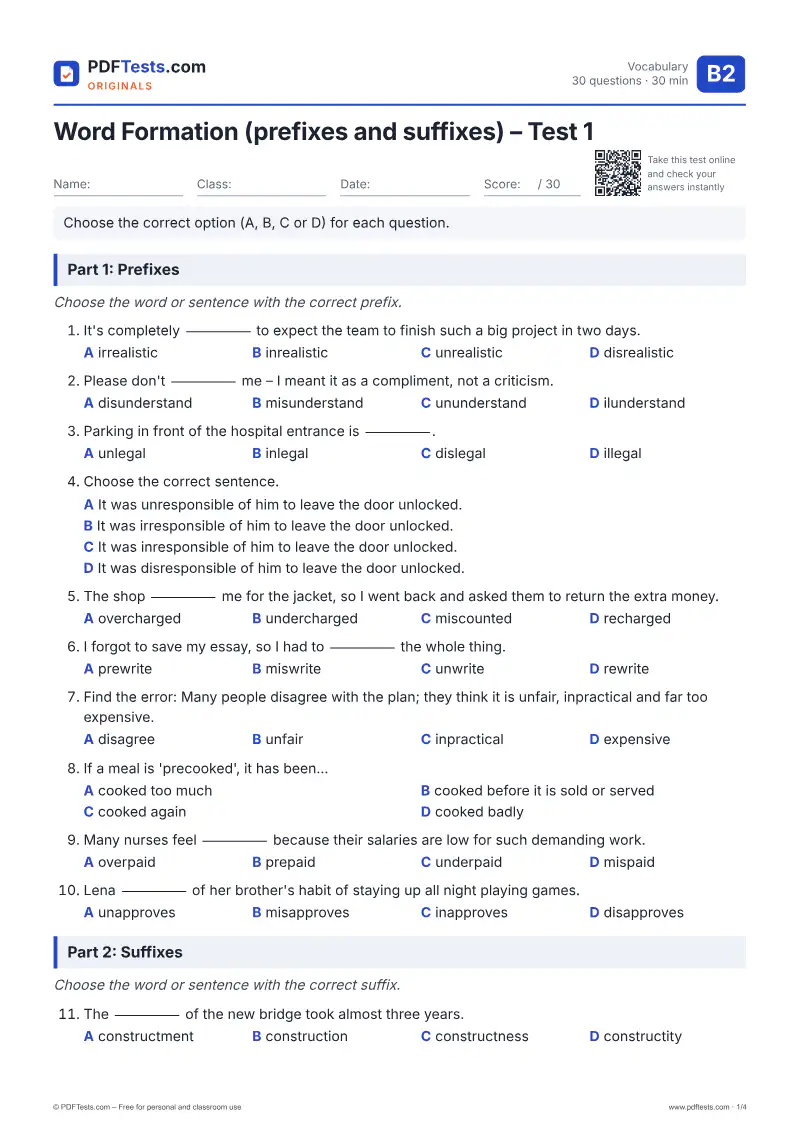
Choose the correct option (A, B, C or D) for each question. Choose your answers, then press “Check my answers”.

Part 1: Prefixes

Choose the word or sentence with the correct prefix.

  1. It's completely _____ to expect the team to finish such a big project in two days.

  2. Please don't _____ me – I meant it as a compliment, not a criticism.

  3. Parking in front of the hospital entrance is _____.

  4. Choose the correct sentence.

  5. The shop _____ me for the jacket, so I went back and asked them to return the extra money.

  6. I forgot to save my essay, so I had to _____ the whole thing.

  7. Find the error: Many people disagree with the plan; they think it is unfair, inpractical and far too expensive.

  8. If a meal is 'precooked', it has been…

  9. Many nurses feel _____ because their salaries are low for such demanding work.

  10. Lena _____ of her brother's habit of staying up all night playing games.

Part 2: Suffixes

Choose the word or sentence with the correct suffix.

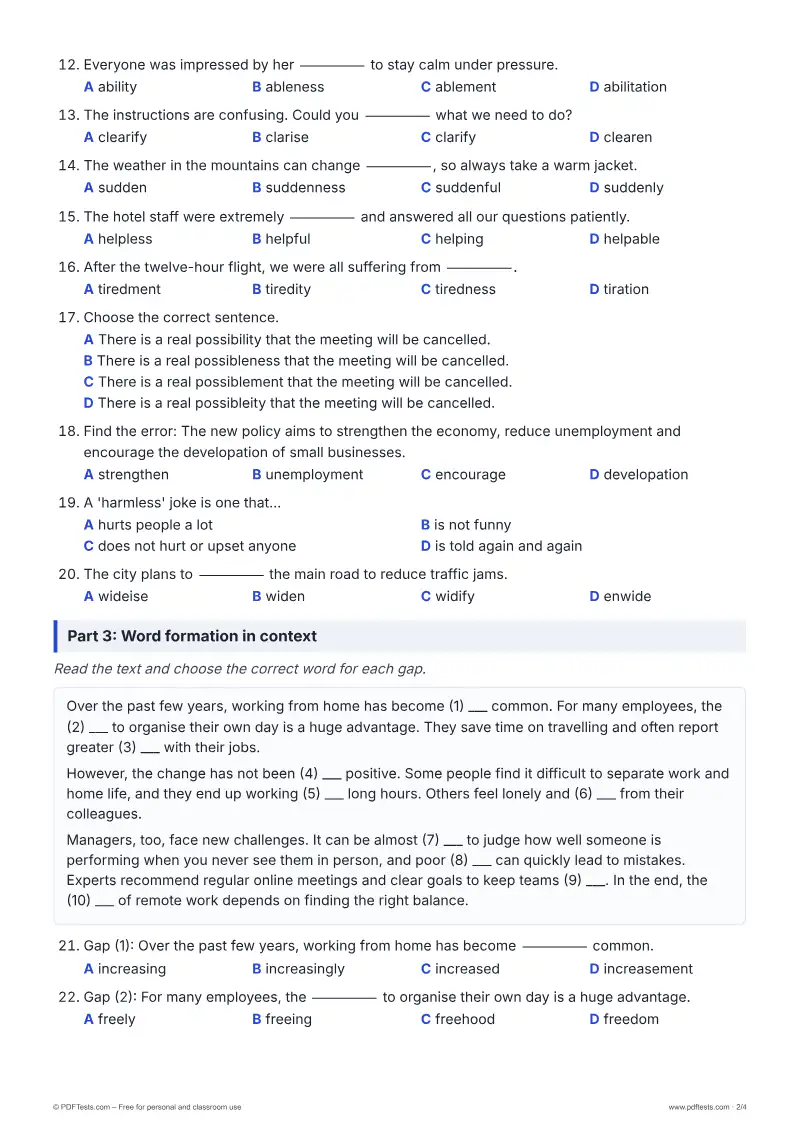
  1. The _____ of the new bridge took almost three years.

  2. Everyone was impressed by her _____ to stay calm under pressure.

  3. The instructions are confusing. Could you _____ what we need to do?

  4. The weather in the mountains can change _____, so always take a warm jacket.

  5. The hotel staff were extremely _____ and answered all our questions patiently.

  6. After the twelve-hour flight, we were all suffering from _____.

  7. Choose the correct sentence.

  8. Find the error: The new policy aims to strengthen the economy, reduce unemployment and encourage the developation of small businesses.

  9. A 'harmless' joke is one that…

  10. The city plans to _____ the main road to reduce traffic jams.

Part 3: Word formation in context

Read the text and choose the correct word for each gap.

Over the past few years, working from home has become (1) ___ common. For many employees, the (2) ___ to organise their own day is a huge advantage. They save time on travelling and often report greater (3) ___ with their jobs.

However, the change has not been (4) ___ positive. Some people find it difficult to separate work and home life, and they end up working (5) ___ long hours. Others feel lonely and (6) ___ from their colleagues.

Managers, too, face new challenges. It can be almost (7) ___ to judge how well someone is performing when you never see them in person, and poor (8) ___ can quickly lead to mistakes. Experts recommend regular online meetings and clear goals to keep teams (9) ___. In the end, the (10) ___ of remote work depends on finding the right balance.

  1. Gap (1): Over the past few years, working from home has become _____ common.

  2. Gap (2): For many employees, the _____ to organise their own day is a huge advantage.

  3. Gap (3): They often report greater _____ with their jobs.

  4. Gap (4): However, the change has not been _____ positive.

  5. Gap (5): They end up working _____ long hours.

  6. Gap (6): Others feel lonely and _____ from their colleagues.

  7. Gap (7): It can be almost _____ to judge how well someone is performing.

  8. Gap (8): Poor _____ can quickly lead to mistakes.

  9. Gap (9): Experts recommend regular online meetings and clear goals to keep teams _____.

  10. Gap (10): In the end, the _____ of remote work depends on finding the right balance.

Preview

About this test

This B2 vocabulary test checks how well learners use prefixes and suffixes to build and change words. It covers negative and other prefixes, common noun, adjective, verb and adverb suffixes, and word families in a reading text. It suits upper-intermediate students preparing for exams such as B2-level certificates, and teachers who need a quick, printable check.

Topics covered

Negative prefixesPrefixes of meaning (mis-, over-, under-, re-, pre-)Noun suffixesAdjective and adverb suffixesVerb-forming suffixesWord families in context

How to use this test

  1. Download the PDF and print it, or take the test online below.
  2. Answer every question without a dictionary or time pressure.
  3. Check your answers and note the topics you need to review.

Notes for teachers

Use Part 1 and Part 2 as a diagnostic of individual affixes, then Part 3 to see whether students can choose the right word class in a longer text. The distractors target typical errors such as the wrong negative prefix (inpractical, unlegal), invented suffixes (developation, tiredment) and the wrong part of speech (entire for entirely). For follow-up, ask students to build full word families (e.g. succeed, success, successful, successfully, unsuccessful) for the words in the test.