PDFTests Originals

Future Continuous and Future Perfect – Test 1

B2 Upper-intermediate GrammarEnglish

This B2 grammar test checks how well you form and use the future continuous (will be doing) and the future perfect (will have done). It covers affirmative, negative and question forms, the difference in meaning between the two tenses, time expressions such as 'by' and 'this time tomorrow', and typical learner errors. It is suitable for upper-intermediate learners, exam candidates and teachers who need a ready-made classroom check.
Questions
30
Time
30 min
PDF
4 pages
Answer key
Included
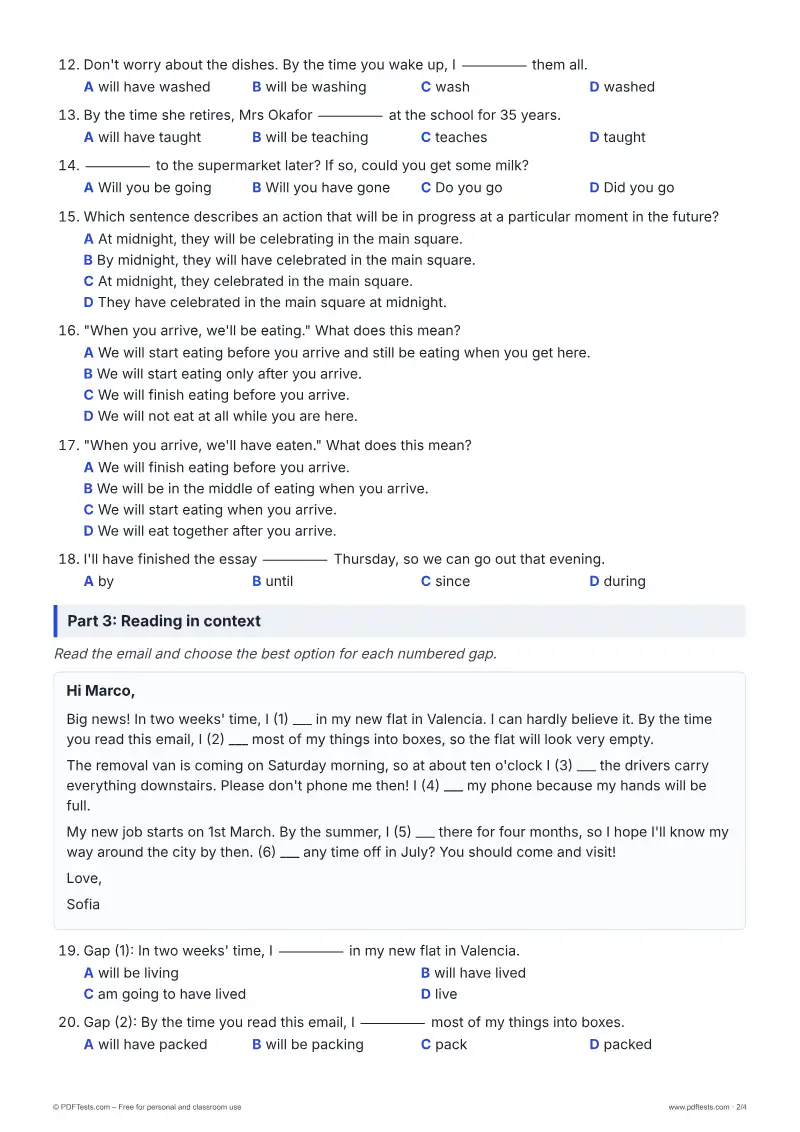
  • 100% free
  • No sign-up or email
  • Print-ready A4 PDF
Preview of page 1 of Future Continuous and Future Perfect – Test 1 Open PDF

Take the test online

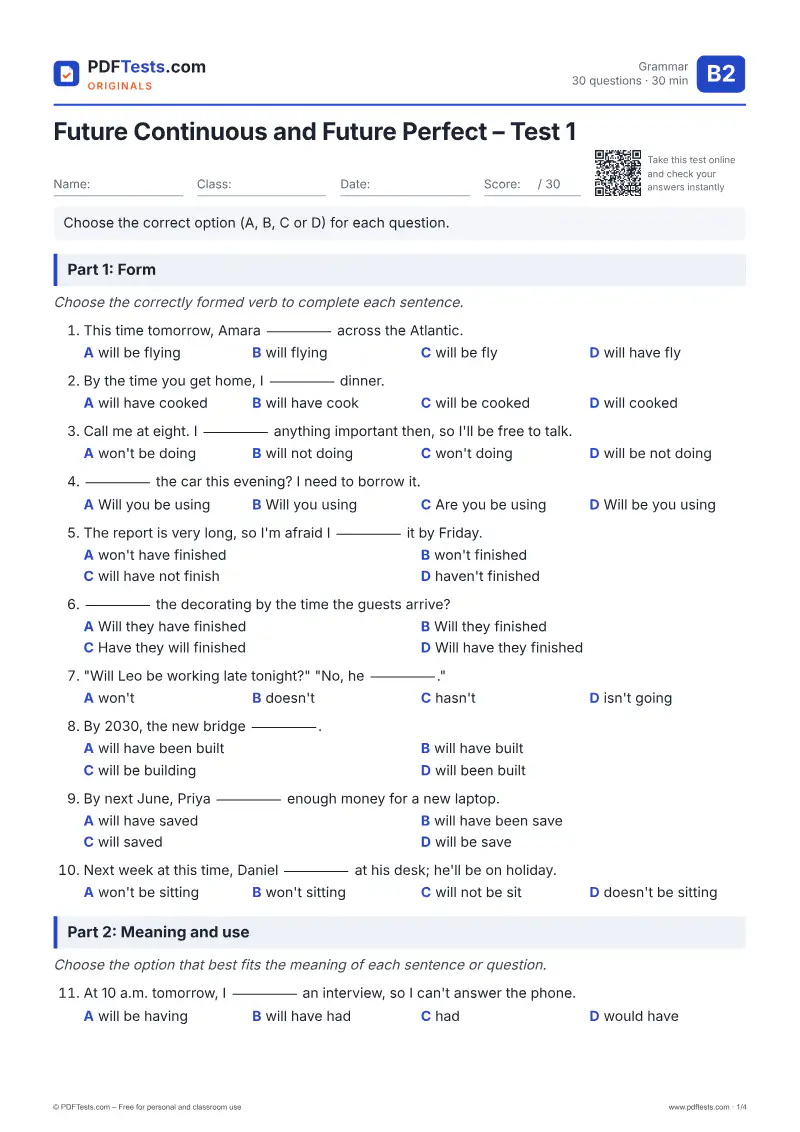
Choose the correct option (A, B, C or D) for each question. Choose your answers, then press “Check my answers”.

Part 1: Form

Choose the correctly formed verb to complete each sentence.

  1. This time tomorrow, Amara _____ across the Atlantic.

  2. By the time you get home, I _____ dinner.

  3. Call me at eight. I _____ anything important then, so I'll be free to talk.

  4. _____ the car this evening? I need to borrow it.

  5. The report is very long, so I'm afraid I _____ it by Friday.

  6. _____ the decorating by the time the guests arrive?

  7. "Will Leo be working late tonight?" "No, he _____."

  8. By 2030, the new bridge _____.

  9. By next June, Priya _____ enough money for a new laptop.

  10. Next week at this time, Daniel _____ at his desk; he'll be on holiday.

Part 2: Meaning and use

Choose the option that best fits the meaning of each sentence or question.

  1. At 10 a.m. tomorrow, I _____ an interview, so I can't answer the phone.

  2. Don't worry about the dishes. By the time you wake up, I _____ them all.

  3. By the time she retires, Mrs Okafor _____ at the school for 35 years.

  4. _____ to the supermarket later? If so, could you get some milk?

  5. Which sentence describes an action that will be in progress at a particular moment in the future?

  6. "When you arrive, we'll be eating." What does this mean?

  7. "When you arrive, we'll have eaten." What does this mean?

  8. I'll have finished the essay _____ Thursday, so we can go out that evening.

Part 3: Reading in context

Read the email and choose the best option for each numbered gap.

Hi Marco,

Big news! In two weeks' time, I (1) ___ in my new flat in Valencia. I can hardly believe it. By the time you read this email, I (2) ___ most of my things into boxes, so the flat will look very empty.

The removal van is coming on Saturday morning, so at about ten o'clock I (3) ___ the drivers carry everything downstairs. Please don't phone me then! I (4) ___ my phone because my hands will be full.

My new job starts on 1st March. By the summer, I (5) ___ there for four months, so I hope I'll know my way around the city by then. (6) ___ any time off in July? You should come and visit!

Love,

Sofia

  1. Gap (1): In two weeks' time, I _____ in my new flat in Valencia.

  2. Gap (2): By the time you read this email, I _____ most of my things into boxes.

  3. Gap (3): At about ten o'clock I _____ the drivers carry everything downstairs.

  4. Gap (4): I _____ my phone because my hands will be full.

  5. Gap (5): By the summer, I _____ there for four months.

  6. Gap (6): _____ any time off in July?

Part 4: Find the error

Choose the correct sentence, or identify the part of the sentence that contains an error.

  1. Which sentence is correct?

  2. Which part contains the error? "When I will get home, my parents will probably be watching the news."

  3. Which part contains the error? "I will have know Ella for ten years next month."

  4. Which part contains the error? "This time next week, we will be knowing whether we passed the exam."

  5. Which sentence is correct?

  6. Which part contains the error? "Don't come at eight because I will be have dinner with my grandparents."

Preview

About this test

This B2 grammar test checks how well you form and use the future continuous (will be doing) and the future perfect (will have done). It covers affirmative, negative and question forms, the difference in meaning between the two tenses, time expressions such as 'by' and 'this time tomorrow', and typical learner errors. It is suitable for upper-intermediate learners, exam candidates and teachers who need a ready-made classroom check.

Topics covered

Future continuousFuture perfectNegatives and questionsTime expressions (by, this time tomorrow)Time clausesStative verbsError correction

How to use this test

  1. Download the PDF and print it, or take the test online below.
  2. Answer every question without a dictionary or time pressure.
  3. Check your answers and note the topics you need to review.

Notes for teachers

Use Part 1 to check form, then Parts 2 and 3 to test whether students understand the difference between an action in progress at a future time and an action completed before a future time. The test targets frequent errors such as 'will' in time clauses, 'until' instead of 'by', missing past participles and stative verbs in the continuous. As a follow-up, ask students to write their own 'This time next year...' and 'By the time I'm 30...' sentences and swap them for peer correction.