PDFTests Originals

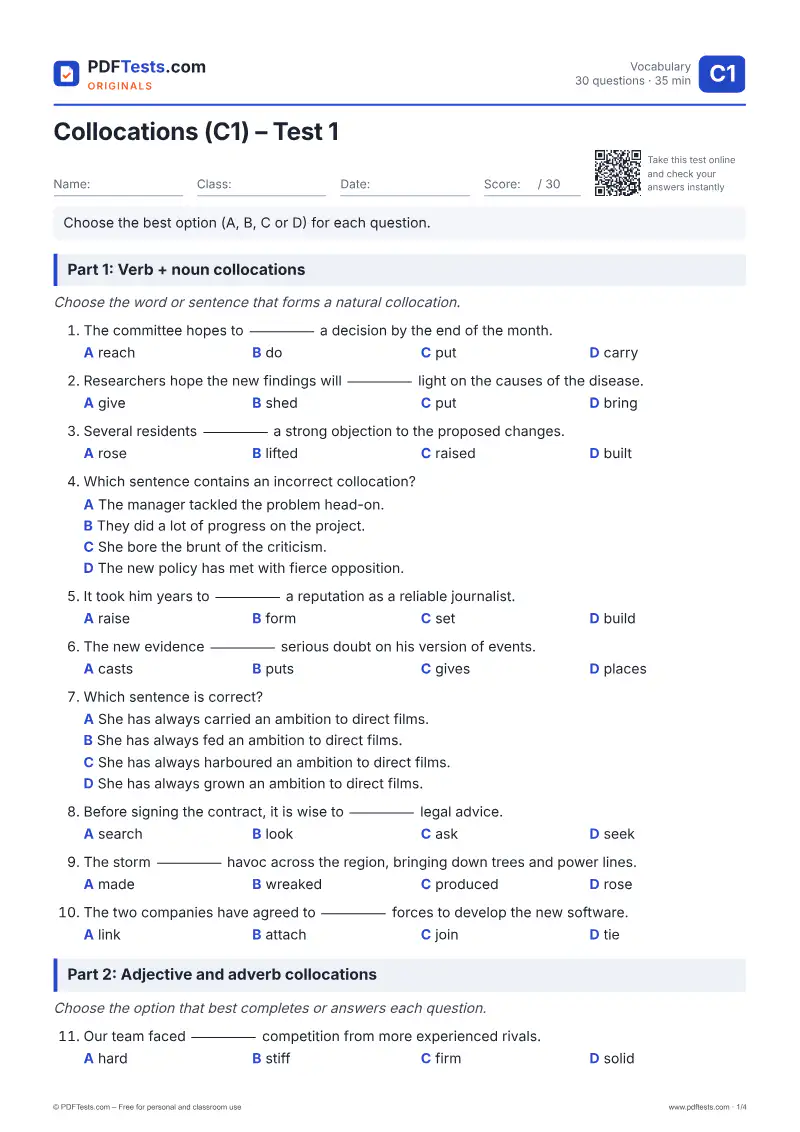
Collocations (C1) – Test 1

C1 Advanced VocabularyEnglish

This C1 vocabulary test checks how well you combine words naturally in English. It covers verb + noun collocations, adverb and adjective combinations, word formation and collocations in a longer reading text. It suits advanced learners preparing for exams such as C1-level certificates and teachers who need a ready-made class quiz.
Questions
30
Time
35 min
PDF
4 pages
Answer key
Included
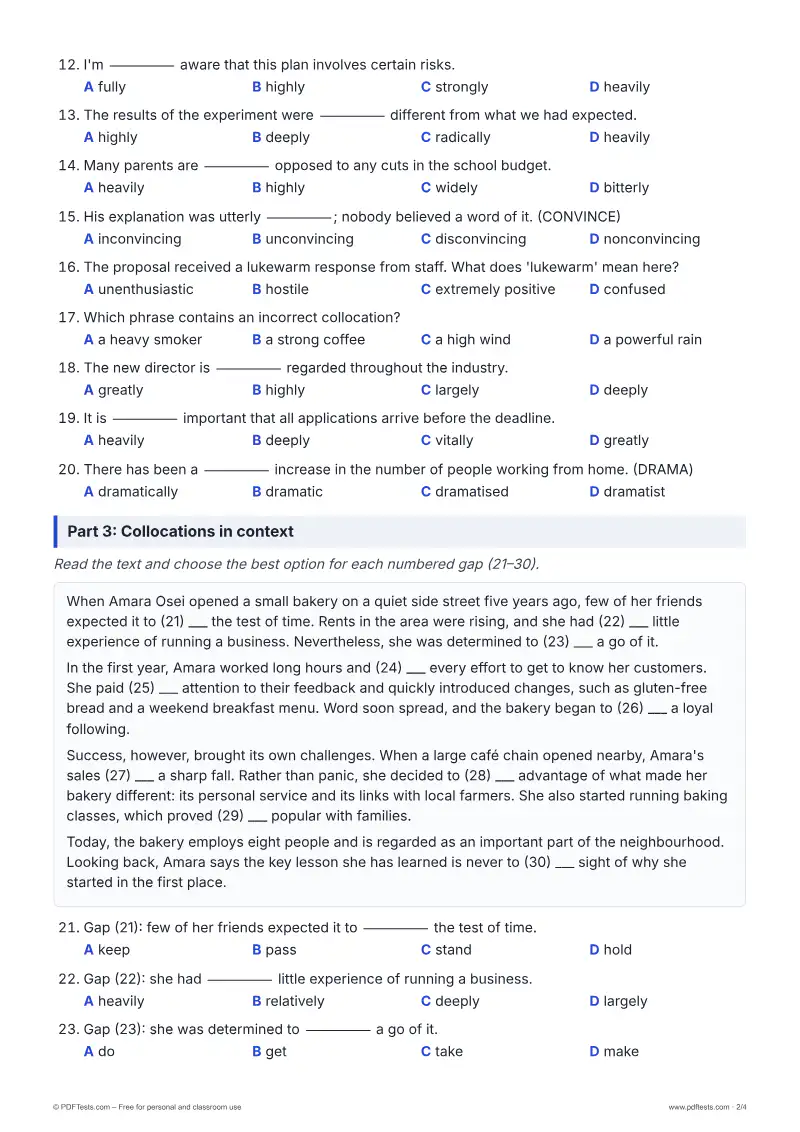
  • 100% free
  • No sign-up or email
  • Print-ready A4 PDF
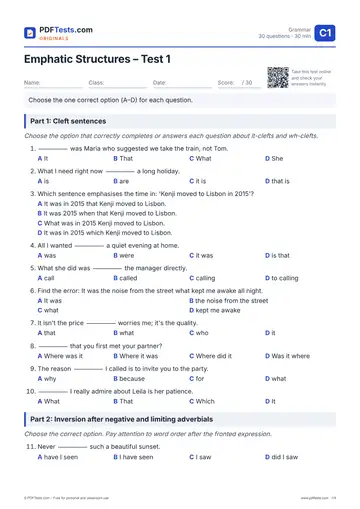
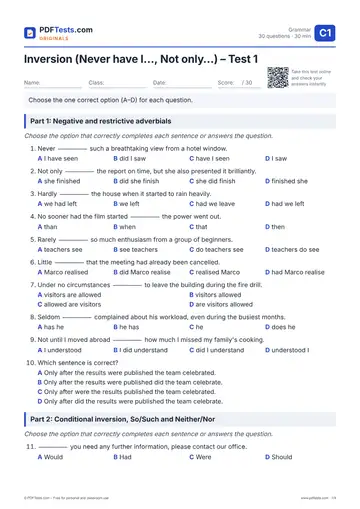
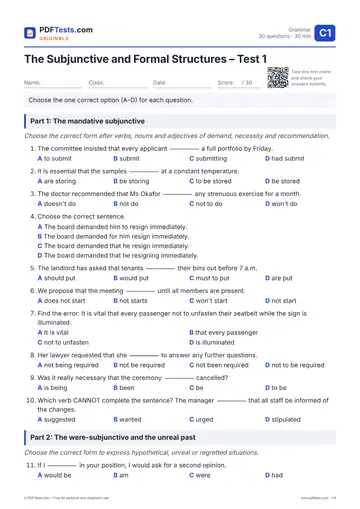
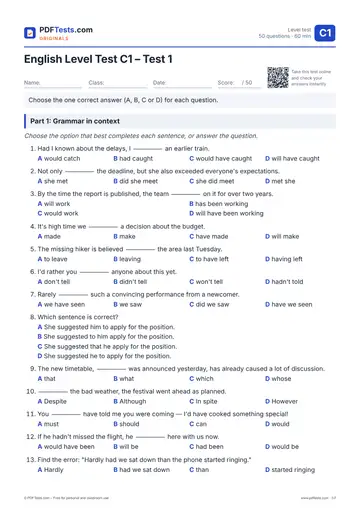
Preview of page 1 of Collocations (C1) – Test 1 Open PDF

Take the test online

Choose the best option (A, B, C or D) for each question. Choose your answers, then press “Check my answers”.

Part 1: Verb + noun collocations

Choose the word or sentence that forms a natural collocation.

  1. The committee hopes to _____ a decision by the end of the month.

  2. Researchers hope the new findings will _____ light on the causes of the disease.

  3. Several residents _____ a strong objection to the proposed changes.

  4. Which sentence contains an incorrect collocation?

  5. It took him years to _____ a reputation as a reliable journalist.

  6. The new evidence _____ serious doubt on his version of events.

  7. Which sentence is correct?

  8. Before signing the contract, it is wise to _____ legal advice.

  9. The storm _____ havoc across the region, bringing down trees and power lines.

  10. The two companies have agreed to _____ forces to develop the new software.

Part 2: Adjective and adverb collocations

Choose the option that best completes or answers each question.

  1. Our team faced _____ competition from more experienced rivals.

  2. I'm _____ aware that this plan involves certain risks.

  3. The results of the experiment were _____ different from what we had expected.

  4. Many parents are _____ opposed to any cuts in the school budget.

  5. His explanation was utterly _____; nobody believed a word of it. (CONVINCE)

  6. The proposal received a lukewarm response from staff. What does 'lukewarm' mean here?

  7. Which phrase contains an incorrect collocation?

  8. The new director is _____ regarded throughout the industry.

  9. It is _____ important that all applications arrive before the deadline.

  10. There has been a _____ increase in the number of people working from home. (DRAMA)

Part 3: Collocations in context

Read the text and choose the best option for each numbered gap (21–30).

When Amara Osei opened a small bakery on a quiet side street five years ago, few of her friends expected it to (21) ___ the test of time. Rents in the area were rising, and she had (22) ___ little experience of running a business. Nevertheless, she was determined to (23) ___ a go of it.

In the first year, Amara worked long hours and (24) ___ every effort to get to know her customers. She paid (25) ___ attention to their feedback and quickly introduced changes, such as gluten-free bread and a weekend breakfast menu. Word soon spread, and the bakery began to (26) ___ a loyal following.

Success, however, brought its own challenges. When a large café chain opened nearby, Amara's sales (27) ___ a sharp fall. Rather than panic, she decided to (28) ___ advantage of what made her bakery different: its personal service and its links with local farmers. She also started running baking classes, which proved (29) ___ popular with families.

Today, the bakery employs eight people and is regarded as an important part of the neighbourhood. Looking back, Amara says the key lesson she has learned is never to (30) ___ sight of why she started in the first place.

  1. Gap (21): few of her friends expected it to _____ the test of time.

  2. Gap (22): she had _____ little experience of running a business.

  3. Gap (23): she was determined to _____ a go of it.

  4. Gap (24): Amara worked long hours and _____ every effort to get to know her customers.

  5. Gap (25): She paid _____ attention to their feedback.

  6. Gap (26): the bakery began to _____ a loyal following.

  7. Gap (27): Amara's sales _____ a sharp fall.

  8. Gap (28): she decided to _____ advantage of what made her bakery different.

  9. Gap (29): baking classes, which proved _____ popular with families.

  10. Gap (30): the key lesson is never to _____ sight of why she started.

Preview

About this test

This C1 vocabulary test checks how well you combine words naturally in English. It covers verb + noun collocations, adverb and adjective combinations, word formation and collocations in a longer reading text. It suits advanced learners preparing for exams such as C1-level certificates and teachers who need a ready-made class quiz.

Topics covered

Verb + noun collocationsAdverb + adjective collocationsAdjective + noun collocationsWord formationCollocations in contextFixed expressions

How to use this test

  1. Download the PDF and print it, or take the test online below.
  2. Answer every question without a dictionary or time pressure.
  3. Check your answers and note the topics you need to review.

Notes for teachers

Use this test after a unit on collocations or as a diagnostic for advanced learners. Distractors target typical learner errors such as 'do progress', 'hard competition', 'search advice' and 'powerful rain', which come from literal translation. For follow-up, ask students to record each correct collocation in a notebook with an example sentence, or to rewrite the reading text using different collocations with the same meaning.