PDFTests Originals

Word Formation (C1) – Test 1

C1 Advanced VocabularyEnglish

This C1 vocabulary test checks how well you can build and choose the right word form in English. It covers negative and meaning-changing prefixes, noun, adjective, verb and adverb suffixes, and word formation in a full reading text. It is suitable for advanced learners preparing for C1-level exams and for teachers who need a ready-made classroom or homework test.
Questions
30
Time
35 min
PDF
4 pages
Answer key
Included
  • 100% free
  • No sign-up or email
  • Print-ready A4 PDF
Preview of page 1 of Word Formation (C1) – Test 1 Open PDF

Take the test online

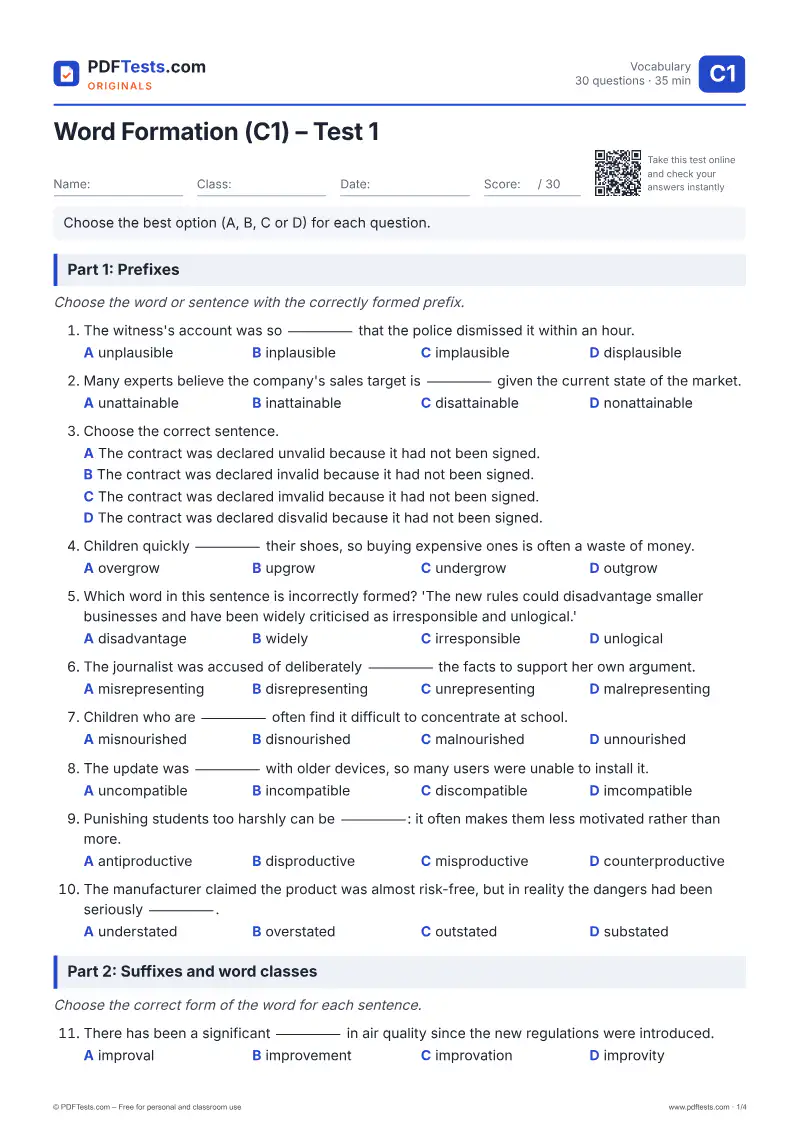
Choose the best option (A, B, C or D) for each question. Choose your answers, then press “Check my answers”.

Part 1: Prefixes

Choose the word or sentence with the correctly formed prefix.

  1. The witness's account was so _____ that the police dismissed it within an hour.

  2. Many experts believe the company's sales target is _____ given the current state of the market.

  3. Choose the correct sentence.

  4. Children quickly _____ their shoes, so buying expensive ones is often a waste of money.

  5. Which word in this sentence is incorrectly formed? 'The new rules could disadvantage smaller businesses and have been widely criticised as irresponsible and unlogical.'

  6. The journalist was accused of deliberately _____ the facts to support her own argument.

  7. Children who are _____ often find it difficult to concentrate at school.

  8. The update was _____ with older devices, so many users were unable to install it.

  9. Punishing students too harshly can be _____: it often makes them less motivated rather than more.

  10. The manufacturer claimed the product was almost risk-free, but in reality the dangers had been seriously _____.

Part 2: Suffixes and word classes

Choose the correct form of the word for each sentence.

  1. There has been a significant _____ in air quality since the new regulations were introduced.

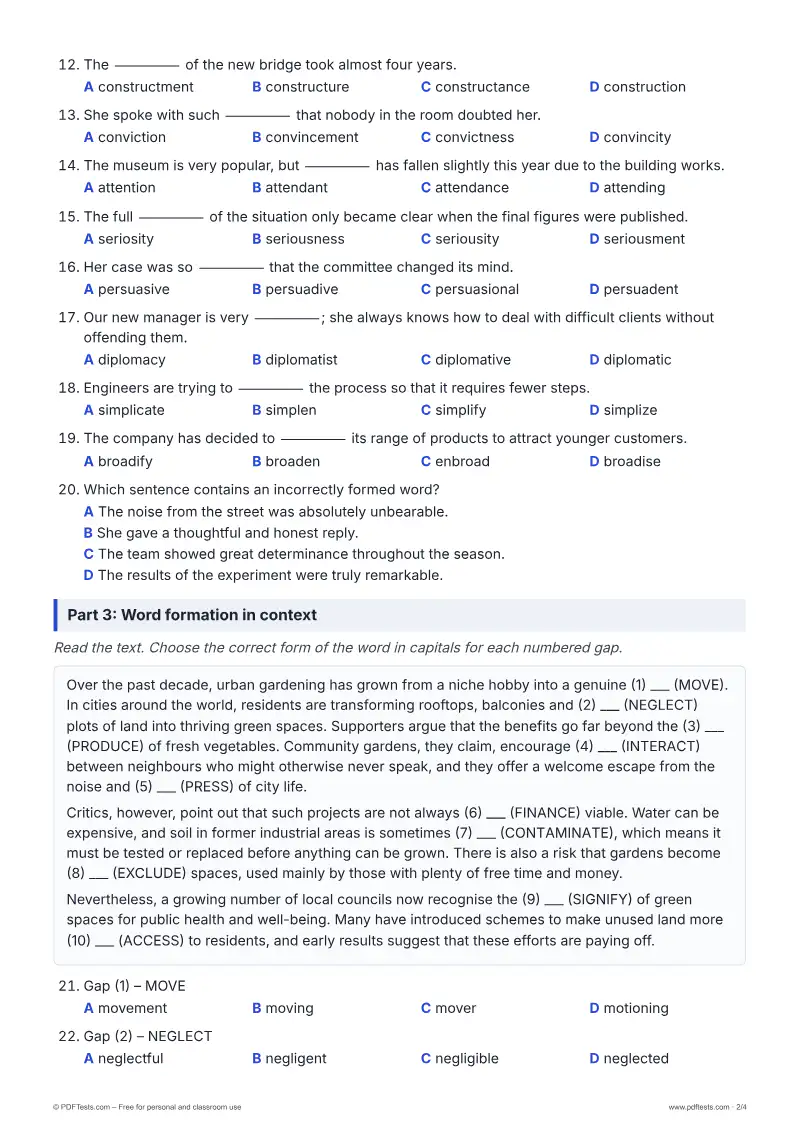
  2. The _____ of the new bridge took almost four years.

  3. She spoke with such _____ that nobody in the room doubted her.

  4. The museum is very popular, but _____ has fallen slightly this year due to the building works.

  5. The full _____ of the situation only became clear when the final figures were published.

  6. Her case was so _____ that the committee changed its mind.

  7. Our new manager is very _____; she always knows how to deal with difficult clients without offending them.

  8. Engineers are trying to _____ the process so that it requires fewer steps.

  9. The company has decided to _____ its range of products to attract younger customers.

  10. Which sentence contains an incorrectly formed word?

Part 3: Word formation in context

Read the text. Choose the correct form of the word in capitals for each numbered gap.

Over the past decade, urban gardening has grown from a niche hobby into a genuine (1) ___ (MOVE). In cities around the world, residents are transforming rooftops, balconies and (2) ___ (NEGLECT) plots of land into thriving green spaces. Supporters argue that the benefits go far beyond the (3) ___ (PRODUCE) of fresh vegetables. Community gardens, they claim, encourage (4) ___ (INTERACT) between neighbours who might otherwise never speak, and they offer a welcome escape from the noise and (5) ___ (PRESS) of city life.

Critics, however, point out that such projects are not always (6) ___ (FINANCE) viable. Water can be expensive, and soil in former industrial areas is sometimes (7) ___ (CONTAMINATE), which means it must be tested or replaced before anything can be grown. There is also a risk that gardens become (8) ___ (EXCLUDE) spaces, used mainly by those with plenty of free time and money.

Nevertheless, a growing number of local councils now recognise the (9) ___ (SIGNIFY) of green spaces for public health and well-being. Many have introduced schemes to make unused land more (10) ___ (ACCESS) to residents, and early results suggest that these efforts are paying off.

  1. Gap (1) – MOVE

  2. Gap (2) – NEGLECT

  3. Gap (3) – PRODUCE

  4. Gap (4) – INTERACT

  5. Gap (5) – PRESS

  6. Gap (6) – FINANCE

  7. Gap (7) – CONTAMINATE

  8. Gap (8) – EXCLUDE

  9. Gap (9) – SIGNIFY

  10. Gap (10) – ACCESS

Preview

About this test

This C1 vocabulary test checks how well you can build and choose the right word form in English. It covers negative and meaning-changing prefixes, noun, adjective, verb and adverb suffixes, and word formation in a full reading text. It is suitable for advanced learners preparing for C1-level exams and for teachers who need a ready-made classroom or homework test.

Topics covered

Negative prefixesMeaning-changing prefixesNoun suffixesAdjective and verb suffixesWord familiesWord formation in context

How to use this test

  1. Download the PDF and print it, or take the test online below.
  2. Answer every question without a dictionary or time pressure.
  3. Check your answers and note the topics you need to review.

Notes for teachers

Use this test after teaching prefix and suffix patterns, or as a diagnostic before C1 exam preparation. It targets typical advanced-learner errors such as choosing the wrong negative prefix (unlogical, inplausible), inventing noun forms (determinance, improval) and confusing members of the same word family (neglectful/negligent/negligible, exclusive/excluded). As a follow-up, ask students to build word-family tables for the base words in Part 3 and write their own gapped sentences.