PDFTests Originals

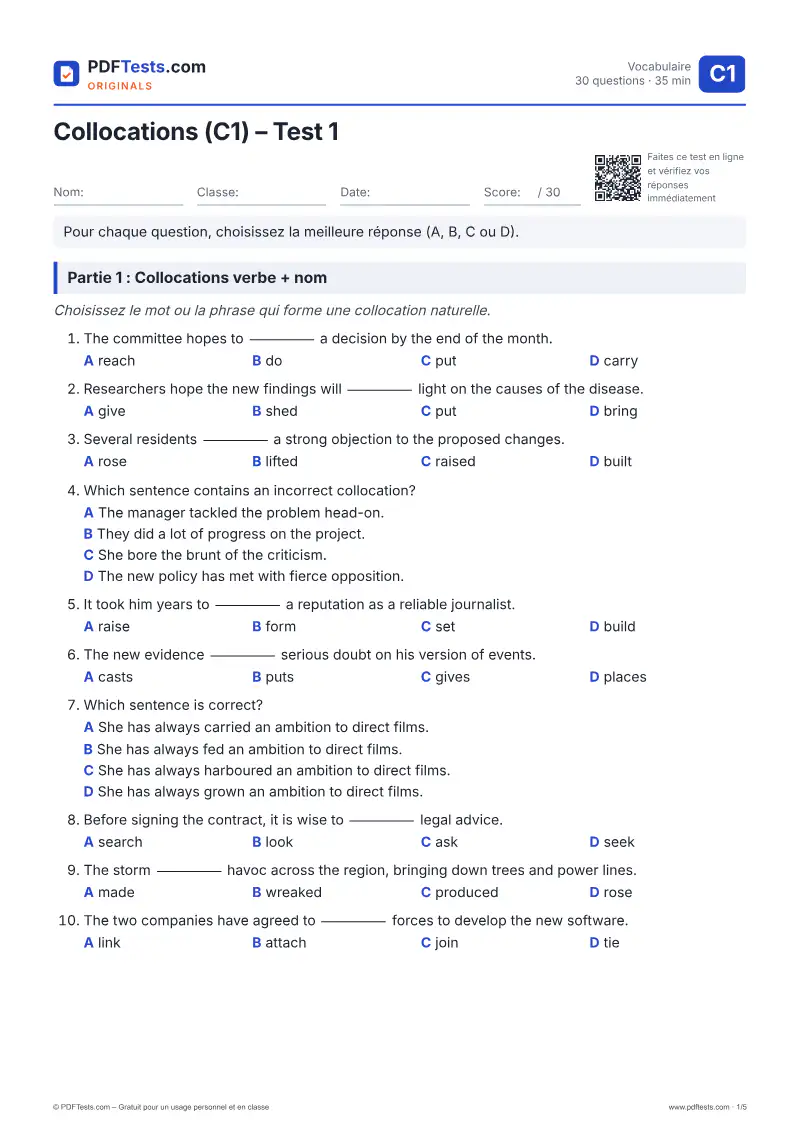
Collocations (C1) – Test 1

C1 Avancé VocabulaireAnglais

Ce test de vocabulaire de niveau C1 évalue votre capacité à associer les mots de façon naturelle en anglais. Il porte sur les collocations verbe + nom, les associations adverbe + adjectif et adjectif + nom, la formation des mots et les collocations dans un texte plus long. Il s'adresse aux apprenants avancés qui préparent un examen de niveau C1 ainsi qu'aux enseignants à la recherche d'un quiz prêt à l'emploi pour leur classe.
Questions
30
Durée
35 min
PDF
5 pages
Corrigé
Inclus
  • 100 % gratuit
  • Sans inscription
  • PDF A4 prêt à imprimer
Aperçu de la page 1 : Collocations (C1) – Test 1 Ouvrir le PDF

Faire le test en ligne

Pour chaque question, choisissez la meilleure réponse (A, B, C ou D). Choisissez vos réponses, puis cliquez sur « Vérifier mes réponses ».

Partie 1 : Collocations verbe + nom

Choisissez le mot ou la phrase qui forme une collocation naturelle.

  1. The committee hopes to _____ a decision by the end of the month.

  2. Researchers hope the new findings will _____ light on the causes of the disease.

  3. Several residents _____ a strong objection to the proposed changes.

  4. Which sentence contains an incorrect collocation?

  5. It took him years to _____ a reputation as a reliable journalist.

  6. The new evidence _____ serious doubt on his version of events.

  7. Which sentence is correct?

  8. Before signing the contract, it is wise to _____ legal advice.

  9. The storm _____ havoc across the region, bringing down trees and power lines.

  10. The two companies have agreed to _____ forces to develop the new software.

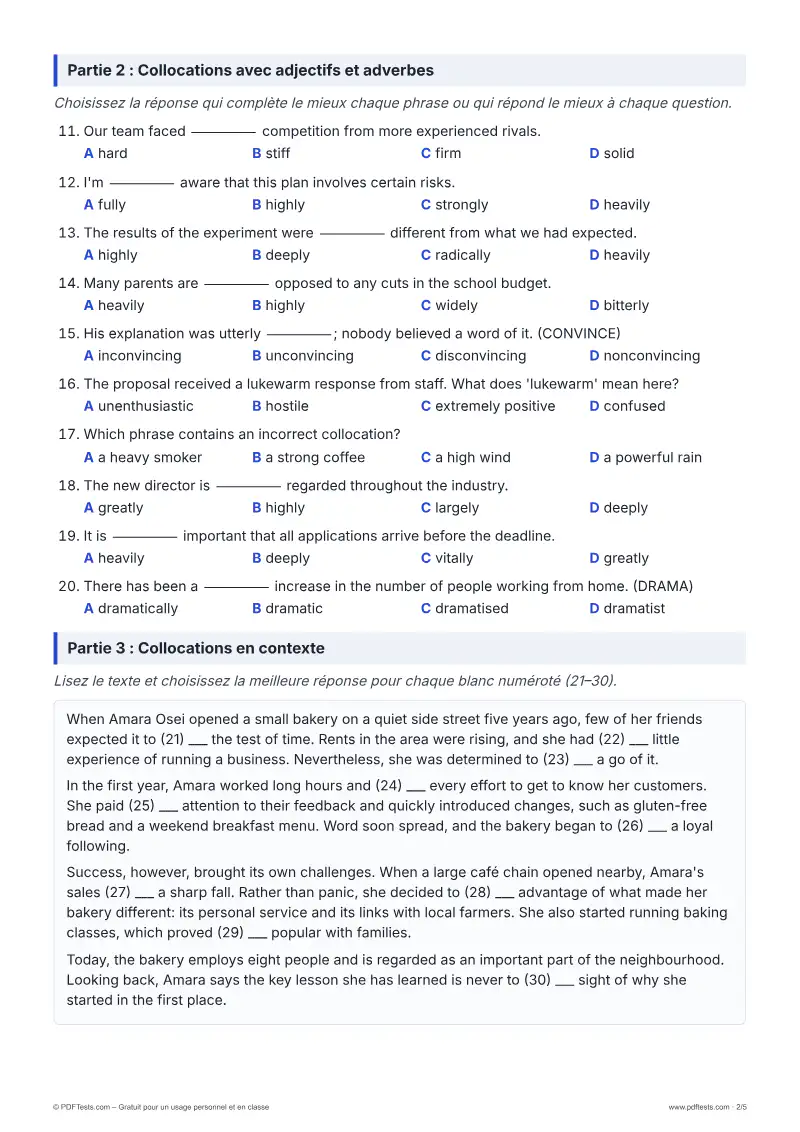
Partie 2 : Collocations avec adjectifs et adverbes

Choisissez la réponse qui complète le mieux chaque phrase ou qui répond le mieux à chaque question.

  1. Our team faced _____ competition from more experienced rivals.

  2. I'm _____ aware that this plan involves certain risks.

  3. The results of the experiment were _____ different from what we had expected.

  4. Many parents are _____ opposed to any cuts in the school budget.

  5. His explanation was utterly _____; nobody believed a word of it. (CONVINCE)

  6. The proposal received a lukewarm response from staff. What does 'lukewarm' mean here?

  7. Which phrase contains an incorrect collocation?

  8. The new director is _____ regarded throughout the industry.

  9. It is _____ important that all applications arrive before the deadline.

  10. There has been a _____ increase in the number of people working from home. (DRAMA)

Partie 3 : Collocations en contexte

Lisez le texte et choisissez la meilleure réponse pour chaque blanc numéroté (21–30).

When Amara Osei opened a small bakery on a quiet side street five years ago, few of her friends expected it to (21) ___ the test of time. Rents in the area were rising, and she had (22) ___ little experience of running a business. Nevertheless, she was determined to (23) ___ a go of it.

In the first year, Amara worked long hours and (24) ___ every effort to get to know her customers. She paid (25) ___ attention to their feedback and quickly introduced changes, such as gluten-free bread and a weekend breakfast menu. Word soon spread, and the bakery began to (26) ___ a loyal following.

Success, however, brought its own challenges. When a large café chain opened nearby, Amara's sales (27) ___ a sharp fall. Rather than panic, she decided to (28) ___ advantage of what made her bakery different: its personal service and its links with local farmers. She also started running baking classes, which proved (29) ___ popular with families.

Today, the bakery employs eight people and is regarded as an important part of the neighbourhood. Looking back, Amara says the key lesson she has learned is never to (30) ___ sight of why she started in the first place.

  1. Gap (21): few of her friends expected it to _____ the test of time.

  2. Gap (22): she had _____ little experience of running a business.

  3. Gap (23): she was determined to _____ a go of it.

  4. Gap (24): Amara worked long hours and _____ every effort to get to know her customers.

  5. Gap (25): She paid _____ attention to their feedback.

  6. Gap (26): the bakery began to _____ a loyal following.

  7. Gap (27): Amara's sales _____ a sharp fall.

  8. Gap (28): she decided to _____ advantage of what made her bakery different.

  9. Gap (29): baking classes, which proved _____ popular with families.

  10. Gap (30): the key lesson is never to _____ sight of why she started.

Aperçu

À propos de ce test

Ce test de vocabulaire de niveau C1 évalue votre capacité à associer les mots de façon naturelle en anglais. Il porte sur les collocations verbe + nom, les associations adverbe + adjectif et adjectif + nom, la formation des mots et les collocations dans un texte plus long. Il s'adresse aux apprenants avancés qui préparent un examen de niveau C1 ainsi qu'aux enseignants à la recherche d'un quiz prêt à l'emploi pour leur classe.

Thèmes abordés

Collocations verbe + nomCollocations adverbe + adjectifCollocations adjectif + nomFormation des motsCollocations en contexteExpressions figées

Comment utiliser ce test

  1. Téléchargez le PDF et imprimez-le, ou faites le test en ligne ci-dessous.
  2. Répondez à toutes les questions sans dictionnaire et sans vous presser.
  3. Vérifiez vos réponses et notez les points à revoir.

Notes pour l’enseignant

Utilisez ce test à la fin d'une séquence sur les collocations ou comme test diagnostique pour des apprenants avancés. Les distracteurs reprennent des erreurs typiques d'apprenants, comme 'do progress', 'hard competition', 'search advice' ou 'powerful rain', souvent dues à une traduction littérale. En prolongement, demandez aux élèves de noter chaque collocation correcte dans un carnet avec une phrase d'exemple, ou de réécrire le texte de la partie 3 en remplaçant les collocations par d'autres de même sens.