PDFTests Originals

Collocations et nuances (C2) – Test 1

C2 Maîtrise VocabulaireAnglais

Ce test de vocabulaire de niveau C2 évalue votre maîtrise des collocations avancées en anglais, des différences de sens subtiles et du choix du mot juste en contexte. Il porte sur les collocations verbe–nom et adverbe–adjectif, les familles de mots faciles à confondre et un texte à trous. Il s'adresse aux apprenants avancés qui préparent un examen de niveau maîtrise (C2 Proficiency, par exemple) ainsi qu'aux enseignants à la recherche d'une évaluation clés en main.
Questions
30
Durée
35 min
PDF
5 pages
Corrigé
Inclus
  • 100 % gratuit
  • Sans inscription
  • PDF A4 prêt à imprimer
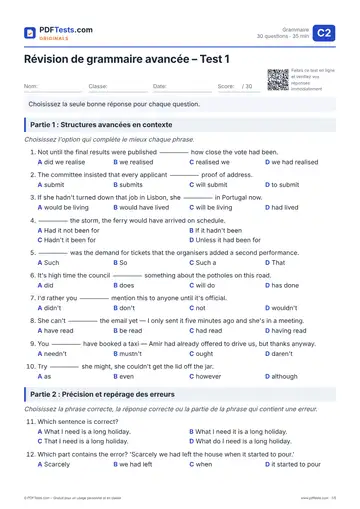
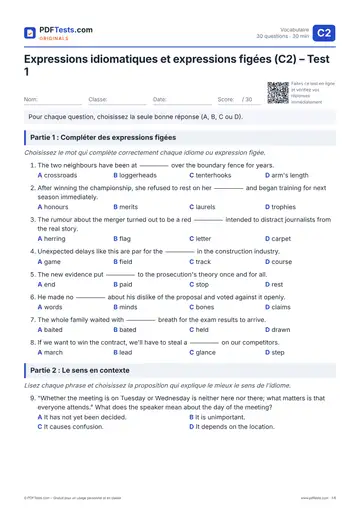
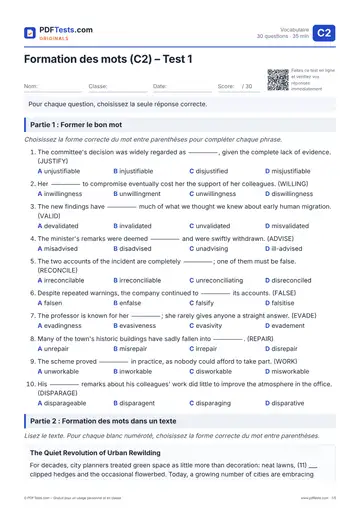
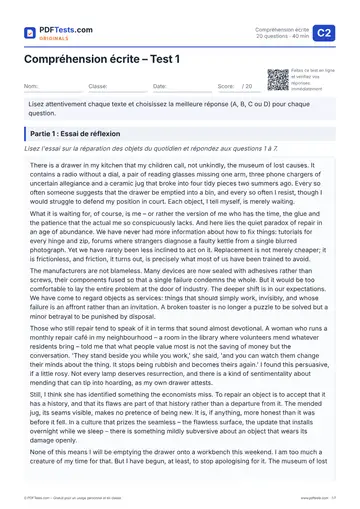
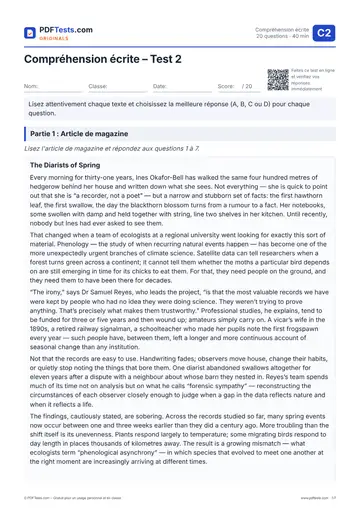
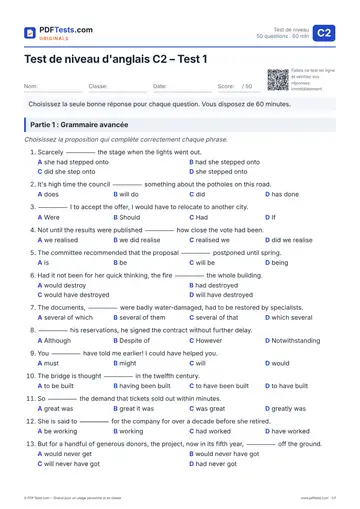
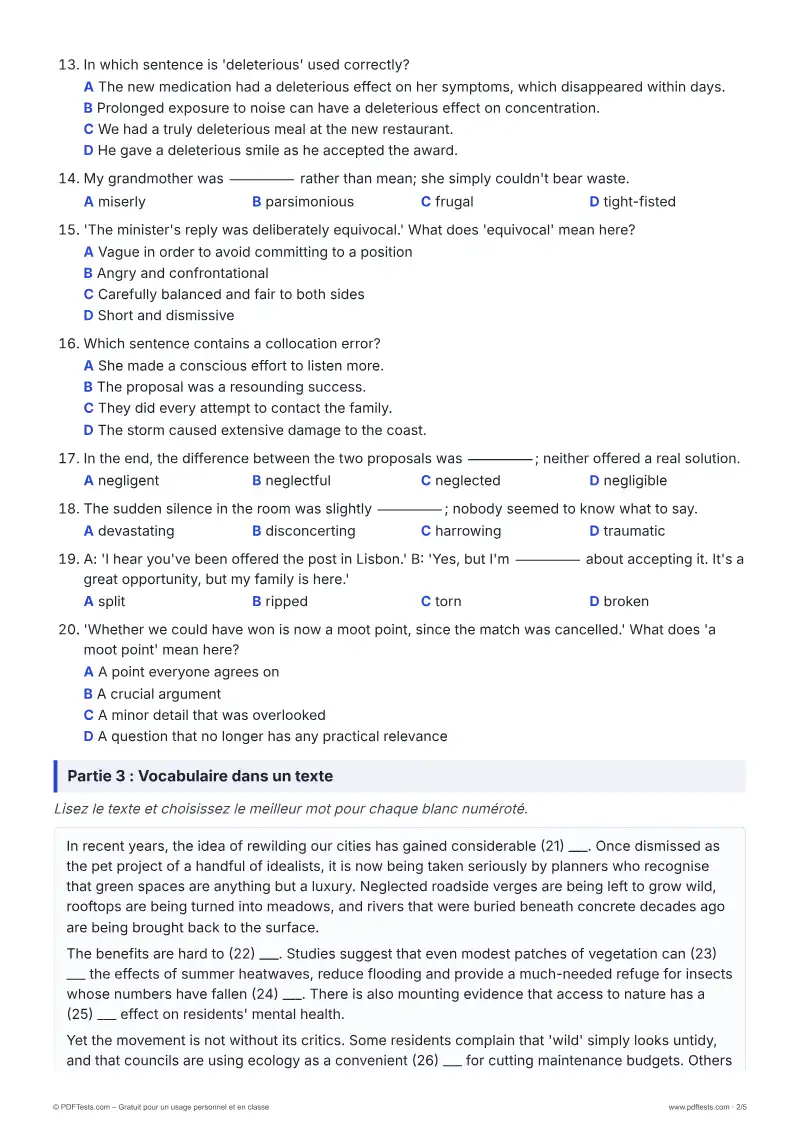
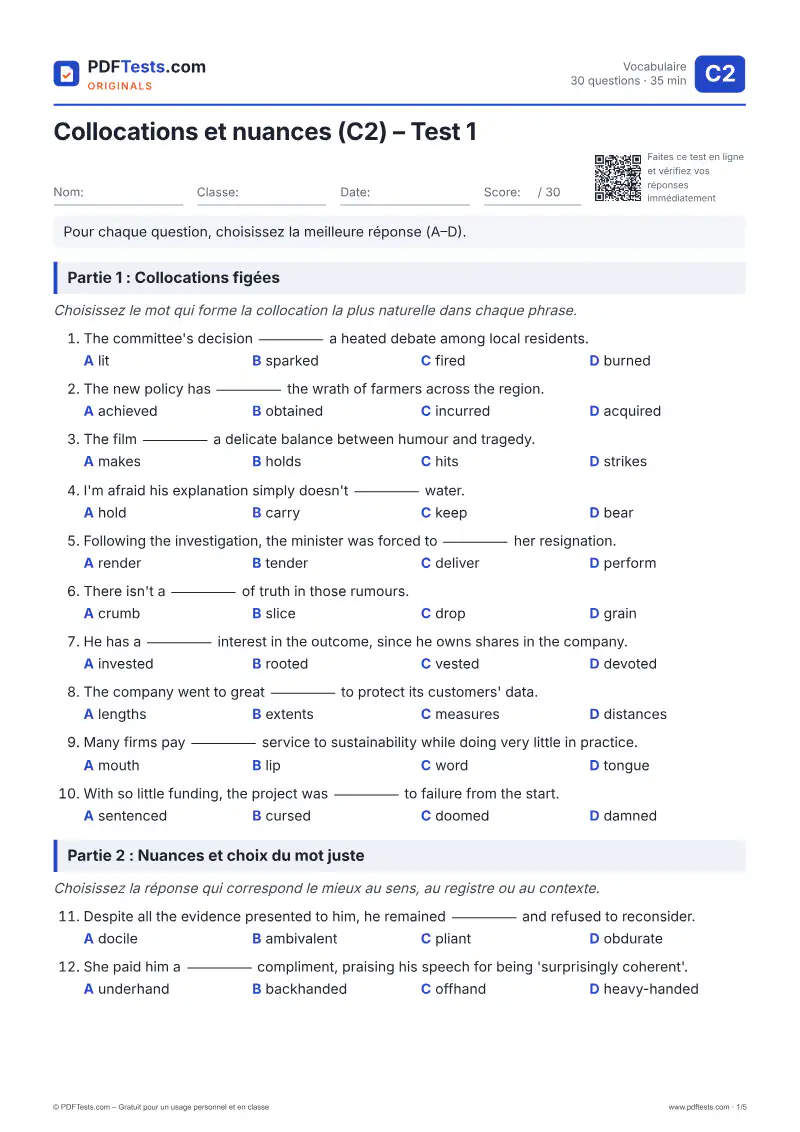
Aperçu de la page 1 : Collocations et nuances (C2) – Test 1 Ouvrir le PDF

Faire le test en ligne

Pour chaque question, choisissez la meilleure réponse (A–D). Choisissez vos réponses, puis cliquez sur « Vérifier mes réponses ».

Partie 1 : Collocations figées

Choisissez le mot qui forme la collocation la plus naturelle dans chaque phrase.

  1. The committee's decision _____ a heated debate among local residents.

  2. The new policy has _____ the wrath of farmers across the region.

  3. The film _____ a delicate balance between humour and tragedy.

  4. I'm afraid his explanation simply doesn't _____ water.

  5. Following the investigation, the minister was forced to _____ her resignation.

  6. There isn't a _____ of truth in those rumours.

  7. He has a _____ interest in the outcome, since he owns shares in the company.

  8. The company went to great _____ to protect its customers' data.

  9. Many firms pay _____ service to sustainability while doing very little in practice.

  10. With so little funding, the project was _____ to failure from the start.

Partie 2 : Nuances et choix du mot juste

Choisissez la réponse qui correspond le mieux au sens, au registre ou au contexte.

  1. Despite all the evidence presented to him, he remained _____ and refused to reconsider.

  2. She paid him a _____ compliment, praising his speech for being 'surprisingly coherent'.

  3. In which sentence is 'deleterious' used correctly?

  4. My grandmother was _____ rather than mean; she simply couldn't bear waste.

  5. 'The minister's reply was deliberately equivocal.' What does 'equivocal' mean here?

  6. Which sentence contains a collocation error?

  7. In the end, the difference between the two proposals was _____; neither offered a real solution.

  8. The sudden silence in the room was slightly _____; nobody seemed to know what to say.

  9. A: 'I hear you've been offered the post in Lisbon.' B: 'Yes, but I'm _____ about accepting it. It's a great opportunity, but my family is here.'

  10. 'Whether we could have won is now a moot point, since the match was cancelled.' What does 'a moot point' mean here?

Partie 3 : Vocabulaire dans un texte

Lisez le texte et choisissez le meilleur mot pour chaque blanc numéroté.

In recent years, the idea of rewilding our cities has gained considerable (21) ___. Once dismissed as the pet project of a handful of idealists, it is now being taken seriously by planners who recognise that green spaces are anything but a luxury. Neglected roadside verges are being left to grow wild, rooftops are being turned into meadows, and rivers that were buried beneath concrete decades ago are being brought back to the surface.

The benefits are hard to (22) ___. Studies suggest that even modest patches of vegetation can (23) ___ the effects of summer heatwaves, reduce flooding and provide a much-needed refuge for insects whose numbers have fallen (24) ___. There is also mounting evidence that access to nature has a (25) ___ effect on residents' mental health.

Yet the movement is not without its critics. Some residents complain that 'wild' simply looks untidy, and that councils are using ecology as a convenient (26) ___ for cutting maintenance budgets. Others worry that new parks will drive up property prices, pushing out the very communities they were meant to serve, a process sometimes called 'green gentrification'.

Advocates concede that these concerns are not (27) ___. The challenge, they argue, is to involve local people from the outset rather than presenting them with a (28) ___ accompli. Where residents have been given a genuine say, projects have tended to (29) ___ root far more successfully. Rewilding, it seems, is as much about people as it is about plants, and its long-term success will (30) ___ on whether cities can get that balance right.

  1. (21) the idea of rewilding our cities has gained considerable _____

  2. (22) The benefits are hard to _____.

  3. (23) even modest patches of vegetation can _____ the effects of summer heatwaves

  4. (24) insects whose numbers have fallen _____

  5. (25) access to nature has a _____ effect on residents' mental health

  6. (26) councils are using ecology as a convenient _____ for cutting maintenance budgets

  7. (27) Advocates concede that these concerns are not _____.

  8. (28) rather than presenting them with a _____ accompli

  9. (29) projects have tended to _____ root far more successfully

  10. (30) its long-term success will _____ on whether cities can get that balance right

Aperçu

À propos de ce test

Ce test de vocabulaire de niveau C2 évalue votre maîtrise des collocations avancées en anglais, des différences de sens subtiles et du choix du mot juste en contexte. Il porte sur les collocations verbe–nom et adverbe–adjectif, les familles de mots faciles à confondre et un texte à trous. Il s'adresse aux apprenants avancés qui préparent un examen de niveau maîtrise (C2 Proficiency, par exemple) ainsi qu'aux enseignants à la recherche d'une évaluation clés en main.

Thèmes abordés

Collocations verbe–nomCollocations adverbe–adjectifConnotation et nuancesMots souvent confondus (paronymes)Familles de motsExpressions idiomatiquesVocabulaire en contexte

Comment utiliser ce test

  1. Téléchargez le PDF et imprimez-le, ou faites le test en ligne ci-dessous.
  2. Répondez à toutes les questions sans dictionnaire et sans vous presser.
  3. Vérifiez vos réponses et notez les points à revoir.

Notes pour l’enseignant

Utilisez ce test comme évaluation diagnostique ou comme bilan de fin de séquence avec des groupes de niveau C2 ou de bon niveau C1. Les distracteurs ciblent les erreurs typiques des apprenants avancés : quasi-synonymes qui ne forment pas de collocation (do/make, efforts/lengths), formes faciles à confondre (mitigate/militate, negligible/negligent) et mots à la connotation inadaptée (frugal/miserly). En prolongement, demandez aux élèves de rédiger leurs propres phrases avec les collocations correctes, ou d'expliquer pourquoi chaque distracteur sonne faux.