PDFTests Originals

Colocaciones y matices (C2): Test 1

C2 Maestría VocabularioInglés

Este test de vocabulario de nivel C2 evalúa tu dominio de las colocaciones avanzadas del inglés, las diferencias sutiles de significado y la elección de palabras según el contexto. Incluye colocaciones verbo + sustantivo y adverbio + adjetivo, familias de palabras que se confunden con facilidad y un texto de lectura con huecos. Está pensado para estudiantes avanzados que preparan exámenes de nivel Proficiency y para docentes que necesitan una evaluación lista para usar.
Preguntas
30
Tiempo
35 min
PDF
5 páginas
Soluciones
Incluidas
  • 100 % gratis
  • Sin registro
  • PDF A4 listo para imprimir
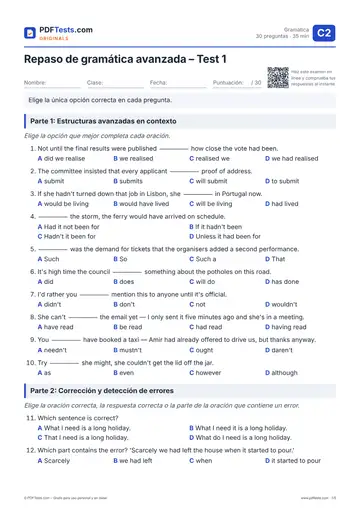
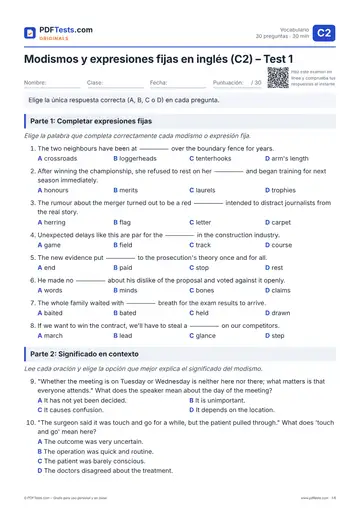
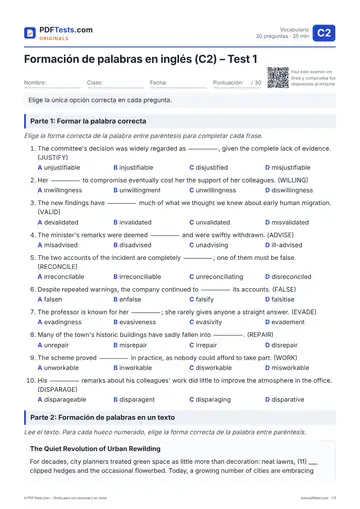
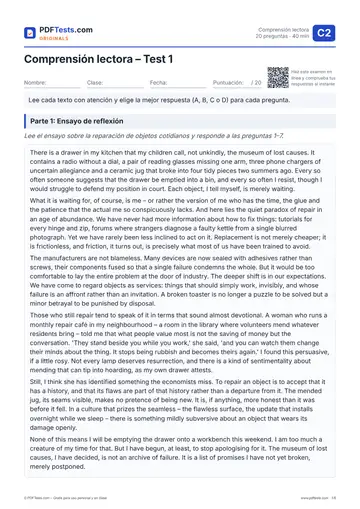
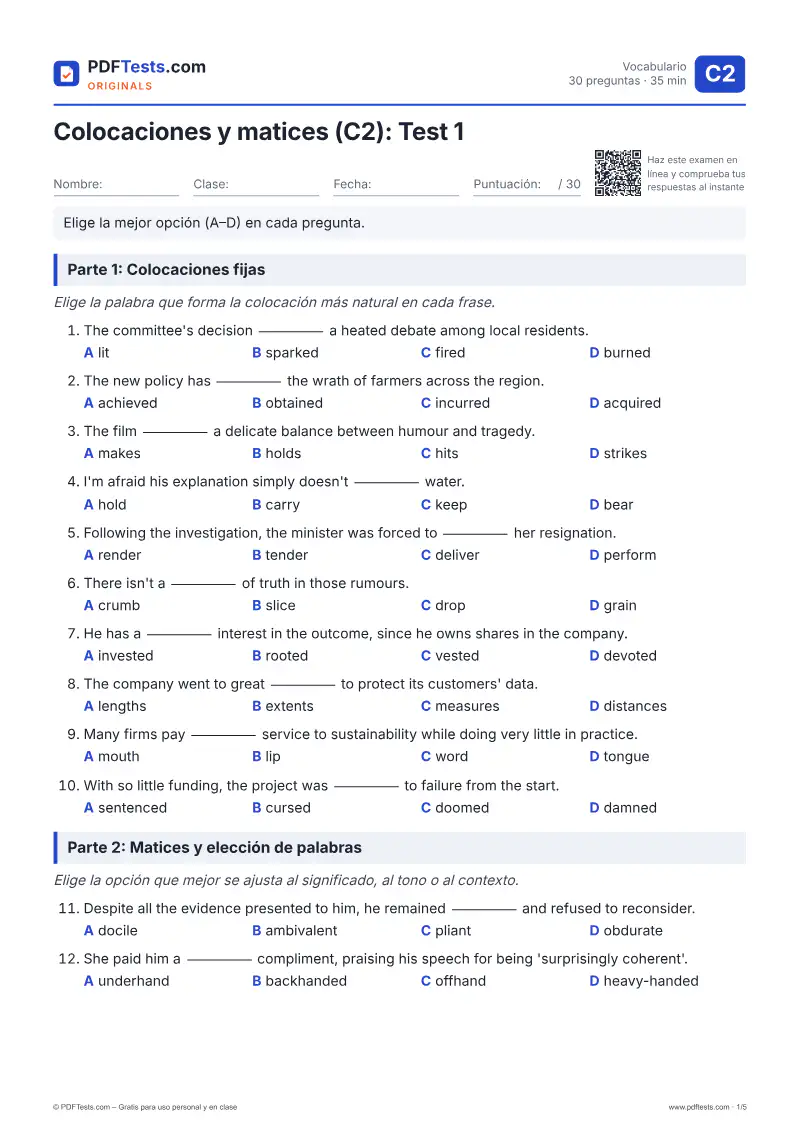
Vista previa de la página 1: Colocaciones y matices (C2): Test 1 Abrir PDF

Haz el examen en línea

Elige la mejor opción (A–D) en cada pregunta. Elige tus respuestas y pulsa «Comprobar respuestas».

Parte 1: Colocaciones fijas

Elige la palabra que forma la colocación más natural en cada frase.

  1. The committee's decision _____ a heated debate among local residents.

  2. The new policy has _____ the wrath of farmers across the region.

  3. The film _____ a delicate balance between humour and tragedy.

  4. I'm afraid his explanation simply doesn't _____ water.

  5. Following the investigation, the minister was forced to _____ her resignation.

  6. There isn't a _____ of truth in those rumours.

  7. He has a _____ interest in the outcome, since he owns shares in the company.

  8. The company went to great _____ to protect its customers' data.

  9. Many firms pay _____ service to sustainability while doing very little in practice.

  10. With so little funding, the project was _____ to failure from the start.

Parte 2: Matices y elección de palabras

Elige la opción que mejor se ajusta al significado, al tono o al contexto.

  1. Despite all the evidence presented to him, he remained _____ and refused to reconsider.

  2. She paid him a _____ compliment, praising his speech for being 'surprisingly coherent'.

  3. In which sentence is 'deleterious' used correctly?

  4. My grandmother was _____ rather than mean; she simply couldn't bear waste.

  5. 'The minister's reply was deliberately equivocal.' What does 'equivocal' mean here?

  6. Which sentence contains a collocation error?

  7. In the end, the difference between the two proposals was _____; neither offered a real solution.

  8. The sudden silence in the room was slightly _____; nobody seemed to know what to say.

  9. A: 'I hear you've been offered the post in Lisbon.' B: 'Yes, but I'm _____ about accepting it. It's a great opportunity, but my family is here.'

  10. 'Whether we could have won is now a moot point, since the match was cancelled.' What does 'a moot point' mean here?

Parte 3: Vocabulario en un texto de lectura

Lee el texto y elige la palabra más adecuada para cada hueco numerado.

In recent years, the idea of rewilding our cities has gained considerable (21) ___. Once dismissed as the pet project of a handful of idealists, it is now being taken seriously by planners who recognise that green spaces are anything but a luxury. Neglected roadside verges are being left to grow wild, rooftops are being turned into meadows, and rivers that were buried beneath concrete decades ago are being brought back to the surface.

The benefits are hard to (22) ___. Studies suggest that even modest patches of vegetation can (23) ___ the effects of summer heatwaves, reduce flooding and provide a much-needed refuge for insects whose numbers have fallen (24) ___. There is also mounting evidence that access to nature has a (25) ___ effect on residents' mental health.

Yet the movement is not without its critics. Some residents complain that 'wild' simply looks untidy, and that councils are using ecology as a convenient (26) ___ for cutting maintenance budgets. Others worry that new parks will drive up property prices, pushing out the very communities they were meant to serve, a process sometimes called 'green gentrification'.

Advocates concede that these concerns are not (27) ___. The challenge, they argue, is to involve local people from the outset rather than presenting them with a (28) ___ accompli. Where residents have been given a genuine say, projects have tended to (29) ___ root far more successfully. Rewilding, it seems, is as much about people as it is about plants, and its long-term success will (30) ___ on whether cities can get that balance right.

  1. (21) the idea of rewilding our cities has gained considerable _____

  2. (22) The benefits are hard to _____.

  3. (23) even modest patches of vegetation can _____ the effects of summer heatwaves

  4. (24) insects whose numbers have fallen _____

  5. (25) access to nature has a _____ effect on residents' mental health

  6. (26) councils are using ecology as a convenient _____ for cutting maintenance budgets

  7. (27) Advocates concede that these concerns are not _____.

  8. (28) rather than presenting them with a _____ accompli

  9. (29) projects have tended to _____ root far more successfully

  10. (30) its long-term success will _____ on whether cities can get that balance right

Vista previa

Sobre este examen

Este test de vocabulario de nivel C2 evalúa tu dominio de las colocaciones avanzadas del inglés, las diferencias sutiles de significado y la elección de palabras según el contexto. Incluye colocaciones verbo + sustantivo y adverbio + adjetivo, familias de palabras que se confunden con facilidad y un texto de lectura con huecos. Está pensado para estudiantes avanzados que preparan exámenes de nivel Proficiency y para docentes que necesitan una evaluación lista para usar.

Temas

Colocaciones verbo + sustantivoColocaciones adverbio + adjetivoConnotación y maticesPalabras que se confundenFamilias de palabrasExpresiones idiomáticasVocabulario en contexto

Cómo usar este examen

  1. Descarga el PDF e imprímelo, o haz el examen en línea más abajo.
  2. Responde todas las preguntas sin diccionario y sin prisas.
  3. Comprueba tus respuestas y apunta los temas que debes repasar.

Notas para el profesor

Puedes usar este test como prueba diagnóstica o como repaso al final de una unidad con grupos de nivel C2 o C1 alto. Los distractores reproducen errores típicos del nivel avanzado: casi sinónimos que no forman colocación (do/make, efforts/lengths), formas que se confunden (mitigate/militate, negligible/negligent) y palabras con una connotación inadecuada (frugal/miserly). Como actividad complementaria, pide al alumnado que escriba sus propias frases con las colocaciones correctas o que explique por qué cada distractor suena poco natural.